Chamomile oil is not blue in the flower. The colour is made in the still, and it is the plainest evidence you have that the oil in front of you is real.
Nothing in a chamomile field is blue. The deep ink colour appears during distillation and nowhere before it.
Heat converts a compound in the flower into chamazulene, and chamazulene is what turns the oil that startling blue. Which means colour is a genuine signal here in a way it almost never is with other oils: a pale, straw-coloured chamomile has either been cut with something or was never German chamomile in the first place.
The confusion is helped along by names. Roman chamomile is a different plant entirely and is not blue. Plenty of bottles say chamomile and leave you to guess. Ours says Matricaria chamomilla because that is what is in it.
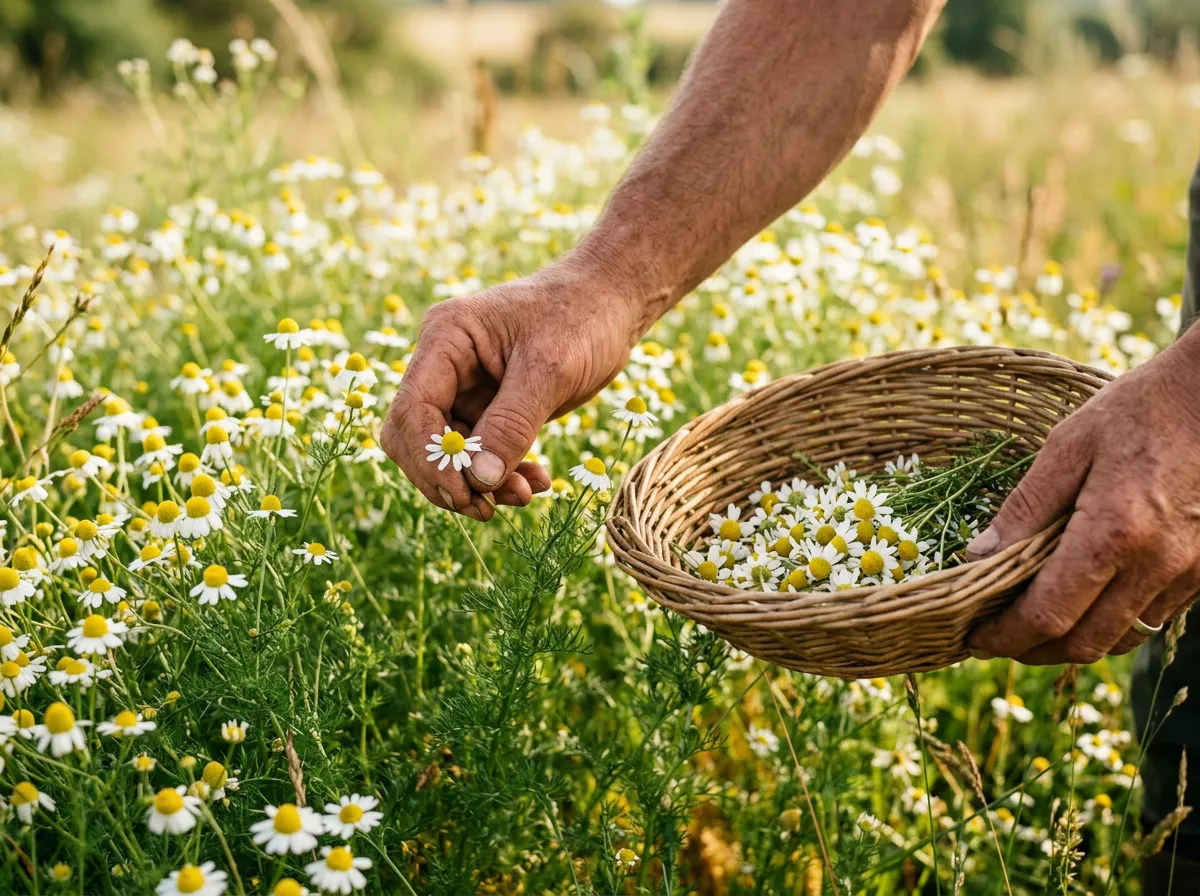
We use the blossoms. Stem and leaf carry almost nothing worth having and mostly dilute the charge, so they stay in the field.
Our blossom comes from Bulgaria, where the crop is grown widely enough to support the repeated hand-picking this flower demands.
Chamomile flowers in flushes rather than all at once, so a field is picked repeatedly across the season. It is slow, fiddly work and it is the main reason this oil costs what it does.
Flowers are taken when the white ray petals have opened and begun to tip back from the yellow centre. That is the point at which the aromatic content is highest.
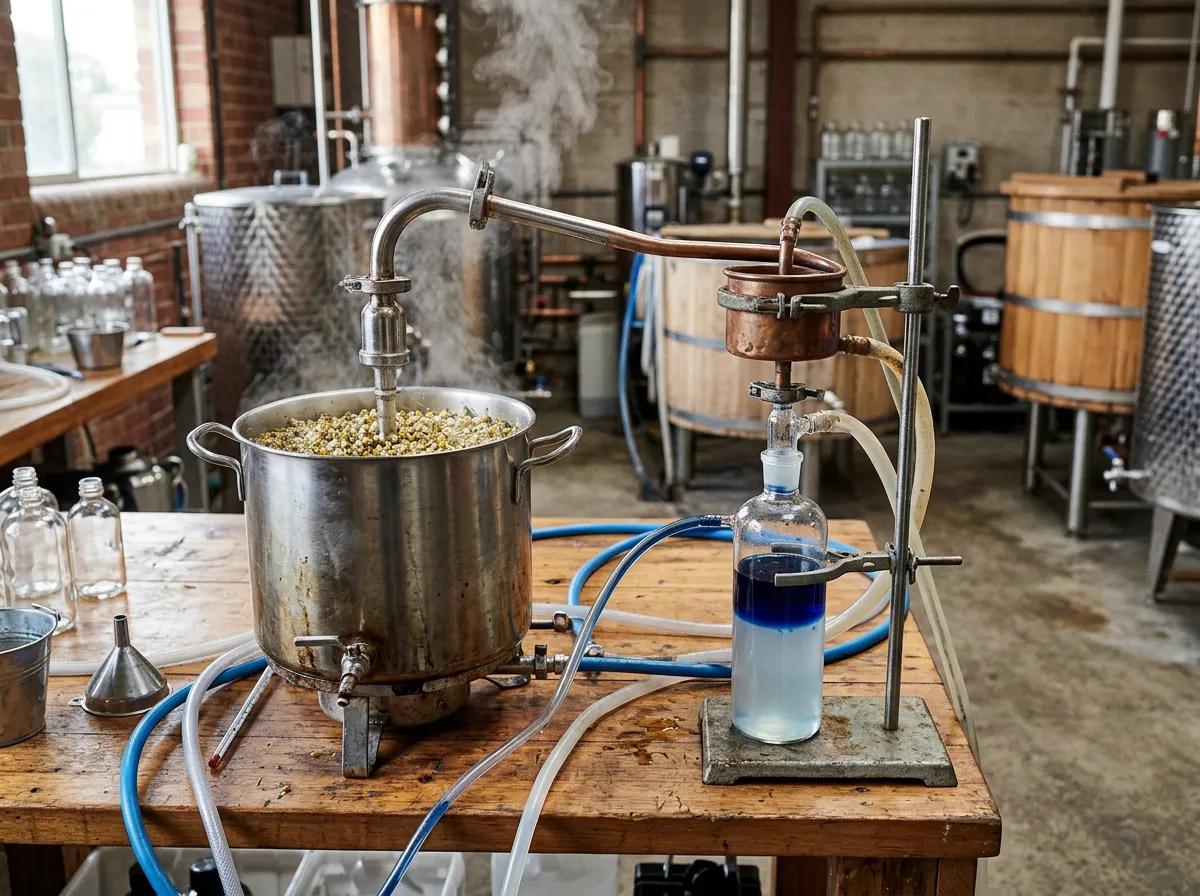
Because we operate the still ourselves, nothing arrives here already made. For a material graded on colour, that matters more than usual.
Steam passes through the packed blossom, the aromatics lift, and as the vapour cools the oil separates out already deep blue. Watching it collect is the closest thing to a live authenticity test that exists in this trade.
The run goes to completion rather than to a timer. Chamazulene forms as the distillation proceeds, so cutting a run short costs you exactly the compound people buy this oil for.
Every batch goes to an outside laboratory that has no commercial interest in the result.
The compound behind the colour, measured rather than assumed from how blue the bottle looks.
The second marker set for German chamomile, and a check that the species is what the label says.
Confirms nothing has been thinned with a carrier or coloured to imitate a proper chamazulene reading.
Tell us which lot you have and we will forward its report. The contact page works too.
Two printed dates and a lot number, so the age of the oil is never guesswork.
All sizes amber. Light breaks down chamazulene, and the colour goes with it.
Pure Matricaria chamomilla, with no carrier oil and no added colour.
Six things that hold for every chamomile lot we sell.
Flower heads in the charge, with stem and leaf left in the field.
Bought in bulk straight from organic chamomile growers we deal with directly.
Our still, our charge, our responsibility for what the colour turns out to be.
Outside laboratory analysis on the marker, not a judgement made by eye.
The colour comes out of the still or it does not go in the bottle.
Little vials or large containers, all filled from one distillation.
Chamomile belongs to the Asteraceae family, alongside ragweed, daisies and marigolds. If you are sensitive to those, patch test carefully and leave it alone if you react.
Blend it into a carrier for skin work, and test a small area before committing to a batch.
No health claims from us. Chamomile carries centuries of gentle-use tradition and we will happily point you at the reading, but we will not tell you what it does for you.
It will stain. Deep blue oil on a pale towel or a light worktop is not coming out easily, so decant over something you do not mind marking.
German chamomile blossom, distilled in our own still, blue from the process rather than the bottle, and analysed by an independent laboratory.
Judge it by the colour first.
Shop Chamomile Oil