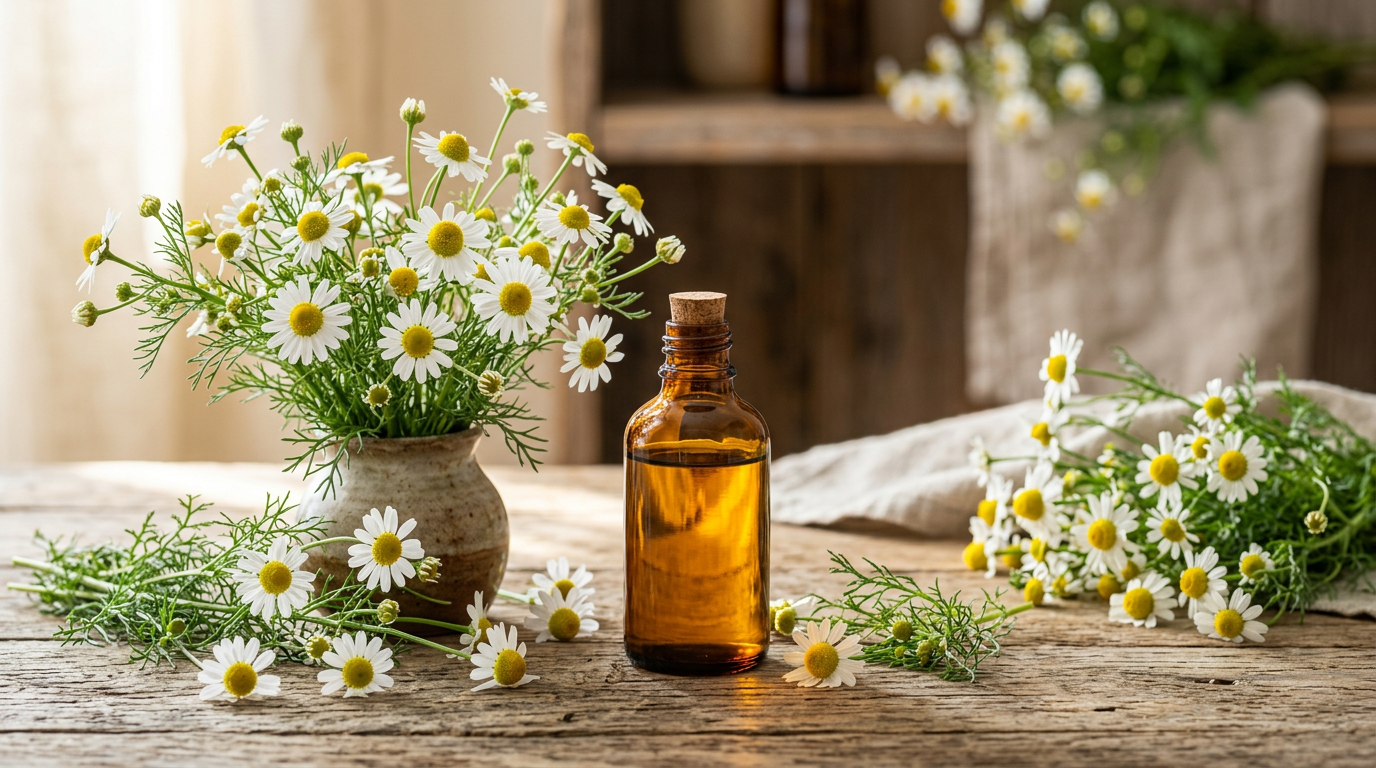
A Soapmaker's Batch Notes: Chamomile Oil in Cold Process Soap
Chamomile essential oil shows up on a lot of soapmaker wish lists. The scent is soft, hay-like, and a little apple-sweet depending on whether you're working with Roman or German chamomile, and it pairs well with lavender, oat, and honey fragrance profiles. But chamomile has a reputation in soaping circles for being unpredictable once it hits raw lye. We wanted to see that unpredictability firsthand rather than take the forum warnings at face value, so we ran a small series of cold process batches over several weeks and kept detailed notes on each one. What follows is a walkthrough of that process: what we set out to test, how we structured the batches, what we saw at trace, at gel, and at cure, and what we'd tell a soapmaker who's about to reach for a bottle of chamomile oil for the first time.
Roman Chamomile Essential Oil
Our own Roman Chamomile Essential Oil, in sizes from 0.5 oz to bulk.
From $32.99
Shop Now →Why Chamomile Behaves Differently in the Pot
Cold process soap is an unforgiving environment for any essential oil. The batter sits at a high pH during saponification, often climbs above 150°F internally as it gels, and stays alkaline for days before the cure evens things out. Citrus oils are famous for fading fast under those conditions. Chamomile has its own quirks. German chamomile in particular carries chamazulene, the compound responsible for its deep blue-green color in the raw oil, and chamazulene is notably reactive to heat and alkalinity. Roman chamomile, which is pale and doesn't carry chamazulene, behaves more like a typical floral-herbaceous oil but still isn't immune to scent drift over a four to six week cure.
Our working questions going in were simple:
- How much of the chamomile scent survives from pour to finished bar?
- Does chamomile oil discoloration in soap follow a predictable pattern, or does it vary batch to batch?
- Does the base recipe (oil blend, additives, superfat) change the outcome?
The Batch Setup
We ran six batches over five weeks, each a one kilogram bar mold, using the same 5% superfat and the same 33% lye concentration as a control. We varied three things across batches: the chamomile type (Roman vs. German), the usage rate (0.5 oz and 1 oz per pound of oils, which sits within commonly cited cold process ranges), and the base oil blend, since a paler base tends to show discoloration more clearly than a base already tinted by unrefined oils.
| Batch | Chamomile Type | Usage Rate | Base Blend | Additive |
|---|---|---|---|---|
| 1 | Roman | 0.5 oz/lb | Olive, coconut, palm-free (sunflower sub) | None |
| 2 | Roman | 1 oz/lb | Olive, coconut, palm-free (sunflower sub) | None |
| 3 | German | 0.5 oz/lb | Olive, coconut, palm-free (sunflower sub) | None |
| 4 | German | 1 oz/lb | Olive, coconut, palm-free (sunflower sub) | None |
| 5 | German | 1 oz/lb | Olive, coconut, palm-free (sunflower sub) | Colloidal oatmeal |
| 6 | German | 1 oz/lb | Shea-heavy, unrefined | None |
Each batch was mixed to a light trace, scented, poured, and logged at set intervals: two hours post-pour, gel peak (roughly six to ten hours in), 48 hours, one week, and again at four weeks of cure. We noted color by eye against a plain white card and rated scent strength on a simple one-to-five scale, smelling the same interior cut surface each time rather than the exposed top, since the exterior of a bar oxidizes and dries differently than the core.
What We Observed
Color Shift
The German chamomile batches told the clearest story. Batches 3 and 4 both moved from a faint green cast at pour to a soft tan-beige within 48 hours, with the shift most visible right around gel peak. This tracks with what we understood going in: chamazulene doesn't hold up well against the high pH of fresh soap batter, and the blue-green color it carries in the bottle doesn't translate directly into the bar. By four weeks, batches 3 and 4 had settled into a warm oatmeal tan that looked more like a vanilla-stabilized bar than anything overtly green. Batch 6, the shea-heavy blend, ended up a shade darker still, which made it harder to isolate how much of that color came from the chamomile versus the unrefined shea itself.
Roman chamomile, batches 1 and 2, showed almost no discoloration at any usage rate. The bars stayed close to their base color throughout the cure. If color consistency matters more to a project than getting German chamomile's specific scent profile, Roman is the more predictable choice on that front alone, based on what we saw in this run.
Batch note, day 2: "Batch 4 has gone from a barely-there green at pour to a flat tan overnight. Looks like batch 3 did at the same point, just a shade lighter given the lower usage rate. Not what I expected walking in, I assumed more oil would mean the color held longer."
Scent Retention
This is where usage rate mattered more than chamomile type. Essential oil retention in cold process soap depends on a mix of factors, vapor pressure of the individual aromatic compounds, how long the batter stays hot during gel, exposure to air during cure, and our notes lined up with the general pattern soapmakers describe: chamomile is a mid-range fader, not as volatile as citrus top notes but not as stable as a resin like patchouli or a heavier base note like vetiver.
At the 0.5 oz/lb rate, both batch 1 (Roman) and batch 3 (German) were noticeably faint by the one-week mark and had dropped to barely detectable by four weeks. At 1 oz/lb, batches 2 and 4 retained a soft, recognizable chamomile note through the full cure, though even at that higher rate the scent by week four was maybe half as strong as it was on day one. Batch 5, which included colloidal oatmeal, tracked closely with batch 4's scent curve. If anything, the oatmeal seemed to round out the aroma slightly rather than compete with it, though we'd want more repetitions before calling that a real effect rather than batch-to-batch variation.
None of this is a surprise if you think about what's actually happening physically: the batter's internal temperature during gel can climb well past the boiling point of some of chamomile's more volatile aromatic compounds, and a four to six week cure is a long window for anything to off-gas. What we can say from this run is that going toward the higher end of a commonly used usage rate range gave a more durable result, and that base oil blend and additives didn't shift scent retention nearly as much as usage rate did.
Key Learnings
- Expect color drift with German chamomile, not color stability. If a recipe depends on chamomile's natural blue-green tint showing up in the finished bar, cold process is the wrong method. That color is a function of chamazulene reacting to heat and pH, and in our batches it consistently gave way to tan and beige tones well before the four-week mark.
- Roman chamomile is the safer bet for color-neutral projects. It didn't introduce the same shift in any of our batches, at either usage rate.
- Usage rate drove scent retention more than any other variable we tested. The gap between 0.5 oz/lb and 1 oz/lb was larger than the gap between chamomile types or base oil blends.
- Additives like colloidal oatmeal didn't meaningfully compete with or mask the scent in our small sample, though we'd want a larger batch count before treating that as settled.
- Cure time matters as much as pour-day choices. The biggest scent and color changes in every batch happened between pour and the one-week mark, not gradually across the full cure.
Notes for Your Own Batch
A few practical points if you're planning a chamomile cold process batch of your own, based on what we ran into:
- Stay within an established usage rate for facial or body bars. Cold process soap is a rinse-off leave-on-skin-briefly product, and essential oil usage guidelines for that category are generally more conservative than for candles or room sprays. Check a current usage rate reference (the IFRA standards or a soap-specific dilution chart) rather than relying on habit or a single blog post.
- Patch test the finished, fully cured bar on a small area of skin before regular use, and wait the recommended 24 to 48 hours to check for any reaction. This matters even more with a fully cured bar than with the raw oil, since the finished pH and remaining aromatic compounds are what actually contact skin.
- Don't expect the bottle's color or scent strength to predict the bar's. Our notes make clear that both shift substantially through saponification and cure. Test small before committing to a full batch size.
- Log your batches. The single most useful thing we did here wasn't picking the "right" recipe, it was writing down what we saw at each interval so the next batch could be adjusted with actual data instead of guesswork.
Chamomile isn't a difficult oil to work with in cold process soap, but it is one that rewards patience and observation over assumption. If your priority is scent, lean toward the higher end of a safe usage range and accept that some fade through cure is normal. If your priority is a specific color in the finished bar, chamomile probably isn't going to deliver it on its own, and you may want to look at other ways to introduce that tone. Either way, the batter doesn't lie: what shows up in the mold at week four is a more honest guide than what's in the bottle on day one.
As always, this reflects our own observations from a small, informal batch series rather than a controlled study, and results can vary with your specific oils, water content, and curing environment. If you have questions about skin sensitivity or use on a specific skin type, a qualified healthcare provider is the right person to ask, not a batch log.