
Chamomile Oil in Pregnancy and Breastfeeding: What Sources Say
No source we could fetch says chamomile essential oil is cleared for pregnancy, and none says it has been shown to cause harm. What exists is a gap: studies of chamomile tea in pregnant women, folkloric warnings about Roman chamomile, and a few case reports. We sell undiluted chamomile oils for aroma and diluted skin use, not as pregnancy products, so this page does not tell you what to do. It tells you what each source says, where they disagree, and what to ask the person who looks after you.
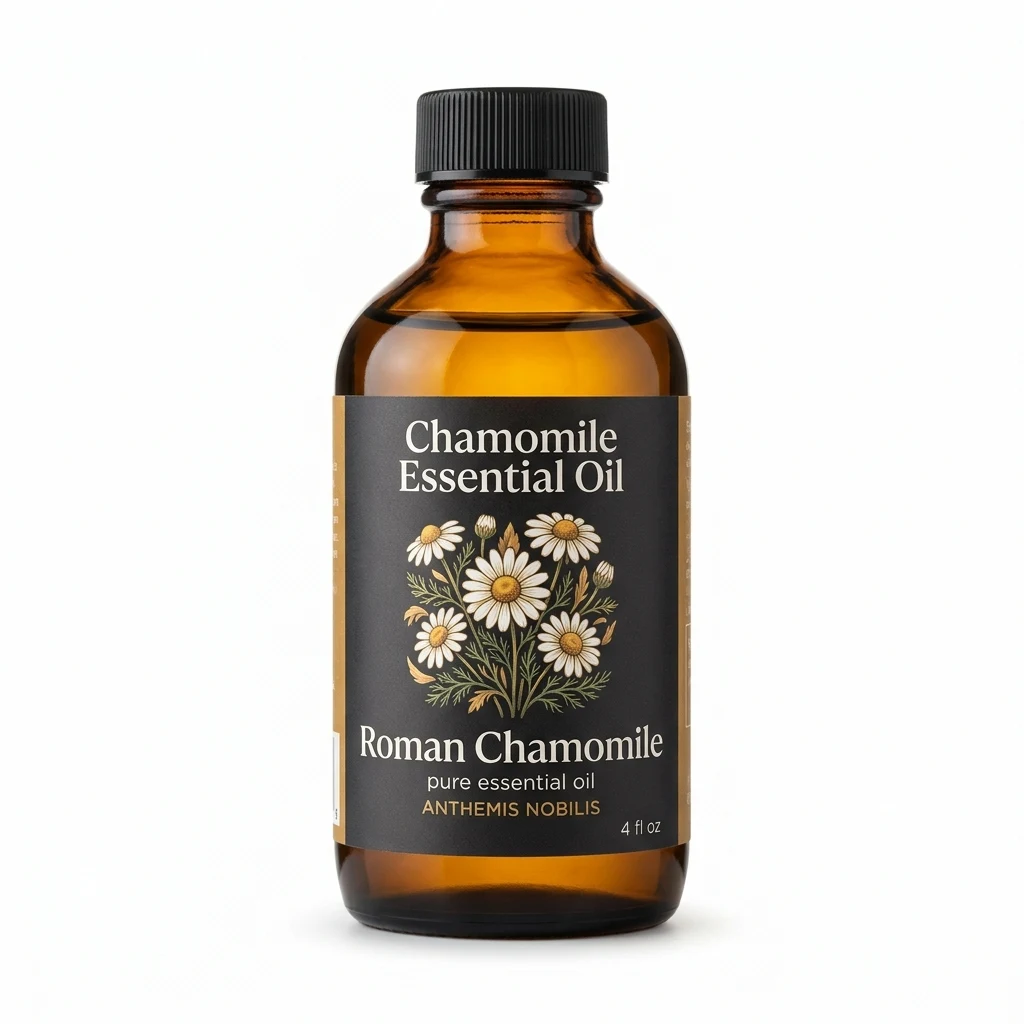
Roman Chamomile Essential Oil
Our own Roman Chamomile Essential Oil, in sizes from 0.5 oz to bulk.
From $32.99
Shop Now →What does the evidence actually cover?
The NCCIH chamomile page is short on this: "Little is known about whether it's safe to use chamomile during pregnancy or while breastfeeding." That sentence is about chamomile in general, mostly tea and supplements, and it is the best-sourced summary there is.
The European Medicines Agency's committee on herbal medicines looked at it twice, as draft assessments, and the two drafts read differently because they cover different plants and different preparations.
- German chamomile (EMA draft, 2014). The assessors summarised large questionnaire studies of pregnant women who used chamomile, almost all as tea. One covered 588 Australian women at 36 to 38 weeks, 11% of whom used chamomile tea. Another surveyed 400 Norwegian women about herbal use in general. The assessors concluded these showed "no risk for the use of at least matricaria teas during pregnancy" but that "for all other preparations there is a lack of data." Essential oil is one of those other preparations. (EMA/HMPC/55837/2011)
- Roman chamomile (EMA draft, 2011). "There have been no formal studies on the effects of Roman chamomile on pregnant women." The report points to 1960s-era folkloric reports that the plant is an emmenagogue (brings on menstruation) or abortifacient, collected in a 1975 review, with no dose details. It also cites a class 2b rating from the American Herbal Products Association, advising against use in pregnancy because of those theoretical effects "when taken at high doses." (EMA/HMPC/560906/2010)
The largest numbers in the German draft come from a cohort in Avon, England: of 14,115 women with data, 3,774 used some complementary medicine in pregnancy, and 551 of them used matricaria. Those are questionnaire counts of herbal use. They do not separate tea from oil, and they say nothing about dose, so we use them only to show how thin the oil-specific evidence is next to the tea evidence.
Where do the sources disagree?
On the Roman plant, the EMA draft says both things in one section: most experts would avoid excess ingestion in pregnancy, yet "there are no reliable data from human studies or case reports" on the menstrual or abortive effect, so at the doses the report discusses it is "not plausible" that such effects appear. The American Herbal Products Association rating is the cautious side; the EMA reading is the lower-concern side; neither tested essential oil on skin or in air. Reasoning from that: the warnings are about the plant taken by mouth at high amounts, and nobody has measured what a few drops diluted in a carrier oil do. The absence of a measurement is not the same as an all-clear, which is why we stop short of both conclusions.
Local practice adds a third voice. One NHS hospital trust's patient page (York Teaching Hospital, labour ward) says women in the first trimester are not to have direct contact with essential oils, and it offers aromatherapy from 37 weeks. It names lavender, clary sage, frankincense, mandarin and peppermint, not chamomile. That is one maternity unit's policy, not a national rule, and we cannot say other units match it.
Skin, air or tea: why the route matters
Roman and German chamomile also carry different cautions on paper, and we sell both. The pregnancy warnings in the sources above are attached mainly to Roman chamomile; the German draft does not repeat them but rests on tea. We would not read that as German being the better choice in pregnancy. It is a difference in what was written down, not in what was measured.
The comforting studies are tea studies, and tea is a weak stand-in for the oil. The German EMA draft states that teas brewed from the flowers carry 10% to 15% of the essential oil present in the flower. A bottle of oil is the concentrated version of that fraction, so a tea trial cannot be read as a trial of the bottle. The reverse also holds: there is no evidence that dilute oil on skin is worse than tea. That is the point of the gap.
The reports of severe reactions are not about pregnancy itself. The EMA German draft lists an anaphylactic reaction in a woman in labour after an enema containing a chamomile preparation (Jensen-Jarolim et al., 1998), which led to an emergency caesarean and a newborn who died the next day. The assessors describe it as "not a pregnancy related risk but could happen to any atopic patient reacting to asteraceae." It involved mucous membranes, not skin, and not essential oil, but it shows why a daisy-family allergy matters more than the pregnancy label.
Breastfeeding questions
For skin use during lactation the German EMA draft says data "are not available," and recommended wording that the nipples should be cleaned of chamomile products before nursing, to prevent sensitisation of the baby. The Roman draft describes two women with contact dermatitis of the nipple after an ointment said to contain Roman chamomile oil (McGeorge and Steele, 1991); the EMA says it is questionable whether the product contained Roman chamomile. Neither document measured oil in breast milk. A lactation consultant or your pediatrician can say what applies to your baby.
Questions to bring to your OB-GYN, midwife or pharmacist
- I have used or am considering chamomile oil, diluted, on skin. Is that acceptable at my stage of pregnancy, given my history?
- If I diffuse or inhale it, does the same answer apply, and how long would you want me to avoid it?
- Do I have any daisy-family allergy (ragweed, mugwort, chrysanthemum, marigold) that should rule it out?
- Are any of my medicines or supplements ones you would want me to keep away from chamomile products?
- If I breastfeed, should any chamomile product stay off my skin around feeds?
- Is your hospital's policy on essential oils the same as the clinic's?
Our own pages say to dilute to 0.5% to 2%, patch test, and keep chamomile oil away from children; they do not describe our oils as made for pregnancy. See our safety overview, our note on dilution, the side effects and interactions evidence, and why we do not recommend swallowing it.
Who should skip it
If you are pregnant or breastfeeding, the careful position given the gap above is to wait for the answer from your provider rather than to use our oils first and ask later. If you have already used it, that is a conversation for your provider, not a cause for alarm from a product page.
Roman Chamomile Essential Oil
Roman Chamomile Essential Oil from our own shop, in sizes from 0.5 oz to bulk.
From $32.99
Shop Now →Sources & Further Reading
- NCCIH. Chamomile. nccih.nih.gov/health/chamomile
- EMA HMPC, 2014 (draft). Assessment report on Matricaria recutita L., flos and aetheroleum. ema.europa.eu, EMA/HMPC/55837/2011
- EMA HMPC, 2011 (draft). Assessment report on Chamaemelum nobile (L.) All., flos. ema.europa.eu, EMA/HMPC/560906/2010
- York Teaching Hospital NHS Foundation Trust. Aromatherapy during pregnancy. yorkhospitals.nhs.uk