
Chamomile Oil for Joint and Muscle Pain: What Trials Tested
The one randomized trial that most often gets cited for chamomile oil and joint pain did not find a difference on its pain questionnaire. What it did find was narrower, and the product in it was not necessarily an undiluted essential oil from a bottle like ours. This guide goes form by form through what has actually been tested, so you can decide whether a bottle of chamomile oil belongs in your routine for sore muscles or achy joints.
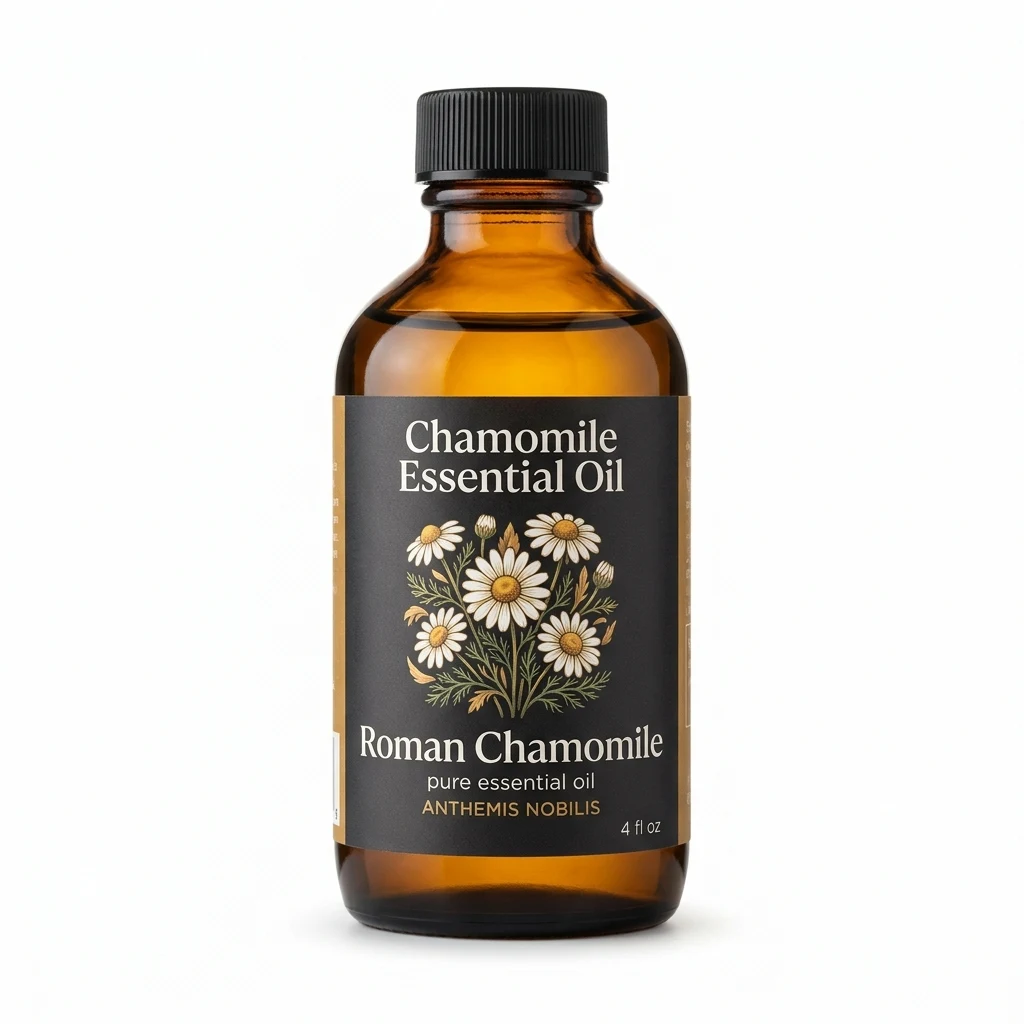
Roman Chamomile Essential Oil
Our own Roman Chamomile Essential Oil, in sizes from 0.5 oz to bulk.
From $32.99
Shop Now →What the knee osteoarthritis trial did and did not show
The trial is Shoara et al., Complementary Therapies in Clinical Practice, 2015, from Shiraz University of Medical Sciences, which also funded it. Patients with knee osteoarthritis were randomized to topical Matricaria chamomilla oil, diclofenac, or placebo, applied three times a day for three weeks. They were allowed acetaminophen as needed, and the researchers recorded how much they took. Pain, function and stiffness were scored weekly on the WOMAC questionnaire.
The result has two halves. The chamomile group used significantly less acetaminophen than either the diclofenac or placebo groups (P = 0.001). But the abstract reports no significant differences between groups in any WOMAC domain. The authors read the first half as a possible benefit. A skeptic reads the second half as the questionnaire outcome coming up empty. We hold both readings at once: the trial is a signal worth repeating, not a result that establishes a pain effect.
Three limits matter for a shopper. The abstract does not state how the "chamomile oil" was made or at what strength, so you cannot translate it into drops of an essential oil. The traditional Persian chamomile oil described by Zargaran et al., Medical Hypotheses, 2014 is an aqueous chamomile extract boiled in sesame oil, which is a different product from a steam-distilled essential oil. We have not seen the Shoara methods section, so whether that applies here is unknown; the point is that "chamomile oil" in a trial title can mean several things. And it is one trial in one condition, osteoarthritis of the knee, not workout soreness.
The pooled picture, and why it is blurry
A 2025 meta-analysis, Ahmadi et al., Caspian Journal of Internal Medicine, pooled eight human studies of chamomile for musculoskeletal pain (searched to July 2024). The authors describe a potential analgesic effect versus placebo, no significant difference versus other pain medicines, and significant heterogeneity, and they call for more research. The abstract does not say which preparations (tea, extract, topical oil) were included, so it cannot tell you what an essential oil does. Reasoning from that: a pooled result built on mixed forms is a statement about chamomile in general, and applying it to our bottles is an inference.
What the lab-bench data can and cannot carry
You will often see alpha-bisabolol and chamazulene named as the "anti-inflammatory" compounds. A 2022 review, El Mihyaoui et al., Life, lists both among the main terpenoids in chamomile essential oil and lists anti-inflammatory effects among the reported activities of the plant's oils and extracts. Its abstract does not tie either compound to that activity, and does not say how much of it comes from cell or animal work. So the claim stays preclinical as far as we can verify, and we found no human trial that tested either compound applied over a sore joint. Chamazulene is also what makes our German chamomile oil blue, and a colour is not evidence of an effect.
Why our product pages stay quiet on pain
Under the FDA's aromatherapy guidance, a product's intended use is judged partly from the claims made for it, and claims such as easing pain or relaxing muscles are examples of drug claims, including for massage oils sold as aromatherapy. The FDA's cosmetic-or-drug page gives the same example: a massage oil that only lubricates skin and adds fragrance is a cosmetic, while one intended for relieving muscle pain is a drug. We sell essential oils as cosmetic ingredients, and our own page says we make no health claims. That is why this guide reports studies and stops there.
Deciding: which form, if any
- You have an injury, a hot swollen joint, pain that persists or wakes you at night, or a diagnosis you were given. Skip the oil question and see a physician or physical therapist. For knee and hand osteoarthritis the NHS says exercise is one of the most important treatments and lists topical NSAID creams as an option that can be particularly effective for knees and hands, with a GP or physiotherapist to plan the exercise. Chamomile oil does not appear on that page.
- You want a fragrant rub for a general massage, with no medical question attached. This is the use our bottles fit. See chamomile oil massage for technique.
- You want to replicate the trial. You cannot. The preparation and strength are not in the abstract, and neither of our oils is sold as that product.
If you decide to use it on skin: the arithmetic
Both of our oils are sold undiluted, so the dilution is your job. The product page range is 0.5% to 2% in a carrier oil; that is our product guidance, not a study result. For a 30 ml (about 1 oz) bottle of carrier, 1% is 0.3 ml of chamomile oil and 2% is 0.6 ml. Our German page gives roughly 3 to 12 drops per ounce. That matches 0.5% to 2% only if you assume about 20 drops per ml, and drop size varies with the bottle, so measure with a small syringe if you want accuracy. We have not tested any recipe, so treat these as figures worked out from the dilution range and ordinary maths. Patch test first (how to patch test), and see how to dilute chamomile essential oil for carriers. We do not sell carrier oils, so buy one from a pharmacy, grocery or reputable supplier.
Who should skip it
Anyone with a ragweed or other Asteraceae allergy should be cautious, as our own safety copy says, and anyone whose skin reacts on the patch test should stop. Keep it away from eyes, children and pets, and do not take it by mouth. Do not rub it over broken skin or an acutely injured joint. If a joint is red, hot, swollen or getting worse, that is a question for a physician, not a bottle. For headaches or period pain, see our separate guides on headaches and menstrual cramps.
Our verdict: the evidence for chamomile oil on joint pain is one small, mixed trial plus a pooled analysis of unspecified preparations. If you like the scent and want it in a diluted massage blend, use it for that. If you want the pain looked at, the people to see are a physician or physical therapist, and neither of our oils is a substitute.
Roman Chamomile Essential Oil
Roman Chamomile Essential Oil from our own shop, in sizes from 0.5 oz to bulk.
From $32.99
Shop Now →Sources & Further Reading
- Shoara R et al., 2015. Efficacy and safety of topical Matricaria chamomilla L. (chamomile) oil for knee osteoarthritis. pubmed.ncbi.nlm.nih.gov/26256137
- Zargaran A et al., 2014. Potential effect and mechanism of action of topical chamomile oil on migraine headache: a medical hypothesis. pubmed.ncbi.nlm.nih.gov/25238714
- Ahmadi M, Mozaffarpur SA, Shirafkan H, 2025. Effect of chamomile on musculoskeletal pain: a systematic review and meta-analysis. pubmed.ncbi.nlm.nih.gov/41394268
- El Mihyaoui A et al., 2022. Chamomile (Matricaria chamomilla L.): a review of ethnomedicinal use, phytochemistry and pharmacological uses. pubmed.ncbi.nlm.nih.gov/35454969
- U.S. FDA. Aromatherapy. fda.gov/cosmetics/cosmetic-products/aromatherapy
- U.S. FDA. Is it a cosmetic, a drug, or both? (Or is it soap?). fda.gov/cosmetics/cosmetics-laws-regulations
- NHS. Osteoarthritis: treatment. nhs.uk/conditions/osteoarthritis/treatment