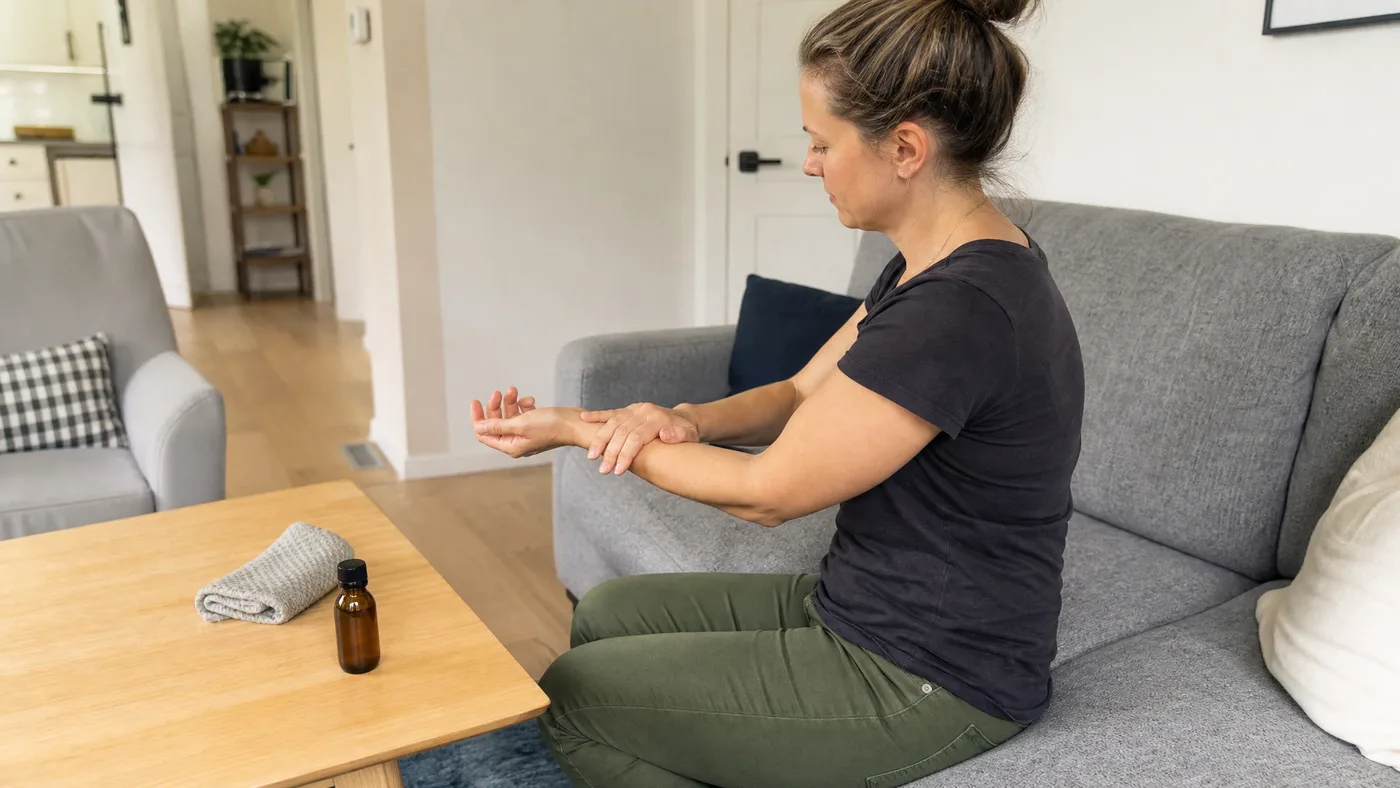
Chamomile Massage Oil: Choosing the Dilution by Body Area
The dilution for a chamomile massage oil is decided by where it goes on the body, not by which chamomile you bought. Both of our oils, German and Roman, are sold undiluted, so the carrier and the arithmetic are yours to do. This page works through that arithmetic, shows what the one aromatherapy-massage trial we read actually tested, and lists who should not massage with it at all.
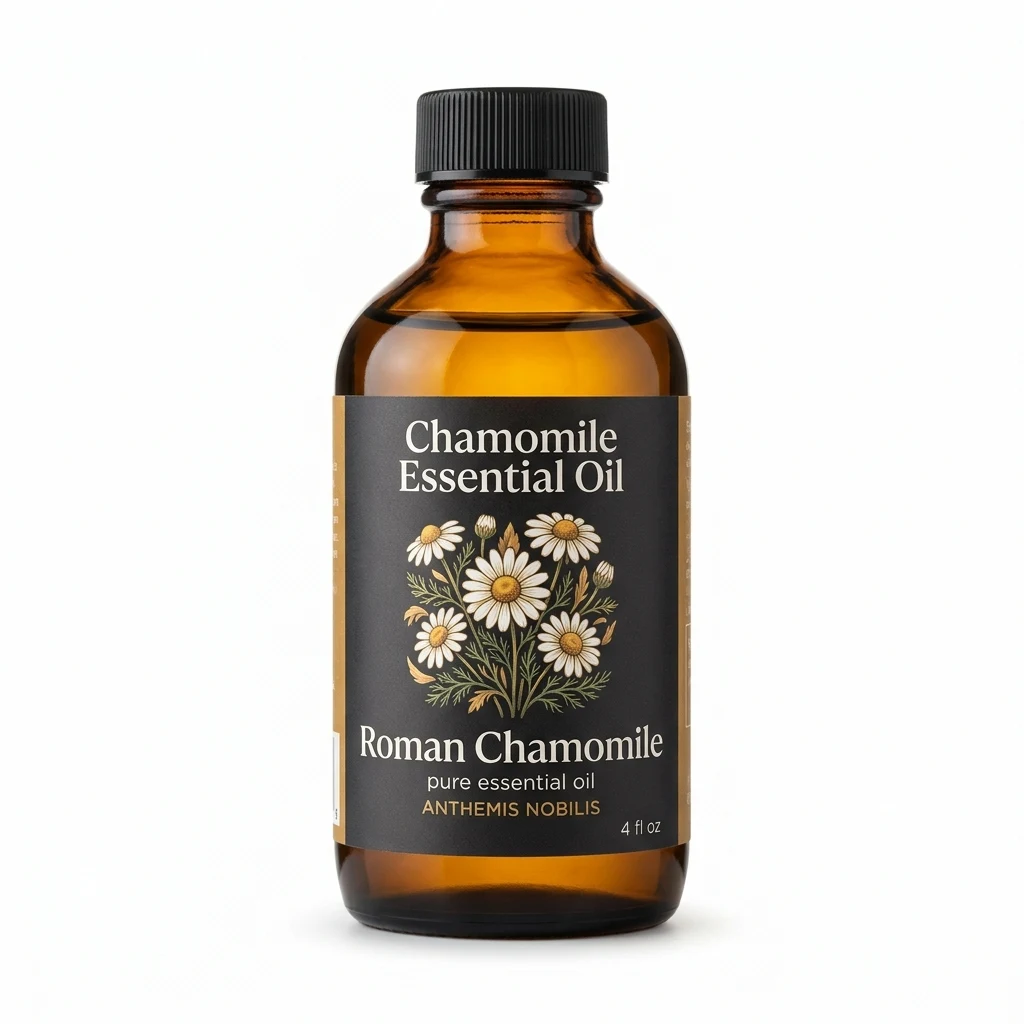
Roman Chamomile Essential Oil
Our own Roman Chamomile Essential Oil, in sizes from 0.5 oz to bulk.
From $32.99
Shop Now →Pick the body area first, then the percentage
The Tisserand Institute dilution page gives two ranges that matter here: 0.5% to 1.2% for facial cosmetics and other sensitive areas such as underarms, and 1% to 3% for body oils and lotions. It says the body range has been used by aromatherapists for body massage for more than 50 years, and it advises starting low and going up only if needed. The page does not mention chamomile at all, so it is a general ceiling, not a chamomile-specific one.
Our own product pages state a narrower range for skin: 0.5% to 2% in a carrier oil, patch test first. That sits inside Tisserand's body range at the bottom and overlaps its face range only up to 1.2%. Our position, reasoning from those two sources: treat 2% as a body-only figure. For the face, neck or any thin, sensitive skin, stay at or under 1.2%. For a first body massage, start at 1%, which is the middle of both sources and the number that needs the least explaining if a reaction occurs. The 3% top of Tisserand's body range is higher than anything we print, so it is not a figure we would offer.
The drop arithmetic, done once
Percent means millilitres of essential oil per 100 ml of finished massage oil. One US fluid ounce is about 29.6 ml, so a 30 ml bottle is close enough to treat as 30 ml. Drops are the weak link: a drop is not a fixed volume, and it varies with the bottle's orifice and the oil's viscosity. We use 20 drops per ml, which reproduces the "3 to 12 drops per ounce" on our German oil page for 0.5% to 2%. If you want precision, measure the essential oil in millilitres with a pharmacy oral syringe and count drops only as a cross-check.
| Dilution | Essential oil in 30 ml | Drops (20 per ml) | Essential oil in 100 ml |
|---|---|---|---|
| 0.5% | 0.15 ml | 3 | 0.5 ml (10 drops) |
| 1% | 0.3 ml | 6 | 1 ml (20 drops) |
| 1.2% (face ceiling) | 0.36 ml | 7 | 1.2 ml (24 drops) |
| 2% (our ceiling) | 0.6 ml | 12 | 2 ml (40 drops) |
| 3% (Tisserand body ceiling) | 0.9 ml | 18 | 3 ml (60 drops) |
The common error is scaling. Six drops is correct for a 30 ml bottle at 1%. Put those six drops into a 100 ml bottle and you have made roughly 0.3%, which is not a safety problem but is a waste of oil. The reverse, 20 drops into 30 ml, is about 3.3%, above every range quoted on this page. Write the bottle size on the bottle and work from ml.
What the massage trial did, and what it did not show
Aromatherapy massage trials are often cited as if they tested chamomile on its own. The one we read did not. Mehrabian et al., International Journal of Therapeutic Massage & Bodywork, 2022, was a randomized trial of 38 nursing-home residents aged 65 to 85 at four facilities in Kerman, Iran. The intervention was a blend of lavender, chamomile and rosemary oils in a 4:3:2 ratio, diluted at 3% in jojoba oil, with ten drops of the blend applied to the legs, feet and knees in 20-minute sessions, three times a week, in two three-week periods (18 sessions). The comparison group received routine care only. Anxiety on the Hospital Anxiety and Depression Scale was reported lower in the massage group by week 7 (6.26 against a baseline of 11.9), while the control scores rose.
The limits are the authors' own. There was no comparison group that received massage with plain carrier oil, so the study cannot separate the oils from the massage and the attention. The researcher could not be blinded, scores were self-reported, the sample was small, the groups differed significantly at baseline, and the paper lists internal numeric inconsistencies between its abstract and table. The authors wrote that there is no proof aromatherapy made the difference. The text we read does not say which chamomile species was used. So the honest reading is: one small trial in older adults reported lower anxiety scores after a three-oil massage course at 3%. It tells you nothing about German versus Roman, about a 1% blend, or about a single oil.
Carrier choice: what we can and cannot tell you
We sell no carrier oils, so this is not a sales pitch. One sourced point bears on massage volumes, which are larger than a face-oil dropper bottle: a review of cosmetic preservation (Halla et al., Molecules, 2018) notes that phenolic antioxidants are used to delay the self-oxidation of unsaturated oils, which affects colour and odour. Reasoning from that, a large bottle of a highly unsaturated oil that sits half-empty for months is the case where oxidation shows up, so mix a quantity you will use within weeks. For which carriers, and for nut-allergy checks on labels, see our carrier oil comparison. If you have a tree-nut or peanut allergy, ask an allergist before using any nut-derived carrier.
Who should skip this, and who to ask instead
- Anyone allergic to ragweed, daisies or other Asteraceae plants. In a patch-test series of 35 patients already positive to sesquiterpene lactones, 86% reacted to German chamomile tea and 43% to a Roman chamomile preparation, as summarised in Ključevšek and Kreft, Health Science Reports, 2025. The same review notes 8 of 12 chamomile-sensitive patients reacted to topical chamomile products in which no sesquiterpene lactones were found, so a clean ingredient list does not rule out a reaction. Ask a dermatologist or allergist, and read our patch test guide.
- Broken, inflamed or newly shaved skin. Do not massage a diluted essential oil into it. See a physician or pharmacist for the skin problem itself.
- Pregnancy, and anyone with a medical condition. The Tisserand Institute safety guidelines tell pregnant people to seek the advice of a doctor or suitable practitioner before using essential oils. Ask your OB-GYN or midwife. We do not say any oil is safe in pregnancy.
- Children. Our product pages say to keep the oil away from children, and Tisserand uses a separate age-based chart for them. Ask a pediatrician.
- Muscle pain or cramps as the reason for the massage. That is a question for a physician. Our pages on pain and menstrual cramps describe the evidence and its limits.
Technique, pressure and which areas to avoid are a licensed massage therapist's territory. We have no massage therapist on staff and have written nothing here about strokes or sequences. The full dilution method is in our dilution guide, and the oil's allergy profile is covered in the safety article.
If you buy a bottle of either chamomile oil for massage, buy it knowing it arrives undiluted, decide the body area first, write the percentage on the carrier bottle, and patch test before the first full application.
Roman Chamomile Essential Oil
Roman Chamomile Essential Oil from our own shop, in sizes from 0.5 oz to bulk.
From $32.99
Shop Now →Sources & Further Reading
- Tisserand Institute. Essential oil dilution guidance. tisserandinstitute.org/safety/dilution
- Tisserand Institute. Safety guidelines. tisserandinstitute.org/safety-guidelines
- Mehrabian S et al., 2022. Aromatherapy massage in nursing-home residents (lavender, chamomile, rosemary). pmc.ncbi.nlm.nih.gov/PMC8887855
- Ključevšek T, Kreft S, 2025. Allergic Potential of Medicinal Plants From the Asteraceae Family. pmc.ncbi.nlm.nih.gov/PMC11847717
- Halla N et al., 2018. Cosmetics Preservation: A Review on Present Strategies. pmc.ncbi.nlm.nih.gov/PMC6099538