
Chamomile Essential Oil Benefits: What Has Been Studied
Nothing we read establishes that chamomile essential oil improves anyone's health, and a page that lists "benefits" without saying so is describing a different product. What exists is a modest pile of small trials of inhaled oil, a larger pile of trials of oral extract and tea, and lab and animal work. This page sorts that pile by what was actually tested, so you can tell which studies describe the oil in the bottle and which describe something else.
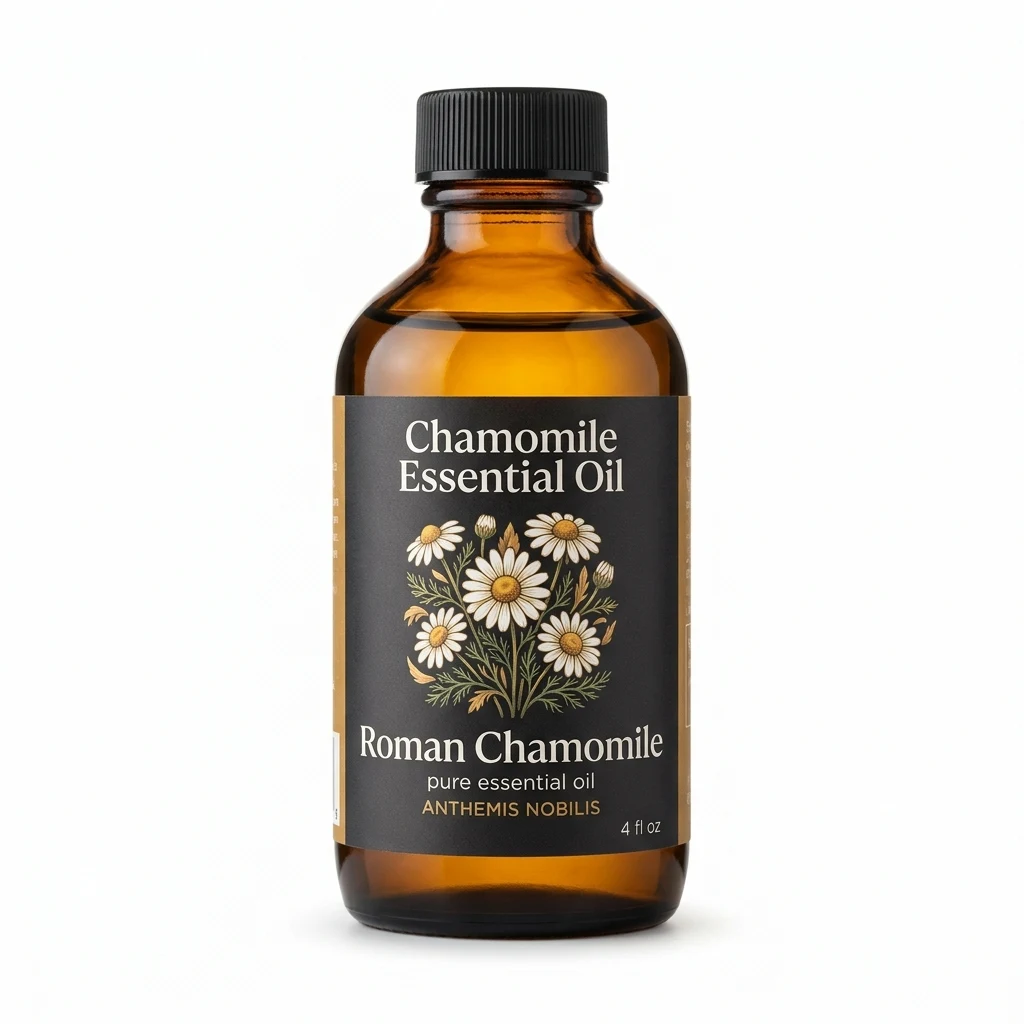
Roman Chamomile Essential Oil
Our own Roman Chamomile Essential Oil, in sizes from 0.5 oz to bulk.
From $32.99
Shop Now →How we grade the evidence (our rubric, not an official one)
The grades below are ours, built only from study design and the form of chamomile used. They are a reading aid, not a verdict from any agency.
- B: at least one randomized trial of the same form we sell (essential oil, inhaled or applied), but small, single-site, or hard to blind.
- C: randomized trials or reviews of a different form (oral extract, tea, a multi-herb product), or a review that mixes forms.
- D: lab, animal or traditional-use findings only.
- E: we found nothing usable.
There is no A. A grade A would need several blinded, adequately sized trials of the same form with the same outcome, and none of the chamomile material we read reaches that.
The evidence map
| Area | Form tested | What was reported | Limit | Grade |
|---|---|---|---|---|
| Anxiety scores | Inhaled oil | Trials in 90 to 183 people reported lower scores than controls (details in our anxiety guide) | Short, mostly hospital settings, blinding by scent is weak, funding not stated in the records we read | B |
| Anxiety disorder (GAD) | Oral extract capsules | 57 people, 8 weeks: larger HAM-A drop than placebo (P = 0.047) | Not oil, not inhaled | C |
| Post-operative pain | Inhaled oil | 136 women after cesarean, four groups of 34 (Zamani Habibabad et al., 2023): the chamomile-aromatherapy group reported lower pain scores than the control group on a visual analog scale | One hospital, control got no scent | B |
| Sleep | Oral chamomile | Pooled review of 12 trials: sleep quality improved, insomnia severity did not | Not oil | C |
| Digestion | Tea, extract, multi-herb products | NCCIH: chamomile alone not shown helpful for infant colic or children's diarrhea | Nothing on oil applied to the abdomen | C/E |
| Skin and acne | Extract in creams, lab assays | Reviews call the evidence limited or indirect | No fetched trial of the oil on acne | D/E |
| Bisabolol, chamazulene | Isolated constituents, animals, cells | Antimicrobial, anti-inflammatory and antispasmodic effects reported in lab and animal work | Results in a dish or a rodent do not transfer by default | D |
What the better evidence is, and is not
The trial with the most participants in the inhaled-oil group is Pourshaikhian et al., BMC Complementary Medicine and Therapies, 2024: 154 acute coronary syndrome patients, double-blind, 10% Matricaria chamomilla oil (7 drops) against 7 drops of sesame oil, two nights. Anxiety fell by 5.2 points in the oil group and 1 point in the placebo group. That is a real result in a real design. It is also a hospital population with a different baseline from a person buying a bottle, and the placebo smelled like sesame, not like nothing, which matters when the outcome is a self-rated feeling.
A 2026 scoping review of chamomile aromatherapy in hospitals (Cabral et al., Complementary Therapies in Medicine, 2026) pooled 17 studies. Anxiety reductions were reported in 58.8% of them, pain reductions in 41.1%, and 41.1% of the studies came from Iran. We read only the abstract, which states no limitations. A scoping review maps what exists; it does not grade risk of bias, so "reported in 58.8% of studies" is a count of papers, not an effect size.
The oral-extract trials are the ones people quote for anxiety. Amsterdam et al., Journal of Clinical Psychopharmacology, 2009 randomized 57 people to extract or placebo for 8 weeks. Mao et al., Phytomedicine, 2016 then randomized 93 responders to continue 1,500 mg a day or switch to placebo for 26 weeks. Relapse was 15.2% on chamomile and 25.5% on placebo, but the hazard ratio of 0.52 had a 95% confidence interval of 0.20 to 1.33, so that primary comparison was not significant. The authors blamed the sample size and a lower-than-expected placebo relapse rate. Neither trial used essential oil.
Two regulators, one careful reading
The EMA's monograph on Matricariae flos (Matricaria recutita flower, first published 2016) lists traditional-use indications such as minor gastrointestinal complaints, common cold, mouth and throat inflammation and skin irritation. "Traditional use" is the EMA's term for plausibility plus at least 30 years of use, with clinical evidence judged insufficient. The summary covers the flower heads as teas, liquids and ointments, and does not state that the essential oil is covered, so reading it as an endorsement of the oil is an inference.
The NCCIH chamomile page (updated November 2024) calls the evidence for a chamomile supplement in generalized anxiety disorder preliminary, says chamomile alone has not been shown helpful for infant colic or diarrhea, and does not mention the essential oil at all. It also notes allergic reactions are more likely in people allergic to ragweed and related plants.
Sleep, skin, hair: go to the narrower posts
For sleep, the pooled review we read (Hieu et al., Phytotherapy Research, 2019, 12 trials) concerned oral chamomile, not oil, and found sleep quality improved while insomnia severity did not. We make no sleep claim for the oil; the evening wind-down post covers the scent-and-routine side. For skin, the cosmetic uses are in this skin guide, and acne gets its own sceptical look in the acne post. Digestion is in the digestion post, and the short version is that the tea reputation does not transfer to oil.
Where the lab work stops
McKay and Blumberg, Phytotherapy Research, 2006 reviewed 138 references on chamomile tea. They report apigenin-type flavonoids and the oil constituents alpha-bisabolol and chamazulene, antimicrobial and antiplatelet activity in vitro, and anti-inflammatory and antispasmodic effects in animals, and they found no clinical trials of sedative properties. That review is about the tea, written in 2006. Newer trials (2020 to 2025) are above, but the lab-to-person gap it describes still applies to every compound-level claim you see on bottle labels.
Who should skip this, and what it means for buying
If you are allergic to ragweed, daisies, marigolds or chrysanthemums, or are pregnant, nursing, on warfarin or other prescription drugs, or choosing for a baby or a pet, the question is not "which benefit" but "should I use it at all," and the answer is for your pharmacist, physician, pediatrician or veterinarian. Never swallow the essential oil.
We sell two undiluted oils, a German chamomile (the blue one) and a Roman chamomile, with skin use at 0.5% to 2% in a carrier oil per our own product pages. The trial literature gives no basis for preferring one over the other, because most of the trial records we read do not state the species. Pick on scent and the blends you want; the oils are covered in our Roman versus German comparison. Do not read the trial concentrations (1.5% to 40% inhaled) as skin dilutions. They are not.
Roman Chamomile Essential Oil
Roman Chamomile Essential Oil from our own shop, in sizes from 0.5 oz to bulk.
From $32.99
Shop Now →Sources & Further Reading
- Zamani Habibabad et al., 2023. Chamomile aromatherapy with and without oxygen on pain after cesarean section: randomized clinical trial, Heliyon. PMID 37123948
- Pourshaikhian et al., 2024. Chamomile aromatherapy, anxiety and hemodynamic indices in acute coronary syndrome. PMID 38172912
- Cabral et al., 2026. Chamomile aromatherapy for pain and anxiety in hospitals: scoping review. PMID 42031027
- Amsterdam et al., 2009. Oral chamomile extract for generalized anxiety disorder. PMID 19593179
- Mao et al., 2016. Long-term chamomile for generalized anxiety disorder. PMID 27912875
- Hieu et al., 2019. Chamomile for state anxiety, GAD, insomnia and sleep quality: meta-analysis. PMID 31006899
- McKay and Blumberg, 2006. Bioactivity and potential health benefits of chamomile tea. PMID 16628544
- European Medicines Agency. Matricariae flos, herbal medicinal product. ema.europa.eu
- NCCIH, updated 2024. Chamomile. nccih.nih.gov/health/chamomile