Chamomile Oil for Acne: What the Evidence Does and Doesn't Say
The pitch goes: acne is bacteria plus inflammation, chamomile oil is described as antibacterial and anti-inflammatory, therefore chamomile oil for breakouts. Every link in that chain is a lab-dish claim, and the last step has no trial under it that we could find. We sell two chamomile oils, German and Roman, and for acne our position is plain: the evidence-based options are on a dermatologist's list, and an essential oil is not on it.
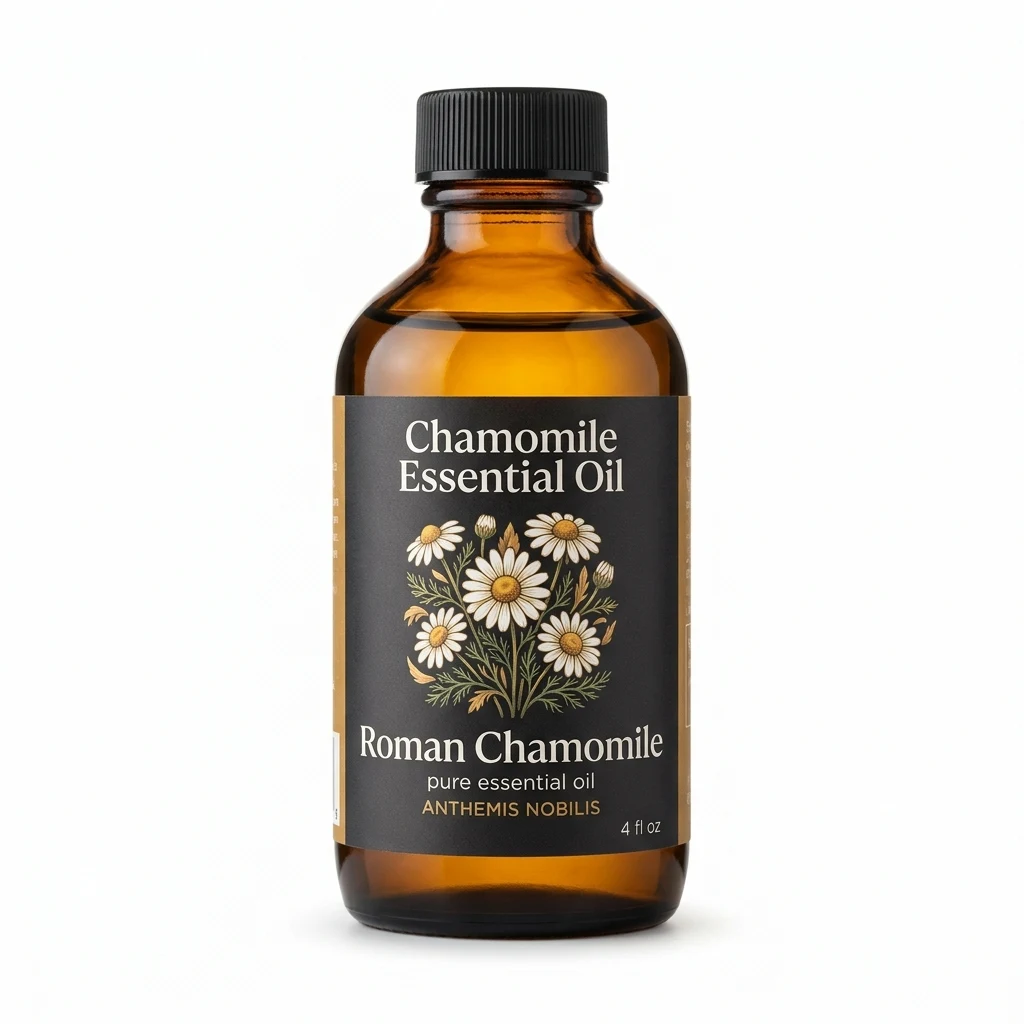
Roman Chamomile Essential Oil
Our own Roman Chamomile Essential Oil, in sizes from 0.5 oz to bulk.
From $32.99
Shop Now →Decision 1: what kind of acne is this?
If it is occasional spots, that is one situation. If it is cystic, painful, leaving marks or scars, or is affecting how you feel about going out, it is a medical skin condition and a dermatologist is the right first call, not a bottle. The 2024 American Academy of Dermatology guideline (Reynolds et al., Journal of the American Academy of Dermatology, 2024) built its 18 recommendations and 5 good-practice statements with the GRADE method. It strongly recommends benzoyl peroxide, topical retinoids, topical antibiotics and oral doxycycline, and strongly recommends isotretinoin for severe, scarring or psychosocially burdensome acne, or acne that has failed standard therapy. The abstract we read lists no essential oil among the recommendations. That is an absence in a summary, not a documented rejection, but it is the benchmark any oil has to be compared with.
Decision 2: what does the chamomile evidence actually consist of?
We searched for a trial of chamomile essential oil on acne and fetched none. What exists falls into three buckets.
- Lab and review claims. McKay and Blumberg, Phytotherapy Research, 2006 report moderate antimicrobial activity for chamomile in vitro and anti-inflammatory effects in animals. That review concerns chamomile tea and predates current acne guidance. A cell-culture result is not a result on a face.
- Systematic reviews that mention chamomile. Pezantes-Orellana et al., Frontiers in Medicine, 2025 reviewed 70 studies of essential oils and extracts in skin care. Chamomile extracts gave positive skin results, tea tree oil was judged most effective for acne, and the authors call for longer trials. Several authors were employed by a company, which the paper discloses. A 2026 review titled around Chinese essential oils (Agrawal et al., Infectious Disorders Drug Targets) says chamomile oil "may outperform" conventional acne therapy, but the abstract gives no data behind it, so we do not repeat it as a finding.
- Extracts, not oil. The positive skin results are for extracts in creams and gels, a different material from steam-distilled oil.
Tea tree is the honest comparison, and we do not sell it. A 2024 scoping review of 29 studies (Dontje et al., Pharmaceuticals, 2024) found tea tree oil the most studied essential oil, with gel for acne showing efficacy and fewer adverse reactions than conventional treatments, but also found many studies small, short or uncontrolled, and product quality verification inconsistent. Even the best-supported oil for acne gets a qualified reading. Chamomile has not earned that much yet.
Decision 3: what does adding an oil cost you?
Here the arithmetic matters more than the marketing. Our product pages give a skin range of 0.5% to 2%. At 2% in one ounce (about 29.6 ml) of carrier, that is about 0.59 ml of chamomile oil, roughly 12 drops at about 20 drops per ml, and about 29 ml of carrier. So 98% of what you smooth onto breakout-prone skin is the carrier, not the chamomile. Reasoning from that, the choice of carrier is a bigger variable than the choice of chamomile, and we did not find a comedogenicity table we could verify well enough to quote ratings. Our carrier oil post covers the options, and we do not sell any carrier, so that choice is made elsewhere.
The second cost is allergy. NCCIH (updated 2024) says allergic reactions to chamomile are more likely in people allergic to ragweed and related plants such as chrysanthemums, marigolds and daisies. McKay and Blumberg report reactions in people sensitive to Asteraceae plants, including from topical use. Reasoning, not a finding: a rash on skin that is already inflamed is hard to tell apart from a flare, which is the practical danger: you may blame the acne for what the oil did. Our own Inside the Still page carries a ragweed and Asteraceae caution for the same reason.
A patch test has a limit worth stating. It checks whether your skin reacts to the diluted oil on a small area, usually the inner forearm, and it cannot tell you how skin that is already inflamed, flaking or being dried by other products will respond. That is reasoning from how a patch test works, not a result from a study we fetched. It is the reason we send anyone with active breakouts to a pharmacist or dermatologist before adding anything new to the routine, rather than offering a schedule of our own.
The third is regulation. The EMA monograph on Matricariae flos lists skin irritation and minor skin inflammation under traditional use only, and it frames the skin-irritation use as add-on treatment after a doctor has excluded serious conditions. It describes infusions, liquids, semi-solids and bath additives made from the flower, and does not state that the essential oil is covered, so applying it to acne is an inference we cannot support.
If you still want to try it
This is a cosmetic-use outline, formulated from our product-page range and ordinary maths, and we have not tested it.
- Choose one oil. German chamomile is the blue one; Roman has the apple-like aroma. Neither is a claimed acne answer.
- Do the patch test first, following our patch test post, on an area away from your face, and wait before going further.
- Start at the low end: 0.5% is about 3 drops per ounce of carrier, and our pages say keep it from your eyes.
- Do not add it on top of a dermatologist's regimen without asking the dermatologist or a pharmacist.
- Stop if the skin stings, reddens or gets worse.
What a fair test would look like
If chamomile oil did have an effect on acne, the evidence would be a randomized trial with a vehicle-only comparison (the carrier alone), a lesion count as the outcome, and a stated oil concentration, run for at least several weeks. None of the sources we fetched reports such a trial for chamomile oil. Until one exists, a before-and-after photo on a retailer's page, or a "may outperform" line in a review abstract, is the weakest tier of evidence we described in our benefits evidence map.
Who should skip this
Skip it if you have ragweed or daisy-family allergy, a diagnosed skin condition under care, open or infected lesions, or acne that scars. Skip it for children and keep it from pets. Do not use it as a reason to postpone a dermatology visit; for severe or scarring acne the guideline's strongest recommendation is a prescription drug. For safe handling in general, see the safety guide; for the full skin picture, our skin guide, the carrier oil picks, and the tea tree comparison.
If you buy from us, you are buying a scented cosmetic ingredient sold undiluted, with the dilution maths left to you. We are not selling an acne product, and nothing in this page says the oil will change your skin.
Roman Chamomile Essential Oil
Roman Chamomile Essential Oil from our own shop, in sizes from 0.5 oz to bulk.
From $32.99
Shop Now →Sources & Further Reading
- Reynolds et al., 2024. Guidelines of care for the management of acne vulgaris. PMID 38300170
- McKay and Blumberg, 2006. Bioactivity and potential health benefits of chamomile tea. PMID 16628544
- Pezantes-Orellana et al., 2025. Essential oils in skin care: a systematic review. PMID 40917836
- Agrawal et al., 2026. Chinese essential oils, acne and anti-aging: systematic review. PMID 42381131
- Dontje et al., 2024. Essential oils for inflammatory skin conditions: scoping review. PMID 38794141
- NCCIH, 2024. Chamomile. nccih.nih.gov/health/chamomile
- European Medicines Agency. Matricariae flos, herbal medicinal product. ema.europa.eu