Chamomile Essential Oil Around Babies and Kids, by Age Band
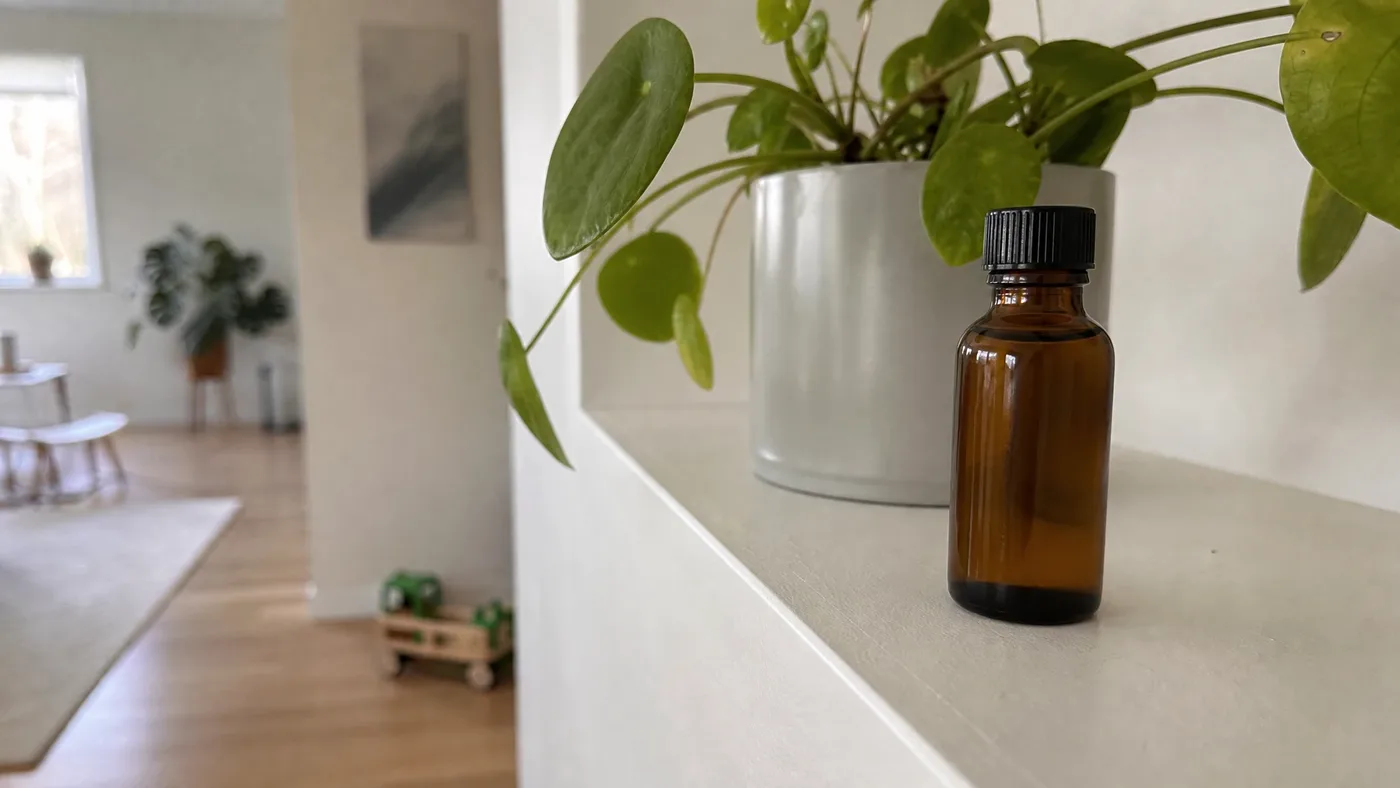
In a home with a toddler, the first chamomile oil question is not which dilution to use. It is where the bottle sits. Poison centre data show that essential oil harm to children is mostly accidental swallowing, and our oils arrive undiluted. We do not make chamomile oil for babies or children, our product pages say to keep it away from them, and the guide below is organised by age so you can see what the published figures are, what they leave out, and when the answer is simply "ask your pediatrician."
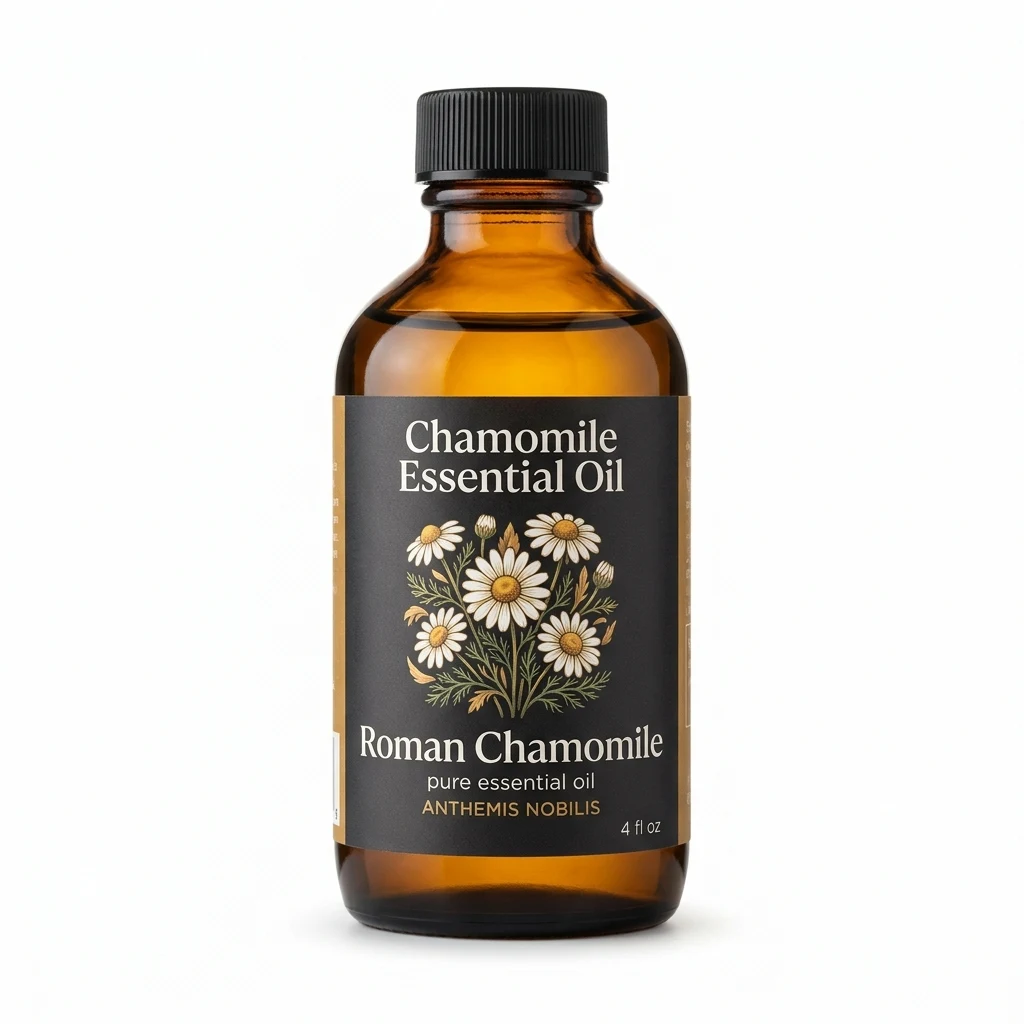
Roman Chamomile Essential Oil
Our own Roman Chamomile Essential Oil, in sizes from 0.5 oz to bulk.
From $32.99
Shop Now →First, the bottle: what the poison data show
A review of four years of calls to the New South Wales Poisons Information Centre counted 4,412 essential oil exposures; 63% involved people under 15, toddlers aged 1 to 4 were the largest group at 49.4%, and 80.0% of cases were accidental (Lee, Harnett and Cairns, Medical Journal of Australia, 2020). Eucalyptus accounted for 46.4%, tea tree for 17.0% and lavender for 6.1%; chamomile was not reported. So this is evidence about essential oils as a category, in Australia, not about our product.
The same authors note that severe toxicity can follow as little as 5 mL, and that the rules they describe require child-resistant closures only on containers above 15 mL. Our smallest size is 0.5 oz, about 14.8 ml, which is under that line. Our product pages do not describe the closure, so check the cap on the bottle you receive and, whatever it is, store the bottle locked up and out of sight. Poison Control says bottles "must be locked up, out of the sight and reach of children and pets," and that "children have thin skin and immature livers," which may make them more susceptible than adults (poison.org). If a child swallows any: US Poison Control, 1-800-222-1222, 24 hours.
One older Canadian review of 251 calls about children swallowing eucalyptus and camphor products found most had no symptoms, but 29% were referred to acute care and two had seizures (Flaman et al., Paediatrics & Child Health, 2001). Those were different oils, so use it as a sense of scale only.
Mix-ups and spills, the other half of the storage problem
The same Australian review found that 13.1% of cases (580) were mix-ups of use, usually a small bottle mistaken for a liquid medicine such as cough liquid, and that 8.3% (365) were referred to hospital. The authors recommend keeping essential oils apart from oral medicines. Reasoning from that: an essential oil bottle in the bathroom cabinet next to children's syrup is the exact arrangement the data warn about, and a bottle on a nightstand is within a crawling child's reach. Two practical consequences follow, and neither needs aromatherapy knowledge: store the bottle high and locked, and never decant it into an unlabelled container. Undiluted oil on a child's skin, in an eye or on a hand that goes to the mouth is the second route, so wash hands after handling, which is also the first line of defence against transferring oil to a baby you pick up afterwards.
What the dilution chart says, band by band
The Tisserand Institute's chart of recommended dilutions, drawn from Essential Oil Safety 2nd edition, is the one age-banded source we fetched (Tisserand Institute, 2017). It calls these "general guidelines," allows exceptions, says some oils may need avoiding altogether, and does not mention chamomile. Here are its bands with the drop arithmetic (one ounce of carrier is 29.57 ml; at about 20 drops per ml that is roughly 590 drops).
| Age | Chart range | Drops in 1 oz of carrier (approx.) |
|---|---|---|
| 0 to 3 months | 0.1% to 0.2% | 0.6 to 1.2 |
| 3 to 24 months | 0.25% to 0.5% | 1.5 to 3 |
| 2 to 6 years | 1% to 2% | 6 to 12 |
| 6 to 15 years | 1.5% to 3% | 9 to 18 |
The first row is the useful lesson. Less than one drop per ounce cannot be measured with a dropper, and drop size varies. Reasoning from the chart's own numbers, anyone making a baby dilution at home is guessing at the very concentration the chart was trying to control. That is a reason to leave under-threes to professionals, not a reason to try harder at the maths.
Under 3 months, and 3 to 24 months
We found no study of chamomile essential oil in infants, so there is nothing to report beyond the chart above and Poison Control's remark about thin skin and immature livers. The EMA draft on German chamomile cites an allergy rate of 0.12% among 817 children (Jeschke et al., 2009), but that publication did not separate how the preparations were given, and the products were not essential oil. We did not retrieve a statement from the American Academy of Pediatrics on essential oils, so we quote none. A pediatrician is the person to ask about any aromatic product around a baby, including diffusing.
2 to 6 years, and 6 to 15
These are the bands where the chart gives ranges a home measurement can reach, and where the allergy question can be raised with a professional: ragweed or other daisy-family allergy in the child or the family is worth raising with the pediatrician or an allergist first (see our safety overview). DermNet reports a trial of nightly essential-oil massage in children with atopic eczema in which some children in the oil group worsened through allergy, chamomile included (DermNet). Patch testing is covered in our patch test guide, and dilution mechanics in our dilution guide, but neither is a recommendation to use it on a child. We have not tested any child recipe.
Why our page says keep away from children when a chart gives numbers
These two statements are not in conflict, though they look it. The chart is a general guide for a professional or a parent choosing a concentration for oils overall, with an explicit caveat that some oils need avoiding altogether and that it does not cover chamomile. Our product page is a seller's statement about a bottle we ship undiluted to the public: it cannot know whether a child is in the house, whether a daisy-family allergy runs in the family, or where the bottle will be kept. So we sit on the stricter side. If a pediatrician looks at a particular child and says a particular dilution is reasonable, that overrides our default; our page does not.
Diffusing near infants is a separate question. We did not retrieve a source on vaporised chamomile oil and young children, so we make no claim either way. Ask the pediatrician, and keep any diffuser out of reach as well.
Who should skip it
Skip our chamomile oils for anyone under three. For older children, skip them if there is a daisy-family allergy, eczema, or a bottle you cannot store out of reach. Pregnant? See our pregnancy article. For everything else about a child, the pediatrician decides.
Roman Chamomile Essential Oil
Roman Chamomile Essential Oil from our own shop, in sizes from 0.5 oz to bulk.
From $32.99
Shop Now →Sources & Further Reading
- Lee KAYR, Harnett JE, Cairns R, 2020. Essential oil exposures in Australia: analysis of cases reported to the NSW Poisons Information Centre. Med J Aust. mja.com.au
- Poison Control (AAPCC). Essential oils. poison.org/articles/essential-oils
- Flaman Z et al., 2001. Unintentional exposures in children to camphor and eucalyptus oil products. Paediatr Child Health. pmc.ncbi.nlm.nih.gov/PMC2804512
- Tisserand Institute, 2017. Recommended dilutions for children. tisserandinstitute.org
- EMA HMPC, 2014 (draft). Assessment report on Matricaria recutita L., flos and aetheroleum. ema.europa.eu, EMA/HMPC/55837/2011
- DermNet. Chamomile. dermnetnz.org/topics/chamomile