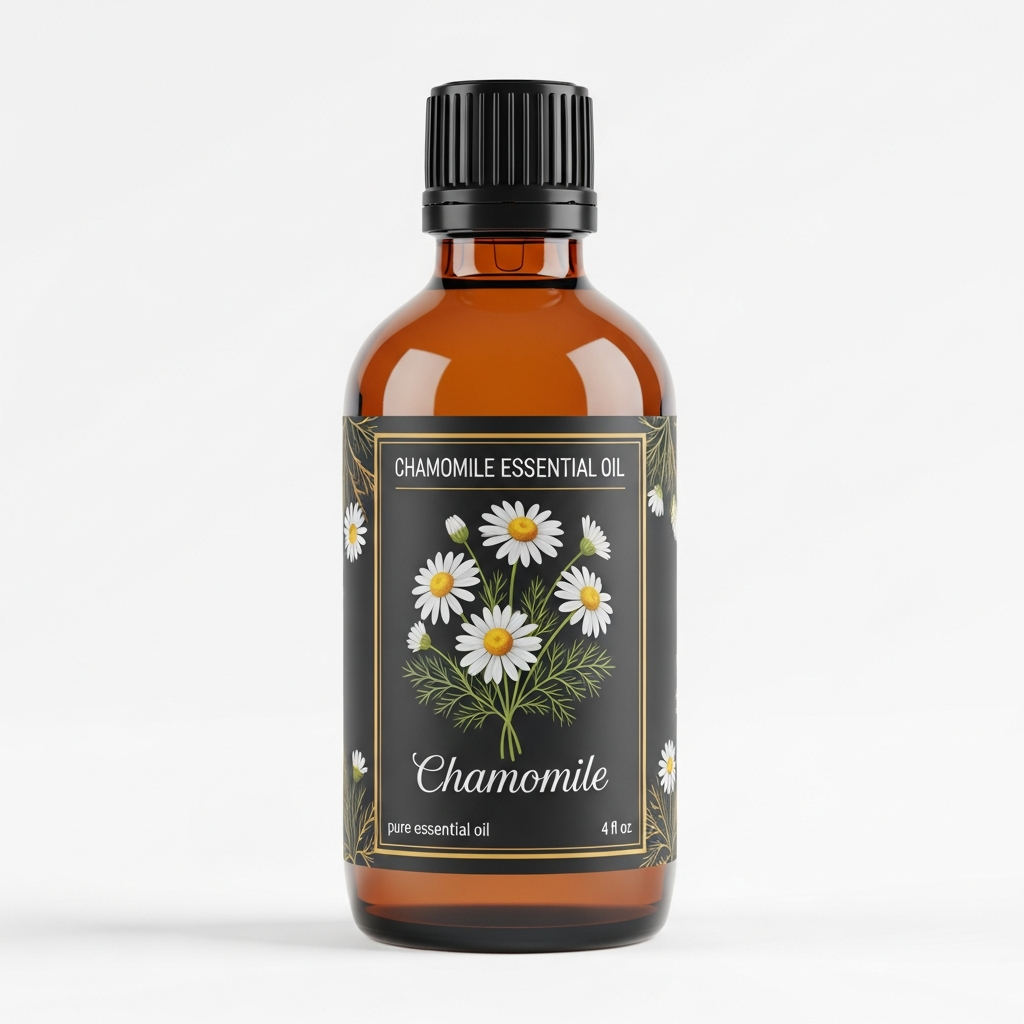
Chamomile essential oil is a distilled botanical with a soft, sweet, apple-like scent that leans herbaceous, almost like sun-dried hay. Its rounded character sits gently behind brighter florals, which makes it a quiet favorite for evening diffusing and softly scented balms.
Inky blue tint: distillation gives this oil a deep blue shade from naturally occurring chamazulene, a trait associated with true chamomile oil.
Botanical grade: it is sold as botanical grade, and the published Certificate of Analysis sits on this page for you to read.
Nine bottle sizes: choose anything from a 0.5 oz sampler up to 400 lbs for production batches.
We gladly fill larger orders of this oil. All nine sizes, from 0.5 oz to 400 lbs, follow one standard, so a sample bottle and a drum match. Formulators, makers, and resellers are all welcome here.
Chamomile oil is concentrated plant material. For skin use, mix 0.5% to 2% into a carrier oil and patch test on a small area first. Keep it away from eyes, children, and pets. It is not meant for internal use. Store the bottle tightly closed somewhere cool and dark.
Frequently Asked Questions
How pure is this chamomile oil? ▾
This oil is sold as botanical grade. You can read the Certificate of Analysis published for it. If you want specifics beyond that document, write to us and we will answer what we can before you buy.
Which chamomile is this, and how is it different from blue tansy? ▾
The exact plant variety is not stated for this oil, so we refer to it simply as chamomile. Buyers often confuse it with blue tansy because both can look blue. Chamomile smells sweet, hay-like, and apple-ish, while blue tansy reads more camphor-herbal.
What does chamomile oil smell like, and what does it blend with? ▾
Expect a sweet, herbaceous, gently fruity scent often compared to fresh apples and hay, softer and rounder than most floral oils. It sits comfortably with lavender, bergamot, clary sage, geranium, sweet orange, and ylang ylang in cozy, evening-style blends.
How should I dilute it for skin use? ▾
Mix chamomile into a carrier oil such as jojoba or sweet almond at 0.5% to 2%. That works out to roughly 3 to 12 drops per ounce of carrier. Patch test a small area first, and keep the mixture away from eyes.
What sizes do you offer, and do you sell wholesale? ▾
There are nine sizes, from 0.5 oz to 400 lbs. The small bottles suit home use and sampling, while the larger containers are meant for makers, formulators, and resellers. Wholesale buyers are welcome and can order any size directly through the store.
Can I buy this oil in bulk sizes? ▾
Yes. The larger sizes, including 5 lbs, 25 lbs, and 400 lbs, are available alongside the small bottles. We do not promise a fixed pattern for per-ounce cost across sizes, so check each listing at checkout and compare the options for yourself.
Is lab documentation included with bulk orders? ▾
Yes, every size is covered by the site's published Certificate of Analysis. If your project needs anything beyond that file, reach out to us before ordering so we can tell you what is available.
Which size should I choose? ▾
Start with 0.5 oz or 1 oz if you are testing the scent in a diffuser or a small skincare batch. The 2 oz and 4 oz bottles suit regular use. Soap, candle, and balm makers often move up to 8 oz, 16 oz, or larger.
How fast do orders ship? ▾
Orders ship within 1 to 2 business days. Bulk sizes of 5 lbs and up may need extra handling, so expect that to add some time. Checkout runs through our Shopify store, where you can confirm your size and address.
Why is chamomile oil blue? ▾
The blue shade comes from chamazulene, a compound that forms naturally while the plant material is distilled. It is a hallmark of true chamomile oil, so a deep blue bottle is expected here and is not a flaw or an added dye.