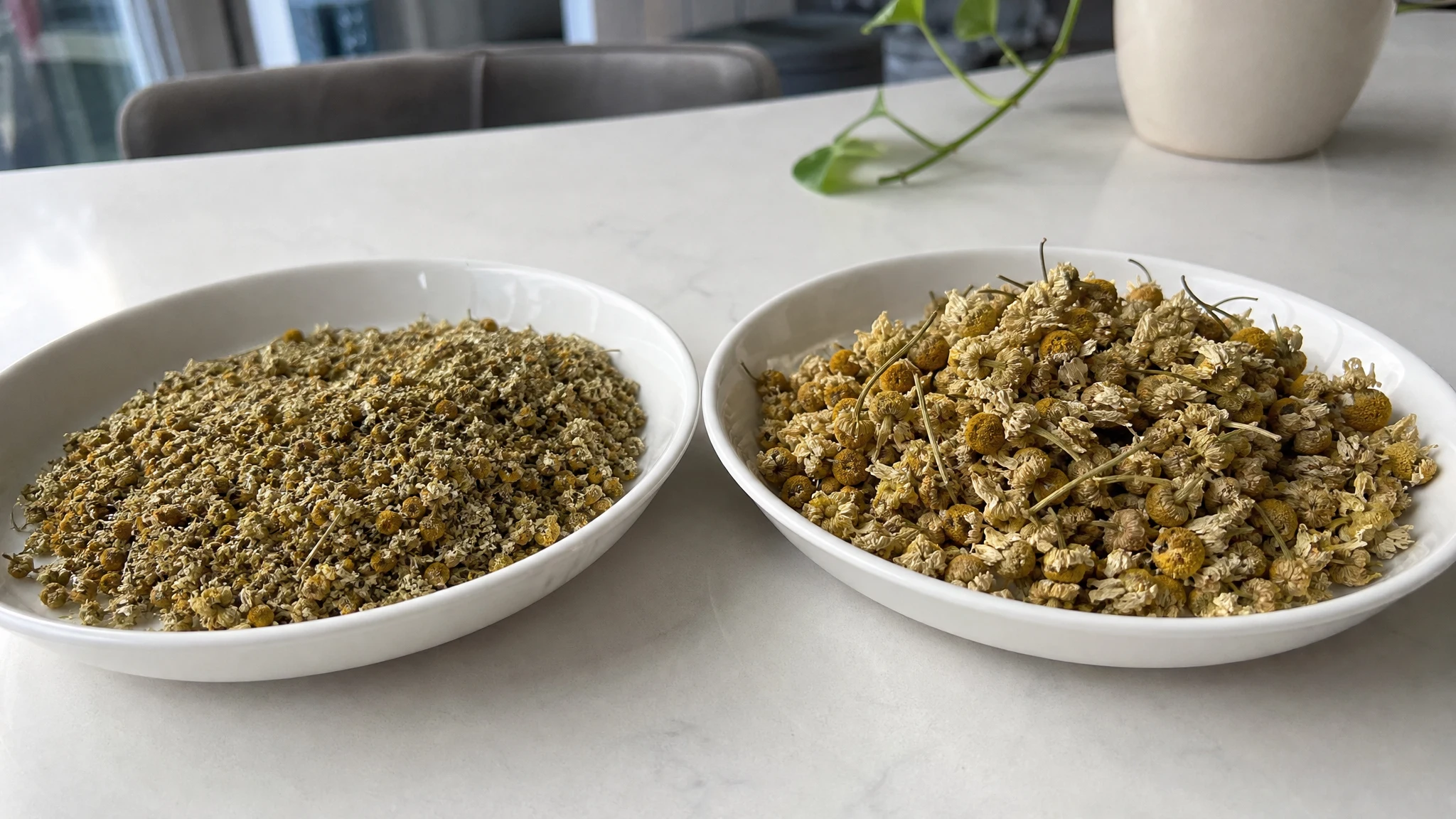
Roman or German Chamomile Oil? Four Questions to Decide
Two bottles, both labelled chamomile, and no obvious reason to prefer either. We sell a Roman chamomile (Anthemis nobilis on our listing) and a German chamomile, and we like both, so here is how we would walk you through the choice: by what you are making, not by which oil is "better".
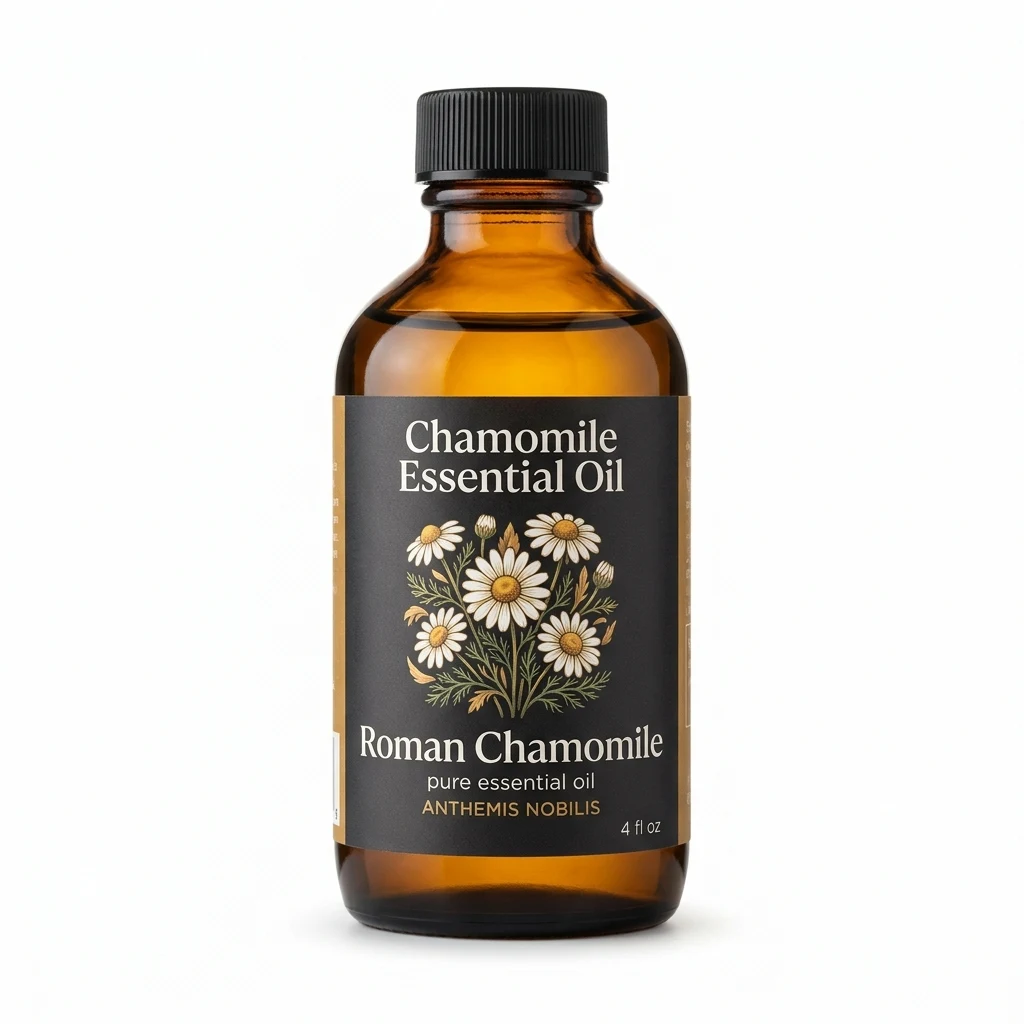
Roman Chamomile Essential Oil
Our own Roman Chamomile Essential Oil, in sizes from 0.5 oz to bulk.
From $32.99
Shop Now →Do you want a blue oil?
If so, the answer is German. The blue is chamazulene, which a 2011 review in Pharmacognosy Reviews describes as an artefact formed from matricin during hydro or steam distillation of Matricaria chamomilla flowers. Roman chamomile oil carries less chamazulene (Srivastava and colleagues, 2010), so it is not where you look for a blue tint.
Two practical notes if colour is the goal. The blue does not stay put: the same 2010 paper says the oil runs from brilliant blue to deep green when fresh and turns dark yellow after storage, so amber glass, a cool shelf and a little flexibility are wise. And German chamomile oil will stain pale fabric, which matters in linen sprays and light balms. If a project cannot take any tint, Roman is the easy answer.
Do you want the oil to read as fruit and herb?
We describe our Roman chamomile as sweet, apple-like and herbaceous, softer and fruitier than German, and we place it as a middle note that blends with lavender, bergamot, clary sage, geranium, sweet orange and frankincense. Our German chamomile is sweet, herbaceous and apple-like with a hay-like softness, and it also pairs with ylang ylang.
There is a chemical reason the two smell different. A Lithuanian study of Roman chamomile (Baranauskiene and colleagues, 2022) found an oil dominated by esters of angelic acid and related acids, with 3-methylpentyl angelate the largest peak at 20.11% to 27.56%. German chamomile oil is led by sesquiterpenes, notably the bisabolol oxides. Different molecules, different nose. Our pairing guide covers what goes with what.
Do you need paperwork?
This one is for formulators and resellers. The Certificate of Analysis we publish covers one batch of German chamomile and lists a relative density of 0.913 and a refractive index of 1.498 at 20 C. If you need a composition report for a particular lot of either oil, ask us in writing through the contact page or our wholesale page before you order. Our GC-MS reading guide explains what to look for.
Composition varies enough that this is worth a thought. Two published Roman samples show it: the Lithuanian one above, and a 2025 Frontiers in Chemistry study (El-Assri and colleagues) of Roman chamomile flowers from Morocco, whose top compounds were beta-oplopenone (18.66%), spathulenol (14.90%) and himachalene (12.47%). Same species name, very different headline compounds.
Is chamomile right for you at all?
Both oils come from daisy-family plants. A 2022 review in Molecules (Dai and colleagues) notes contact dermatitis and hypersensitivity in some people who are allergic to pollen or Compositae plants. If you have a ragweed or daisy-family allergy, an allergist is the right first call. For skin we recommend 0.5% to 2% in a carrier oil with a patch test on a small area first, and our safety guide has more. For pregnancy, babies or pets, ask a physician, pediatrician or veterinarian.
Smell them side by side
Words such as apple, hay and herbaceous apply to both oils, which is why any description, ours included, separates them imperfectly. A paper blotter dipped in each oil and smelled over an hour, labelled with the plant and the date, will tell you more than a page of adjectives. Keep the bottles capped between sniffs. If you are choosing sizes for the comparison, our size guide suggests starting small.
The quick map
- Want a blue or green tint: German, kept in amber glass away from light and heat.
- Want no tint and a fruitier aroma: Roman.
- Not sure: a small bottle of each, side by side.
- Need documentation: ask us in writing for your lot.
- Want something for tea, cooking or a medical purpose: neither. These are undiluted aromatic oils, not for internal use. Our hydrosol comparison and guide to infused oil and CO2 extract cover products we do not sell.
For the longer chemistry story, see our plants, chemistry and colour comparison.
Either way, you are choosing between two good oils, and the smaller decision of which one suits your project is the fun part.
Roman Chamomile Essential Oil
Roman Chamomile Essential Oil from our own shop, in sizes from 0.5 oz to bulk.
From $32.99
Shop Now →Sources & Further Reading
- Singh O, Khanam Z, Misra N, Srivastava MK, 2011. Chamomile (Matricaria chamomilla L.): an overview. Pharmacogn Rev 5(9):82-95. pmc.ncbi.nlm.nih.gov/PMC3210003
- Srivastava JK, Shankar E, Gupta S, 2010. Chamomile: a herbal medicine of the past with bright future. Mol Med Rep 3(6):895-901. pmc.ncbi.nlm.nih.gov/PMC2995283
- Dai YL et al., 2022. Chamomile: a review of its traditional uses, chemical constituents, pharmacological activities and quality control studies. Molecules. pmc.ncbi.nlm.nih.gov/PMC9822300
- Baranauskiene R, Venskutonis PR, Ragazinskiene O, 2022. Valorisation of Roman chamomile herb. Food Res Int 160:111715. pubmed.ncbi.nlm.nih.gov/36076410
- El-Assri EM et al., 2025. Essential oils from Chamaemelum nobile flowers of Morocco. Front Chem 13:1539872. pubmed.ncbi.nlm.nih.gov/39968372