How to Read a Chamomile Oil GC-MS Report
A GC-MS report can tell you what was in a vial of oil, in what proportions of the signal, and whether that mix looks like chamomile. It cannot tell you how much of the bottle is oil, and it can miss a blend that was built to pass. Here is a reading order for a chamomile report, what each line is worth, and the two things it cannot prove. The German oil on our site has its Certificate of Analysis on the product page, so you can run this checklist on a real document; for the Roman oil, contact us about documentation.
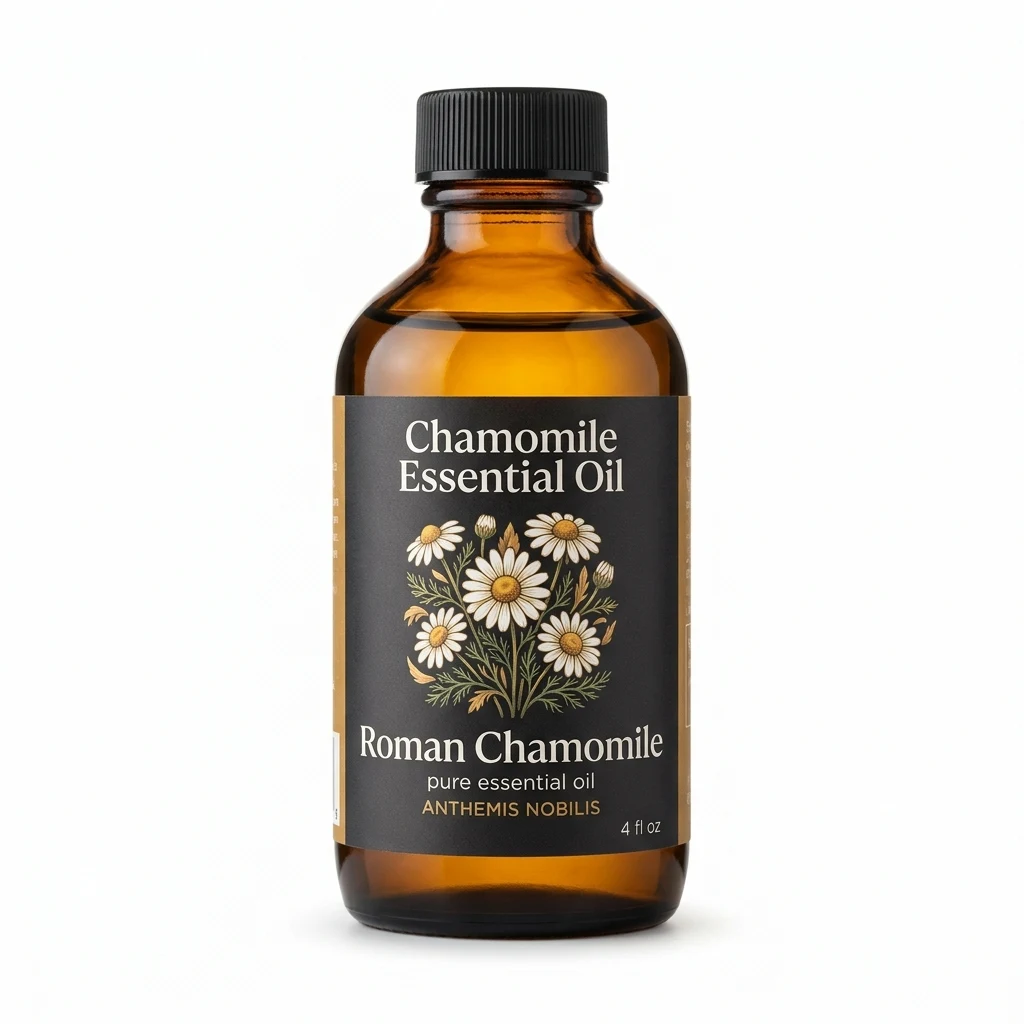
Roman Chamomile Essential Oil
Our own Roman Chamomile Essential Oil, in sizes from 0.5 oz to bulk.
From $32.99
Shop Now →Step 1: before any number, read the header
A usable report names the sample, the lot or batch, a date, the laboratory, and the method (column, temperature programme, detector). If the lot on the report is not the lot on the bottle, the numbers describe some other oil. Our Inside the Still page says our batches carry lot numbers and dates, which is the identifier you match against the report. A lot-less "typical analysis" sheet describes a type of oil, not yours.
Step 2: what the peaks are called
GC separates the oil into compounds, and the mass spectrometer helps name them. A name from a library match is a suggestion. In a 2022 Plants primer by Sadgrove, Padilla-Gonzalez and Phumthum, the authors say library suggestions need confirming against retention indices: on a non-polar column, a value within 10 units of the published index is a tentative match, and library confidence above 90% is a comfortable level to proceed. They also show near-identical mirror matches for globulol versus ledol or viridiflorol, so a spectrum alone can mislead. A report that lists retention indices next to each name is giving you the second check. A report with names and percentages only is giving you the lab's word.
Step 3: what percentages mean
The column is usually "area %": each peak's share of the total signal, normalised so the list adds to about 100. It is not grams, and it is not a share of the bottle. The same primer says GC-MS quantitation "is not regarded as absolute" and that flame ionisation detection (GC-FID) is more accurate for quantities once identities are known. So 12% on a report is 12% of what the detector saw.
Worked example of why that matters. Suppose a lab runs a bottle that is 80% chamomile oil and 20% sunflower oil. The carrier is not volatile at the conditions used, so it does not appear as peaks, and the chamomile peaks are normalised to 100% as if the bottle were whole. This is reasoning, supported by a 2021 Molecules study by Capetti et al., which spiked lavender, bergamot and tea tree oils with sunflower oil at 5 to 50% and stated that adulteration with vegetable oils "cannot be revealed" by the normalised-percentage approach; detecting it took absolute quantitation against a reference profile. It was not a chamomile study, so applying it to chamomile is an inference, but the logic is about how area percent works.
Step 4: which chamomile compounds to look for
For German chamomile, look for chamazulene, alpha-bisabolol, bisabolol oxides A and B, bisabolone oxide A and (E)-beta-farnesene. Their ranges are wide. In Orav, Raal and Arak (Natural Product Research, 2010), oils from European countries gave bisabolol oxide A from 3.1% to 56.0%, alpha-bisabolol from 0.1% to 44.2%, bisabolol oxide B from 3.9% to 27.2%, chamazulene from 0.7% to 15.3% and (E)-beta-farnesene from 2.3% to 6.6%. Bisabolol oxide A led in 8 of 13 samples and alpha-bisabolol led in oils from Moldova, Russia and the Czech Republic. So a report that leads with bisabolol oxide A and one that leads with alpha-bisabolol can both be real German chamomile; this is chemotype variation, not an error. The bisabolol article and the blue-colour explainer cover those molecules.
For Roman chamomile, the signature is esters. The 2026 Molecules paper by Radulovic and Mladenovic analysed two commercial Serbian oils and identified 190 constituents (97.6 to 99.6% of the peak area), led by angelates such as 2-methylpropyl angelate (isobutyl angelate, 11.9 to 13.9%), 3-methylpentyl angelate (9.9 to 10.2%) and 2-methylbutyl angelate (9.3 to 9.5%). The five largest angelates alone, at their lower figures, sum to about 45% (11.9 + 9.9 + 9.3 + 8.5 + 5.4). A one-page report cannot show 190 rows, so reasoning from that figure, expect a COA to list the top peaks and group the rest, and ask what the stated total covers.
Step 5: do the totals and the name agree?
- Does the leading chemistry match the botanical name? An oil sold as German chamomile with ester peaks dominating, or one sold as Roman with bisabolol oxides dominating, is a mismatch to ask about.
- Is the identified total high? Radulovic and Mladenovic's 97.6 to 99.6% is what a thorough lab reached; a report identifying far less has unexplained peaks.
- Does the colour fit? Chamazulene is what makes German chamomile oil blue, so a blue-labelled German oil on a report with no chamazulene line deserves a question. Our storage guide covers keeping the oil in amber glass.
- Which standard is the lab comparing to? ISO 19332:2020 covers matricaria (German chamomile) oil and replaced the 2007 edition. BS ISO 24600:2025 covers Roman chamomile oil. These standards exist, and we have not read their paid text, so we state no limits from them. A report that says what it was compared against is stronger than one that does not.
What a report cannot prove
Dilution with a carrier is the example above. Substitution with synthetics or other oils is the second limit. Sadgrove and colleagues say adulterators can "defeat these 'first pass' chemical checks" by making chemically similar oils or using closely related species. Chiral columns, which separate mirror-image forms of a molecule, and isotope-ratio mass spectrometry can catch some synthetics, but the primer calls the latter a method needing considerable technical expertise. Both are extra tests, so ask whether either was run. We found no chamomile-specific chiral or isotope reference data, so a clean standard GC-MS report is evidence that the oil is plausible, not proof that it is unmodified. Our quality-checks guide covers the buying-side red flags, and the Moroccan chamomile article shows how much one species varies between sites.
Even published papers slip: a 2016 study in Foods by Ghasemi et al. gives a peak bisabolol oxide A value of 55.31% in a table and 51.31% in the text for the same condition. Read the table and the units yourself.
Who should skip this, and limits
A report describes composition. It says nothing about whether the oil suits your skin, your baby or your pet. For allergy, see an allergist; for infants and pregnancy, a pediatrician or an OB-GYN or midwife; for animals, a veterinarian. We sell oil, not medical advice, and we make no health claims.
If you hold one of our German oil's documents, run these five steps on it; if you want the Roman oil's, ask us, and compare whichever you receive against the ranges above.
Roman Chamomile Essential Oil
Roman Chamomile Essential Oil from our own shop, in sizes from 0.5 oz to bulk.
From $32.99
Shop Now →Sources & Further Reading
- Sadgrove NJ, Padilla-Gonzalez GF, Phumthum M, 2022. Fundamental chemistry of essential oils and volatile organic compounds, methods of analysis and authentication. Plants. pmc.ncbi.nlm.nih.gov/PMC8955314
- Capetti F, et al., 2021. Adulteration of essential oils: a multitask issue for quality control. Molecules. pmc.ncbi.nlm.nih.gov/PMC8471154
- Orav A, Raal A, Arak E, 2010. Content and composition of the essential oil of Chamomilla recutita from some European countries. Nat Prod Res. pubmed.ncbi.nlm.nih.gov/20013472
- Radulovic NS, Mladenovic MZ, 2026. Roman chamomile (Anthemis nobilis L.) essential oil: new esters. Molecules. pmc.ncbi.nlm.nih.gov/PMC12843988
- Ghasemi M, et al., 2016. Increase of chamazulene and alpha-bisabolol contents of German chamomile oil using salicylic acid. Foods. pmc.ncbi.nlm.nih.gov/PMC5302395
- ISO, 2020. ISO 19332:2020 Essential oil of matricaria, catalogue record. dinmedia.de/iso-19332
- BSI, 2025. BS ISO 24600:2025 Essential oil of Roman chamomile, catalogue record. knowledge.bsigroup.com