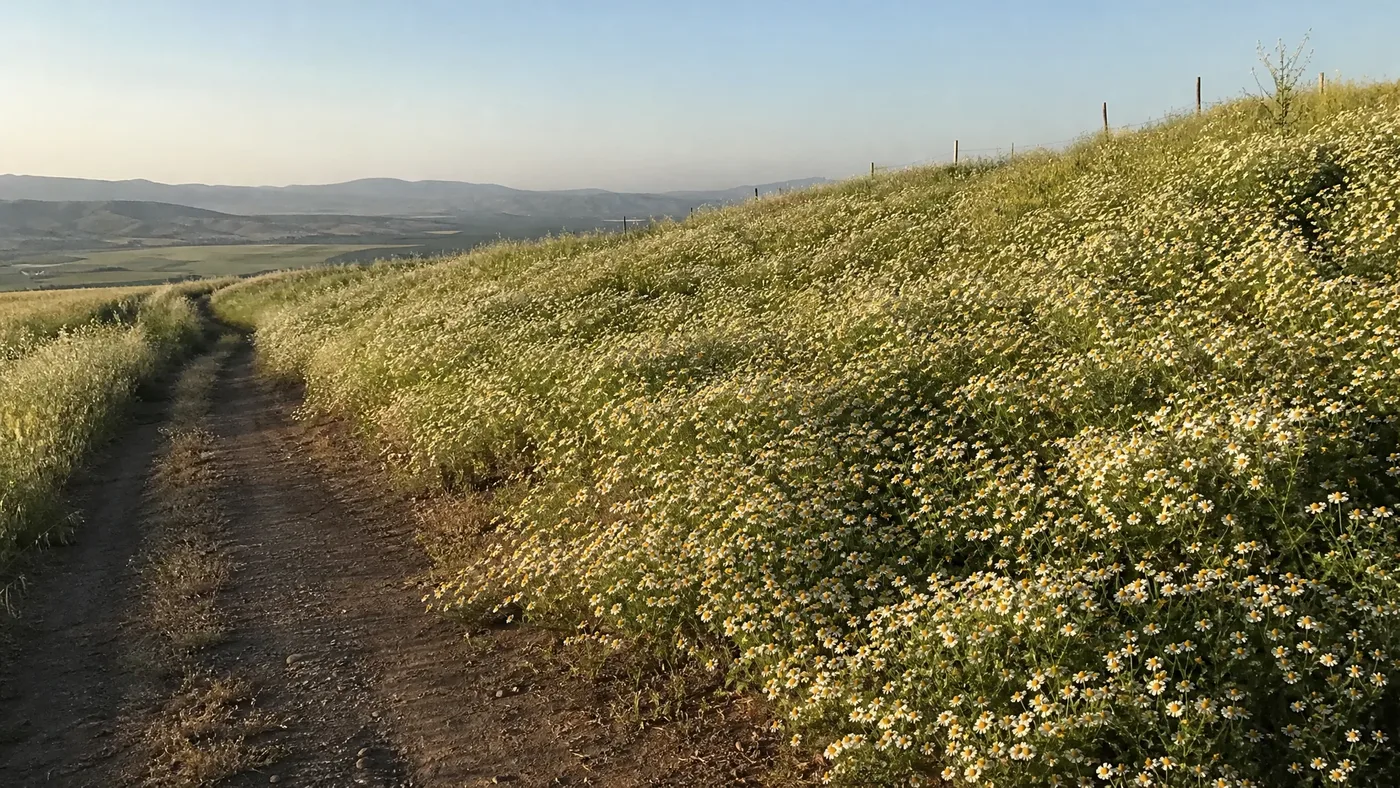
Chamomile Oil Origins Compared: What a Country Label Shows
Two studies of oil from the same country can disagree more than two studies from different countries. In Egypt, one analysis reported bisabolol oxide A at 33 to 50.5% of the oil and another reported cis-beta-farnesene at 27% with bisabolol oxide A at 14.9%. So the country on a chamomile oil label is a starting hint, not a specification, and the lab report for the lot in your hand is the better evidence. We make no origin claim for our own oils on this page, so you can apply the same standard to us.
Roman Chamomile Essential Oil
Our own Roman Chamomile Essential Oil, in sizes from 0.5 oz to bulk.
From $32.99
Shop Now →German chamomile: where the published numbers come from
The broadest primary source is Orav, Raal and Arak (Natural Product Research, 2010), who analysed 13 chamomile drug samples from European countries. Bisabolol oxide A led (27.5 to 56.0%) in 8 of the 13 samples. Alpha-bisabolol led (23.9 to 44.2%) in samples from Moldova, Russia and the Czech Republic. An Armenian sample was rich in bisabolol oxide B (27.2%) and chamazulene (15.3%). The other country figures below come from a 2022 review by El Mihyaoui et al. in Life, which tabulates the work of other groups, so treat them as secondary reports, one sample set each.
| Origin | Lead compounds reported | Source type |
|---|---|---|
| Hungary | alpha-bisabolol oxide A 40.7%, chamazulene 14.3% | Review table |
| Germany | alpha-bisabolol oxide A 39.1% | Review table |
| Egypt (two studies) | bisabolol oxide A 33 to 50.5%; or cis-beta-farnesene 27%, limonene 15.25%, bisabolol oxide A 14.9% | Review table, two separate studies |
| Czech Republic, Moldova, Russia | alpha-bisabolol 37%, 44.2%, 23.9% | Orav 2010 and review |
| Morocco (aerial parts, microwave-assisted) | chamazulene 26.11%, cis-beta-farnesene 11.64% | Review table |
| USA (commercial) | trans-beta-farnesene 42.59%, bisabolol oxide A 21.2% | Review table |
Read this as chemistry, not as a league table. Whether bisabolol oxide A or alpha-bisabolol leads is a chemotype question, and neither is the "right" one; the table also mixes flowers and aerial parts and different distillation methods. The chamazulene figures in particular come out differently by source: Orav reports 0.7 to 15.3% across Europe, while the 2026 Nutrients review (Such et al.) quotes about 13.5 to 31.2%, depending on population and processing. Chamazulene is created during distillation from matricin, so the same flowers distilled for longer or hotter can give a different figure. The blue-colour article has the chemistry.
Processing before the still counts too. The same review reports an Egyptian study in which solar-dried flowers gave 21 identified compounds and microwave-dried flowers gave 13, from one origin. Reasoning from that, two lots from the same farm can differ if one was dried differently, which a country label cannot capture. For a buyer comparing sellers, the practical consequence is that "same origin" is a weak basis for calling two oils equivalent, and a weaker basis for calling one cheaper oil a match for a dearer one.
The plant matters as much as the place
In a 2016 Foods study by Ghasemi et al., three cultivars were grown and distilled: Bushehr (diploid, Iranian origin), Bona (diploid, Slovakian origin) and Bodegold (tetraploid, German origin). The study sprayed salicylic acid and applied heat stress, and bisabolol oxide A reached its highest value, 55.31% in the table (51.31% in the text), in Bodegold under 10 mg per litre salicylic acid and heat stress. The point is not the spray. It is that cultivar and growing conditions moved a lead compound by tens of percentage points in one place. The same paper reported oil yields of 0.1% to 0.8%. Origin is one variable among cultivar, season and treatment, which is why our growing-for-oil article treats the plant, not the postcode, as the unit.
Roman chamomile: a different set of countries, a different spread
BSI's catalogue entry for BS ISO 24600:2025, the standard for Roman chamomile oil, says the oil is mainly produced in France and Italy. The Such review says cultivation is associated with England, France, Belgium and Morocco, and cites oil studies on Serbian, Bulgarian and Croatian material. The reported numbers diverge:
- France: isobutyl angelate 35.9 to 38.5%, as summarised by the 2025 Moroccan study below.
- Serbia, two commercial oils (2026): 2-methylpropyl angelate (the same compound as isobutyl angelate) 11.9 to 13.9%, in a Molecules paper by Radulovic and Mladenovic that identified 190 constituents. They note composition varies with locality, harvest time and growing season.
- Serbian and Bulgarian material, as quoted by Such et al.: isobutyl angelate 28.5 to 35.7% and isoamyl angelate 21.1 to 32.5%. That sits well above the 2026 Serbian figure, so even "Serbian" does not pin the profile.
- Croatia: 3-methylpentyl angelate 20.11 to 27.56%, with isobutyl angelate only 4.84 to 6.79%, across vegetative stages, per the same review.
- Morocco: a 2025 Frontiers in Chemistry paper (El-Assri et al.) found a single Taounate sample led by beta-oplopenone (18.66%) and spathulenol (14.90%), and cited a Khenifra oil led by verbenone (33.74%) and pulegone (26.45%). Neither is ester-led.
Harvest timing shows up in the same review: dried Roman flowers held about 0.22% oil at the vegetative stage and 0.80% at full flowering. Reasoning from that figure, a distiller who harvests early gets roughly a quarter of the oil from the same weight of flowers, and a different profile, as the Croatian vegetative-stage ranges above suggest. Our price guide covers the cost consequence of low yield without our repeating it here.
What we cut
The plan for this article suggested Nepal as an origin. We found no primary source we could verify for Nepalese chamomile oil, so it is out. Likewise we found no trade-survey figures on country volumes; claims of the form "Egypt supplies most of Europe's chamomile" came only from sellers' pages, so we do not repeat them.
A buyer's rule: ask for the lot, not the flag
- Ask for a lot-specific GC-MS report and read the lead compounds against ranges like those above. Our report-reading guide shows how.
- Treat a country as consistent with a profile, not as proof of one. A listing of "Hungarian" German chamomile oil is plausible if bisabolol oxide A and chamazulene appear; the flag cannot show it.
- Check the Latin name first. A "Moroccan" listing could be a different species altogether; see the Moroccan chamomile article.
For our own oils, the German product page carries a Certificate of Analysis, and for the Roman oil you can contact us about documentation. That, not a flag, is what we point you to.
Who should skip this, and limits
Everything above is composition data from a handful of sample sets, mostly one locality or one season each. None of it says an oil from one country is better or safer for any person. For allergy to chamomile or daisy-family plants, see an allergist; for babies, pregnancy or pets, see a pediatrician, an OB-GYN or midwife, or a veterinarian.
Roman Chamomile Essential Oil
Roman Chamomile Essential Oil from our own shop, in sizes from 0.5 oz to bulk.
From $32.99
Shop Now →Sources & Further Reading
- Orav A, Raal A, Arak E, 2010. Content and composition of the essential oil of Chamomilla recutita from some European countries. Nat Prod Res. pubmed.ncbi.nlm.nih.gov/20013472
- El Mihyaoui A, et al., 2022. Chamomile (Matricaria chamomilla L.): a review of ethnomedicinal use, phytochemistry and pharmacological uses. Life. pmc.ncbi.nlm.nih.gov/PMC9032859
- Such S, et al., 2026. German and Roman chamomile: species-specific phytochemical profiles. Nutrients. pmc.ncbi.nlm.nih.gov/PMC13363751
- Ghasemi M, et al., 2016. Increase of chamazulene and alpha-bisabolol contents of German chamomile oil using salicylic acid. Foods. pmc.ncbi.nlm.nih.gov/PMC5302395
- Radulovic NS, Mladenovic MZ, 2026. Roman chamomile (Anthemis nobilis L.) essential oil: new esters. Molecules. pmc.ncbi.nlm.nih.gov/PMC12843988
- El-Assri E-M, et al., 2025. Chamaemelum nobile essential oil from Taounate, Morocco. Front Chem. frontiersin.org/10.3389/fchem.2025.1539872
- BSI, 2025. BS ISO 24600:2025 Essential oil of Roman chamomile, catalogue record. knowledge.bsigroup.com