How Much Chamomile Oil Does a Candle Need?
Chamomile is a quiet oil, and a candle is a loud place to put it. That does not rule it out: a small, soft-scented candle for a desk or a bedside shelf is a perfectly reasonable project. It just means the question is less "how much can I add" and more "what do I expect it to do".
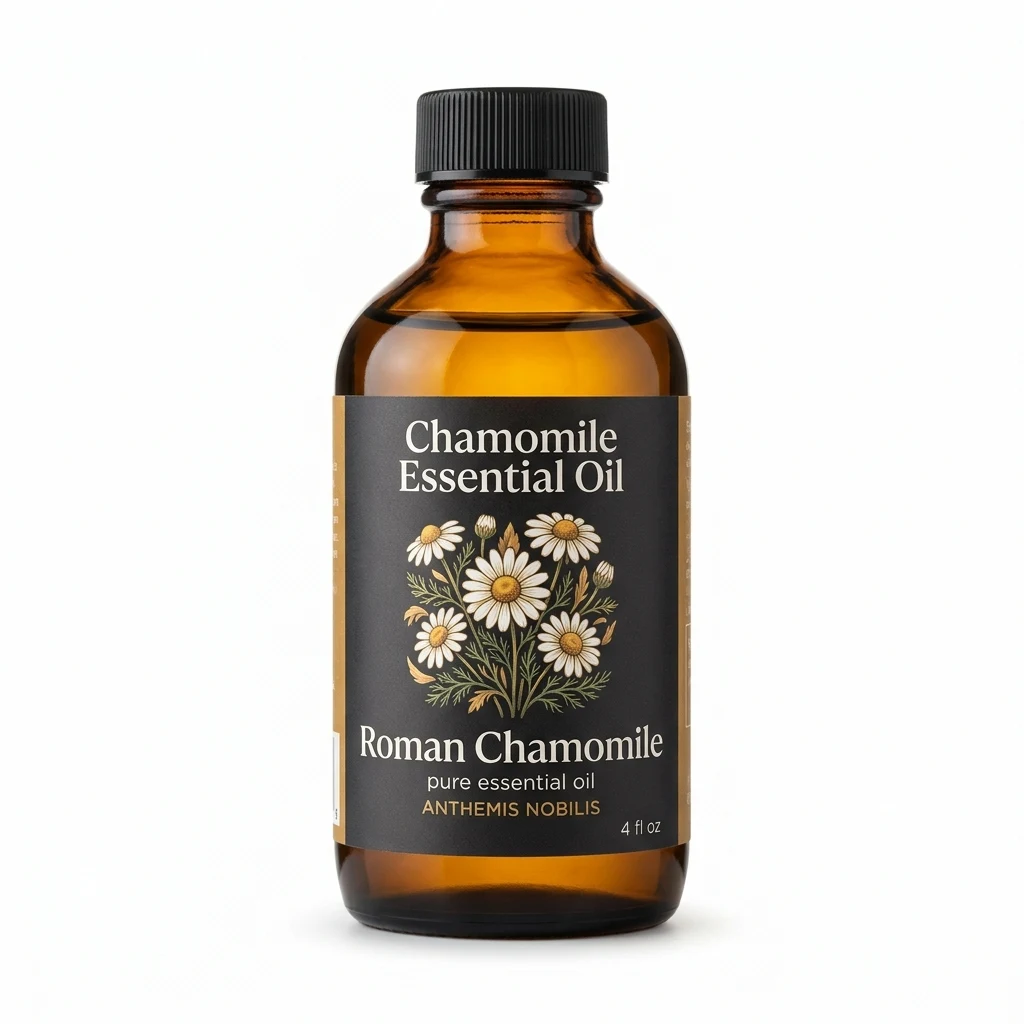
Roman Chamomile Essential Oil
Our own Roman Chamomile Essential Oil, in sizes from 0.5 oz to bulk.
From $32.99
Shop Now →What goes into the wax
We sell two chamomile oils: Roman (listed in our shop as Anthemis nobilis) and German, a blue oil whose Certificate of Analysis names Matricaria chamomilla. This guide leans on Roman, which we describe as sweet, apple-like and herbaceous, softer and fruitier than German.
A look at what Roman oil is made of explains why it behaves as a gentle note. A 2026 analysis of two Serbian Roman chamomile oils found them dominated by angelate, tiglate and senecioate esters, with alpha-pinene as the other notable component. Those are two samples from one supplier, so they describe the type of oil, not any particular bottle. Reasoning from it, this is a light, fruity ester profile rather than a heavy, woody or resinous one, and light notes tend to fade fast in warm wax. That is an inference rather than a measured result, which is exactly why testing beats guessing here.
Decide what the candle is for
If you want a scent that fills a house, chamomile alone is a gamble. Retail guidance from Organic Aromas notes that delicate oils are easily outperformed by sturdier ones such as cedarwood and patchouli. If you want a faint apple-and-hay note by the bed, a single-oil chamomile candle makes sense. And for something in between, let chamomile be a supporting note beside a stronger oil; Oils That Blend With Chamomile covers partners that suit it, and we list lavender, bergamot, clary sage, geranium, sweet orange and frankincense as aroma pairings.
Take the load from the wax, not the oil
Fragrance load is the oil's weight as a percentage of the wax's weight, and the ceiling belongs to the wax. CandleScience suggests starting 1 to 2 percent below your wax's stated maximum, because overloading can make a candle burn badly. Organic Aromas gives a general essential-oil window of 6 to 10 percent and cautions against going past about 10.
With a quiet oil we would not start at the top of anything. Pour a short series, say 3, 5 and 7 percent, in the same wax, container and wick, and compare once they have cured. Past a wax's limit extra oil adds no scent, only trouble.
Turning percentages into millilitres
Loads are by weight and oil is sold by volume, so convert. Essential oils run a little under 1 g per ml (the German batch on our published Certificate of Analysis measured 0.913), so about 0.9 g per ml is a fair planning figure. One fluid ounce is 29.57 ml, or roughly 26.6 g.
A 200 g candle at 3 percent needs 6 g of oil, about 6.7 ml. At 6 percent it needs 12 g, about 13.3 ml. A one-ounce bottle therefore covers about four candles at 3 percent or two at 6. A test series of three 200 g candles at 3, 5 and 7 percent uses 30 g, a little over an ounce. So the real sizing advice is to stay with a small bottle until your own burn tests pass; our sizes guide goes through all nine.
Temperature, flash point and cure time
CandleScience suggests adding fragrance at about 185 F and curing soy and other natural waxes for one to two weeks, paraffin for three to five days. Judge a candle only after it has cured. Organic Aromas also says never to add oil to wax hotter than the oil's flash point. Those two rules can pull against each other for an oil with a low flash point, so ask your wax supplier what they recommend for essential oils at their pour temperature, keep a thermometer in the pour, work with ventilation and keep ignition sources away. If you need a safety data sheet or lot documentation for our oil before ordering, ask us in writing through the contact page.
Who should skip it
Chamomile is in the daisy family. The Cosmetic Ingredient Review has described eczema from an ointment made with Roman chamomile oil. Burning a candle is not skin contact, so we would not stretch that, but if you make candles to sell or give, name the oil on the label and let people with daisy-family allergies decide. Questions about breathing or allergy belong with an allergist. The ASPCA lists the Roman chamomile plant as toxic to dogs, cats and horses; that entry is about the plant, and a veterinarian is the one to ask about candles near animals. Our posts on cats and dogs go further.
A quiet oil rewards patience: three small test candles, a proper cure and an honest sniff test will tell you more than any chart. When one of them wins, you will know exactly how much to buy.
Roman Chamomile Essential Oil
Roman Chamomile Essential Oil from our own shop, in sizes from 0.5 oz to bulk.
From $32.99
Shop Now →Sources & Further Reading
- Radulovic NS, Mladenovic MZ, 2026. Roman chamomile essential oil, new esters. Molecules. PMC12843988
- CandleScience. Candle Making 101: Hot Throw. candlescience.com
- Organic Aromas. Essential Oils for Candles. organicaromas.com
- ASPCA. Roman Chamomile, toxic and non-toxic plants. aspca.org