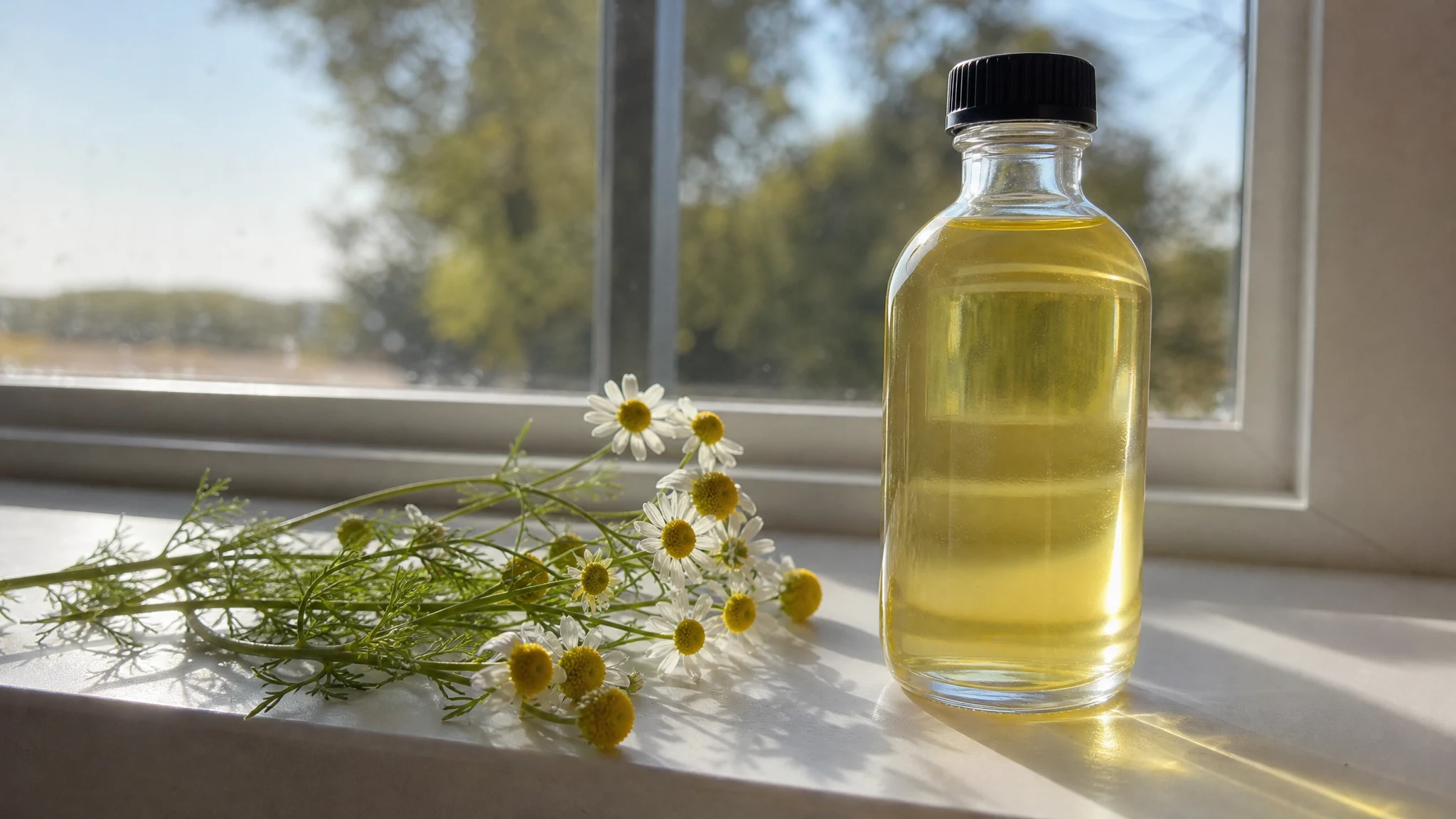
Five Questions to Ask Before You Buy Chamomile Oil
You can't judge a chamomile oil by its colour, its photo or the word "pure". You can judge it by five questions, and a seller who answers with documents deserves more of your trust than one who answers with adjectives. Here is the order we would ask them in, ours included.
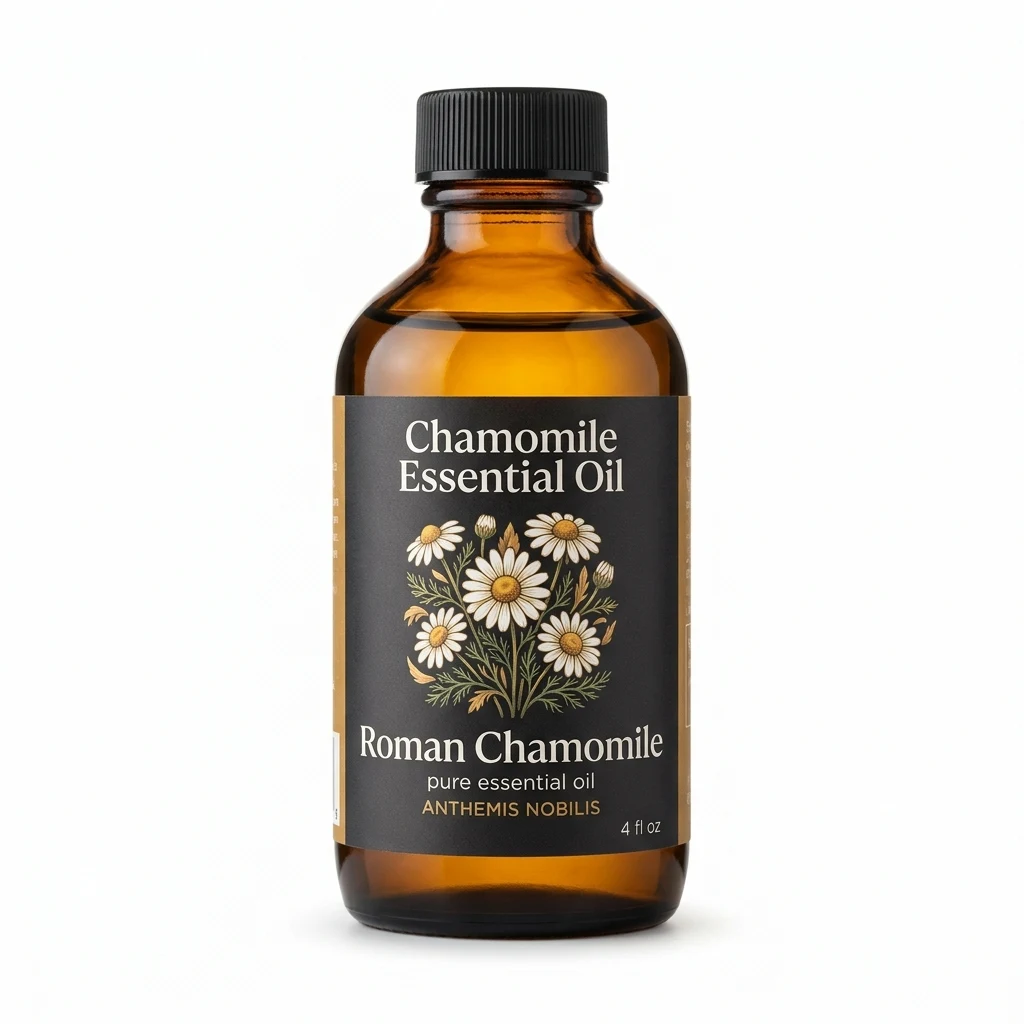
Roman Chamomile Essential Oil
Our own Roman Chamomile Essential Oil, in sizes from 0.5 oz to bulk.
From $32.99
Shop Now →Which chamomile do you actually want?
Settle this first, because German and Roman are different oils. A 2010 review describes German chamomile oil as built around alpha-bisabolol and azulenes such as chamazulene, while Roman contains less chamazulene and is mainly esters of angelic and tiglic acid. A 2026 review concludes the two should not be used interchangeably. So a recipe written around Roman's apple-like aroma will not come out the same with blue German oil, and the other way round. Roman vs German Chamomile Oil: Which One Should You Buy? walks through the choice.
Does the label name the plant and the part?
A bottle that says only "chamomile essential oil" has not told you which plant it holds. Look for a Latin name and a plant part, and expect synonyms: British Standards titles write Roman as Chamaemelum nobile, synonym Anthemis nobilis and German as Matricaria chamomilla, synonym Chamomilla recutita. Two labels with different Latin names can describe one plant, so a synonym is no red flag. A missing name is.
We list our Roman oil as Anthemis nobilis, from the flowers, steam-distilled. Our German oil is distilled from flower heads, and the Certificate of Analysis we publish names Matricaria chamomilla. If the exact botanical identity of a lot matters to your product, ask us in writing before ordering.
What documents exist, and what do they cover?
Be specific here, because this is where most checklists go vague. We publish one Certificate of Analysis, dated 27 August 2026, for one German batch. It records a blue liquid, a floral, balsamic, sweet smell, a relative density of 0.913 and a refractive index of 1.498, both at 20 C, and concludes that the tested parameters comply with the pharmacopoeia criterion it names. It does not include a GC-MS profile, chamazulene or bisabolol percentages, a laboratory name or an origin, and there is no certificate for the Roman oil. Density and refractive index are useful physical checks, but they are no substitute for a chromatogram. If you need a GC-MS report for the lot you will receive, ask through the contact page, and read how to read a chamomile GC-MS report so it makes sense when it arrives. The same questions work on any seller: which standard, which lot, which document.
What can colour and smell tell you?
Less than the internet suggests. Chamazulene is blue and German oil contains it, so a blue oil is consistent with German chamomile and a paler one with Roman. That tells you about the species and about that lot's chamazulene content. It cannot tell you whether an oil was diluted. The same 2010 review calls chamazulene and bisabolol unstable, which is a good reason to prefer a dated, documented lot over a bottle that has sat for years.
Smell works the same way. We describe Roman as sweet, apple-like and herbaceous, and German as sweet and herbaceous with a hay-like softness, so you can choose, not so you can authenticate. A fragrance oil can be built to smell like chamomile, which is the subject of our fragrance oil comparison.
Which claims should make you pause?
- Drinking it. We do not recommend taking essential oil by mouth; see our article on swallowing chamomile oil.
- Medical promises. Any listing that promises a medical result from an essential oil is making a claim the evidence does not back. What has been studied shows what trials really tested.
- A vague "pure". The word is not a measurement. Ask what was measured, on which batch.
- A big size with no species named. If the plant is not stated, the size hardly matters.
- "Organic" with no certifier. Certification is a document, not a word; our organic article covers what to ask for.
A note on safety before the bottle arrives
Whatever you buy, chamomile is a daisy-family plant, and people sensitive to ragweed or chrysanthemums are more prone to contact allergy. We recommend diluting to 0.5% to 2% in a carrier oil, patch testing first and not using it internally; for the face or for a child, a dermatologist or pediatrician is the right person to ask. How to Dilute Chamomile Essential Oil has the details.
Work through these five and you will buy better chamomile from anyone. And if you want to put them to us, send them in writing; we are happy to answer.
Roman Chamomile Essential Oil
Roman Chamomile Essential Oil from our own shop, in sizes from 0.5 oz to bulk.
From $32.99
Shop Now →Sources & Further Reading
- Srivastava JK, Shankar E, Gupta S, 2010. Chamomile: A herbal medicine of the past with bright future. Mol Med Rep 3(6):895-901. PMC2995283
- Such S et al., 2026. German and Roman chamomile: species-specific profiles. Nutrients 18(13):2181. doi.org/10.3390/nu18132181
- BSI. Essential oil of Roman chamomile, standard record (2025). doi.org/10.3403/30485768
- BSI. Essential oil of matricaria, standard record (2020). doi.org/10.3403/30398610