Buying Chamomile Oil Online: Write Your Brief First
Before you open ten shop tabs, write three lines on a scrap of paper. What are you making? How much will you use in a year? What would make you send the bottle back? Those three lines settle which chamomile, which size and which paperwork, and every listing you look at afterwards is simply checked against them.
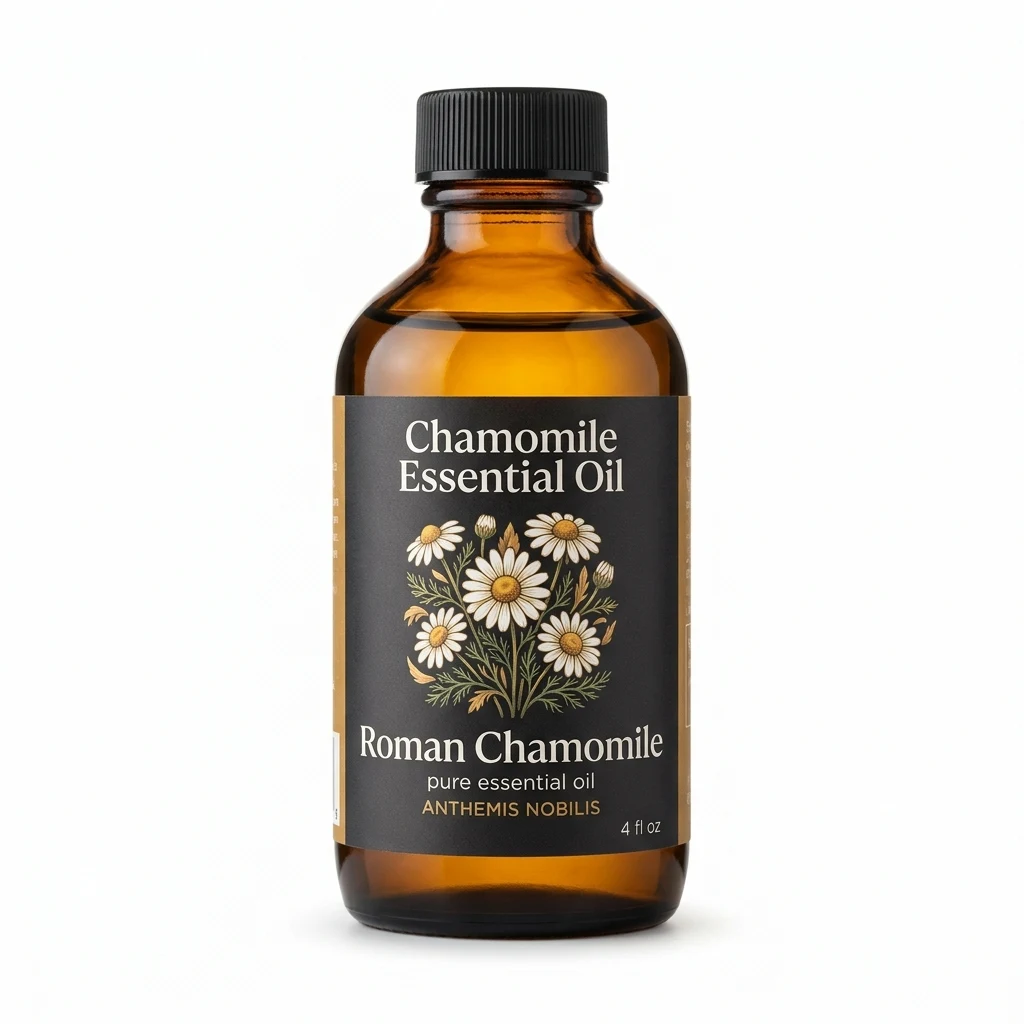
Roman Chamomile Essential Oil
Our own Roman Chamomile Essential Oil, in sizes from 0.5 oz to bulk.
From $32.99
Shop Now →Why the first line changes the purchase
There are two chamomile oils and they are different products. A 2010 review describes German chamomile oil as built around alpha-bisabolol and azulenes such as chamazulene, and Roman as containing less chamazulene and being mainly esters of angelic and tiglic acid. We sell both, so we are happy whichever you pick, and Roman vs German Chamomile Oil: Which One Should You Buy? walks through the choice. The point here is simpler: a listing that says only "chamomile" has not answered your first line.
Four buyers, four different orders
One project, first time
We suggest 0.5 or 1 oz to start, and the arithmetic in the sizes post backs that up. We say chamomile oil typically keeps two to three years tightly capped, cool and dark, so an oil you never finish is not a bargain, whatever the per-ounce figure looks like. Look for amber glass with a printed lot number and dates; our German oil bottles have them, and any seller should say the same of theirs.
Making something to sell or give
Documents matter more than a nice page. Candle, soap and spray makers should read the candle guide for loads and flash-point logic, then ask the seller for paperwork matching the lot being shipped. If you sell a cosmetic, the label has to declare each ingredient in descending order (21 CFR 701.3), and "fragrance" is allowed as a stand-in only where the ingredient fits that term as consumers commonly understand it, so a named essential oil is usually better listed by name. A cosmetic chemist or regulatory consultant is the person to confirm what your product may claim. For larger quantities we offer 5, 25 and 400 lb through our wholesale page.
Buying for someone else
We do not sell gift sets; we sell two bottles of neat oil, nothing boxed or blended. Check the recipient before the packaging. NCCIH notes that people allergic to ragweed, chrysanthemums, marigolds or daisies are more likely to react to chamomile, and that it may irritate the eyes. That page is about chamomile generally, not essential oil, so applying it to a concentrated oil is a cautious inference. The ASPCA lists Roman chamomile as toxic to dogs, cats and horses, so a household with pets is a reason to ask a veterinarian first. Our safety article covers who should skip the oil.
Wanting something else entirely
Several things that show up under "chamomile" are not what we sell: hydrosol, tea, dried flowers, infused oil, CO2 extract, Moroccan chamomile, blue tansy, blends, carrier oils and diffusers. Oil vs hydrosol and oil vs infused oil vs CO2 explain the differences. If your question is medical, such as sleep, anxiety, digestion or a skin condition, an essential oil is not the thing to buy; see a physician, pharmacist or dermatologist.
Questions worth sending in writing
Ask in writing so the answer exists later. For us, use the contact page.
- Which botanical name and plant part is this lot? A synonym is fine. A refusal is the red flag. For our German oil, our certificate names Matricaria chamomilla; if identity matters to your product, ask us about your lot.
- Which document covers my lot, and what does it measure? Ours covers one German batch and reports appearance, smell, density and refractive index, not GC-MS. There is none for the Roman oil. If you need a chemical profile, ask for it for your lot, and how to read a chamomile GC-MS report explains what comes back.
- Is the oil undiluted, with nothing added? Ours is neat, with no carrier or additives. Ask any seller to say the same.
- What dates are on the bottle, and what storage do you assume? A certificate's best-by date describes a batch, so ask which applies to the bottle you will get.
- What benefit claims are you making? This tests the seller more than the oil. We make no health claims for ours, and we would be wary of any listing that does for a cosmetic oil.
If the answer to question two is "all our oils are tested", ask what was tested and on which batch. For the longer paperwork walk-through, see How to Buy Pure Chamomile Essential Oil.
Signs to buy elsewhere
- The seller cannot say which chamomile it is, or says one thing on the listing and another on the document.
- A document exists but does not name your lot.
- The listing says "organic" or a made-up grade without a certificate you can read. We do not sell either oil as organic.
- The seller will not answer in writing.
- You need a blend, a ready-made roll-on, a hydrosol or a set.
A word on dilution
We recommend 0.5% to 2% in a carrier oil with a patch test first. Limits for the face, children or leave-on products can be lower, so check the safety article and talk to a professional rather than treating our line as a clearance for every person.
Write your three lines, send your questions, and the right bottle usually becomes obvious. If your lines don't match what we sell, the best place to buy is wherever they do.
Roman Chamomile Essential Oil
Roman Chamomile Essential Oil from our own shop, in sizes from 0.5 oz to bulk.
From $32.99
Shop Now →Sources & Further Reading
- Srivastava JK, Shankar E, Gupta S, 2010. Chamomile: A herbal medicine of the past with bright future. PMC2995283
- NCCIH. Chamomile. nccih.nih.gov
- ASPCA. Roman Chamomile, toxic and non-toxic plants. aspca.org
- US eCFR, 21 CFR 701.3, Designation of ingredients. ecfr.gov