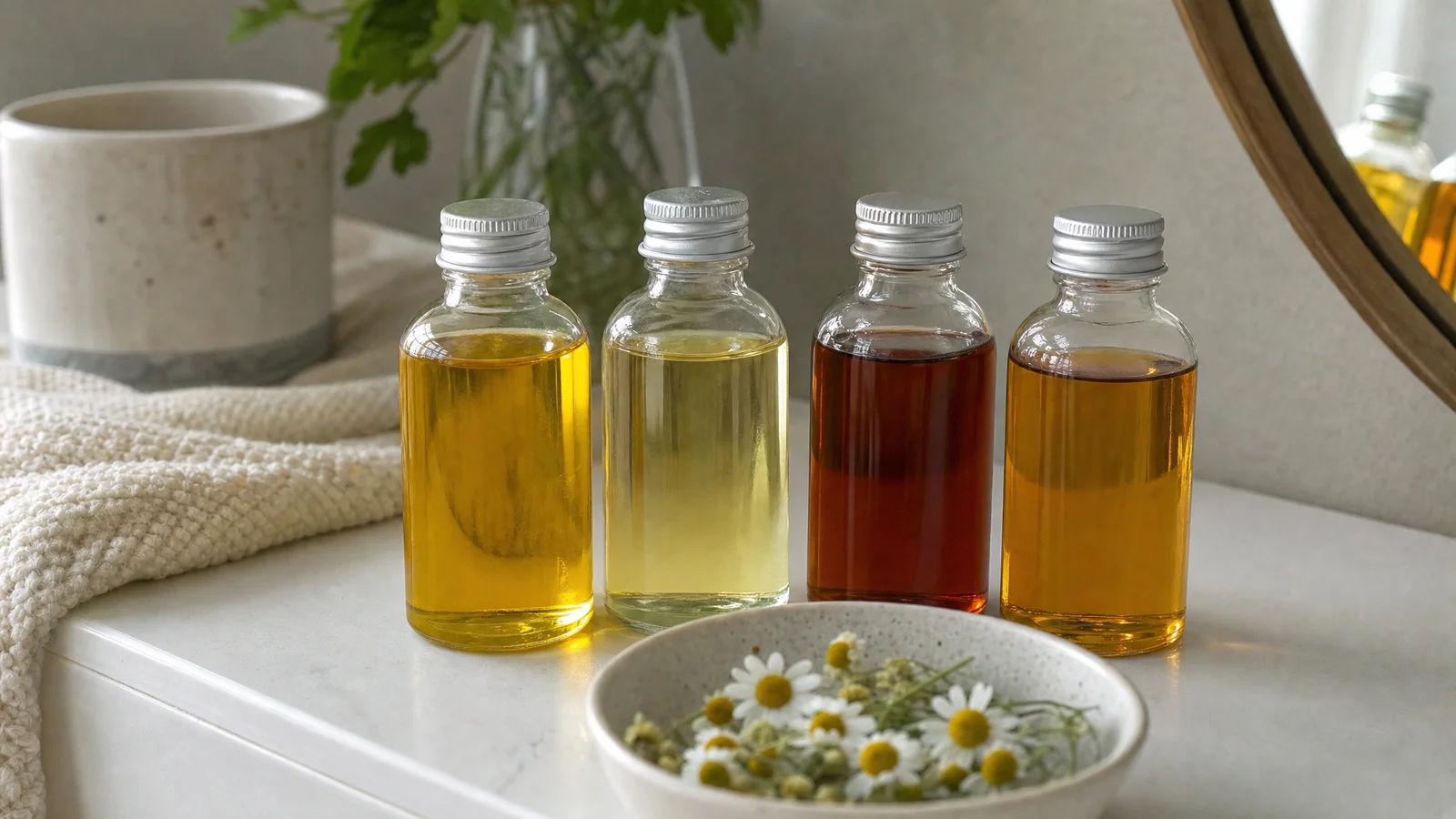
How to Choose a Carrier Oil for Chamomile
Add a few drops of chamomile oil to a bottle of body oil and something worth noticing happens: the carrier is now 98% or more of what you put on your skin. The aroma gets the attention, but the base does most of the work, so it is worth choosing on purpose.
Roman Chamomile Essential Oil
Our own Roman Chamomile Essential Oil, in sizes from 0.5 oz to bulk.
From $32.99
Shop Now →Start with what the blend is for
A leave-on body oil, a scalp oil, a massage blend and a balm each ask something different of a carrier. A massage oil needs slip and gets used by the palmful, which makes the dilution by body area matter; Chamomile Massage Oil: Choosing the Dilution by Body Area covers that. A balm is a different base entirely, and DIY Chamomile Balm: Ratios, Drop Math and Shelf Life walks through it. Here we are talking about a simple liquid oil for skin or hair.
We sell chamomile oil only, not carriers, so you will buy the base from a craft, cosmetic-ingredient or grocery supplier. That also means we have no bottle to push; what follows is how we would choose.
What the human studies actually say
The evidence on carrier oils is smaller than the number of "best carrier" lists would suggest, and it does not rank everything on the shelf. Three pieces do the heavy lifting.
The most useful is a pair of forearm studies on 19 adults in which olive oil reduced the skin's barrier integrity and caused mild redness, while sunflower seed oil left the barrier intact and improved hydration. The authors advised against olive oil for dry skin and for infant massage. A broader review of olive, sunflower, coconut, jojoba, oat and argan oils points the same way: oils with more linoleic acid relative to oleic acid tend to suit barrier repair, and cold pressing is the preferred way to make them.
For hair, a study from an oil company's research group found that coconut oil reduced protein loss in hair, where sunflower and mineral oil did not.
Our reading of all this: for a skin oil that stays on, sunflower seed oil has the clearest human result behind it, and olive oil is the one to skip if your skin runs dry. For hair, coconut has the documented result. Beyond that, nobody has compared carriers specifically for use with chamomile, so any claim that one base "pairs" better with chamomile is marketing rather than data. Choose the carrier for your skin and the job, then add chamomile last.
Four things to look for on the bottle
- Cold-pressed, stated on the label. If the process is not stated, that is a fair question for the seller.
- A fatty acid profile. Linoleic above oleic is the pattern the review favours. Suppliers who care publish it.
- A date. Oils with a lot of unsaturated fat go rancid. Buy what you will use within a month or two and keep it closed, cool and dark, the way we recommend storing the chamomile oil itself.
- Nothing you did not choose. A "scented" oil is already a different product; Chamomile Fragrance Oil vs Essential Oil: What Is the Difference? explains why that matters.
If you have a nut or seed allergy, talk to an allergist before putting an oil made from that source on your skin.
Don't let the chamomile do the carrier's job
It is tempting to add extra chamomile to make a thin base feel richer. It will not; the essential oil adds aroma and a small allergy risk, not body. Chamomile is a daisy-family plant, and a 2002 review of Compositae sensitisation lists both German and Roman chamomile among the suspected culprits. We recommend 0.5% to 2% in a carrier with a patch test first, and for the face, leaning toward the low end. That is roughly 3 to 12 drops per ounce of carrier, and How to Dilute Chamomile Essential Oil has the full drop math.
A worked choice
Say you want a leave-on body oil for dry skin, scented with a little Roman chamomile. On the evidence above you would shortlist a cold-pressed sunflower oil, skip olive as the base, buy the smallest bottle that shows a date, and make 30 ml. Patch test the finished blend on your forearm for 24 hours before using it widely. For a hair oil the steps are the same but the base moves to coconut. In both cases the chamomile is the last decision, not the first. And if a skin condition is behind the question, a dermatologist is the right person to ask.
A good carrier is quiet: it does its job and lets the aroma sit on top. Start there and the rest of the blend gets easy.
Roman Chamomile Essential Oil
Roman Chamomile Essential Oil from our own shop, in sizes from 0.5 oz to bulk.
From $32.99
Shop Now →Sources & Further Reading
- Danby SG et al., 2013. Effect of olive and sunflower seed oil on the adult skin barrier. Pediatr Dermatol. pubmed/22995032
- Vaughn AR et al., 2018. Natural oils for skin-barrier repair. Am J Clin Dermatol. pubmed/28707186
- Rele AS, Mohile RB, 2003. Effect of mineral oil, sunflower oil, and coconut oil on prevention of hair damage. J Cosmet Sci. pubmed/12715094
- Paulsen E, 2002. Contact sensitization from Compositae-containing herbal remedies and cosmetics. pubmed/12492516