Reading a Chamomile GC-MS Report Without a Chemistry Degree
A GC-MS report looks like a wall of chemical names, but it answers a short list of questions. What was in this vial? In what proportions? Does the mix look like the oil on the label? Once you know the reading order, a chamomile report takes five minutes.
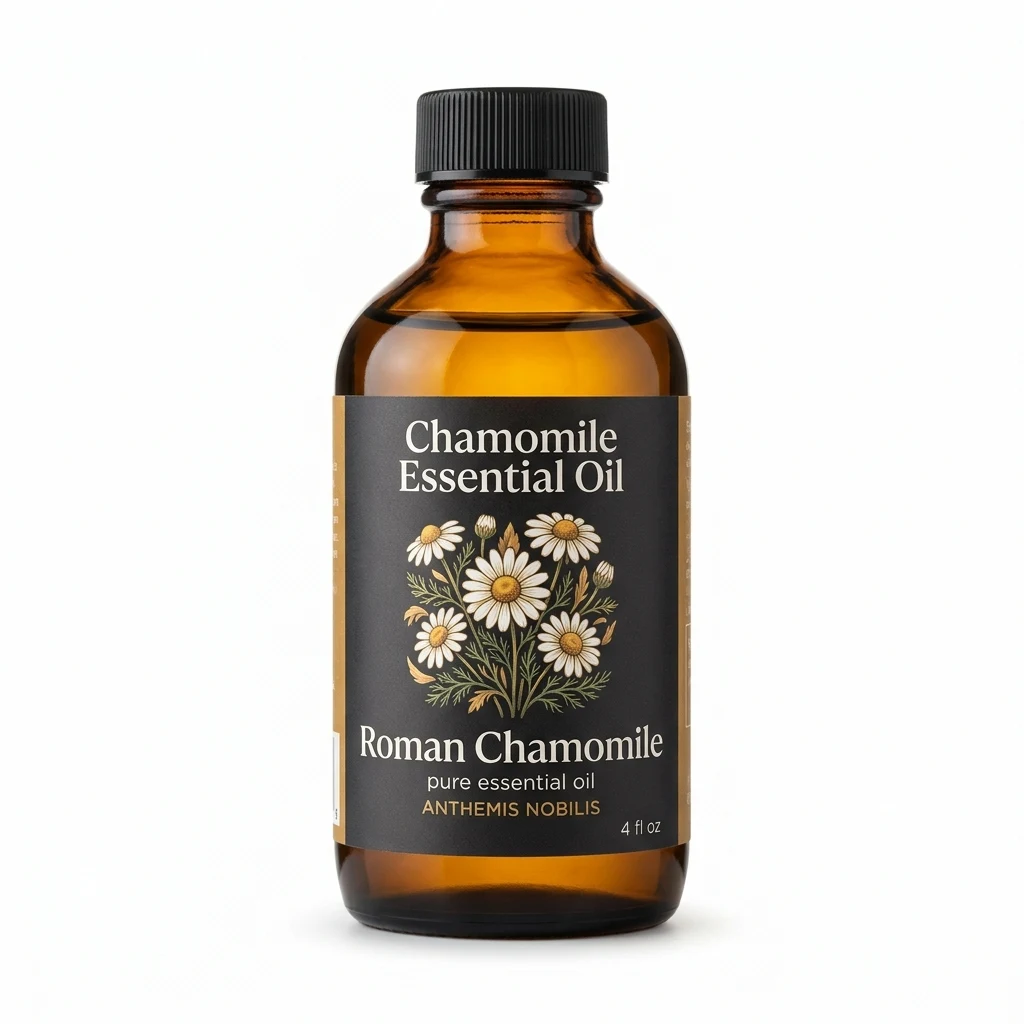
Roman Chamomile Essential Oil
Our own Roman Chamomile Essential Oil, in sizes from 0.5 oz to bulk.
From $32.99
Shop Now →Start with the header, not the numbers
A report worth reading names the sample, the lot or batch, a date, the laboratory and the method. The lot is the most important of these. If the lot on the report is not the lot printed on your bottle, the numbers describe a different oil. A "typical analysis" sheet with no lot describes a kind of oil, not yours. Our German oil bottles carry a lot number and two printed dates, which is the identifier you match against a report.
What the percentages mean
The usual column is "area percent": each compound's share of the total signal the instrument saw, scaled so the list adds up to about 100. It is not grams, and it is not a share of the bottle. That has a practical consequence. Reasoning from how the method works, a vegetable carrier oil mixed into an essential oil would not show up as peaks, and the chamomile peaks would simply be rescaled to 100 as if the bottle were all chamomile. So a clean report is good evidence about the volatile part of the oil and says nothing about whether something non-volatile was added. That is why we say a report is one piece of evidence, not a verdict.
What German chamomile should look like
German chamomile oil is built around alpha-bisabolol, bisabolol oxides A and B, and chamazulene, the compound that makes it blue. The ranges across real samples are wide. A review of the plant's chemistry collects reported chamazulene at about 2 to 11 percent, alpha-bisabolol at about 5 to 11 percent, bisabolol oxide A at roughly 26 to 29 percent and oxide B at roughly 12 to 31 percent across samples. It also notes that chamazulene forms during distillation from a precursor in the flower, and that its level depends on origin and age. In plain English, two genuine German chamomile oils can lead with different compounds. A different top peak is not automatically an error; it may just be a different chemotype. Our bisabolol article and the blue chamomile explainer go deeper on those molecules.
What Roman chamomile should look like
Roman is a different animal. Its signature is esters, mostly of angelic and tiglic acid. In a 2026 analysis of two commercial Roman oils, an angelate ester called 2-methylpropyl angelate made up roughly 12 to 14 percent, with alpha-pinene at around 6 to 9 percent. The authors identified 190 compounds, which tells you something useful about reading a one-page certificate: it will list the biggest peaks and bundle the rest, so ask what the stated total covers.
Do the name and the chemistry agree?
This is where a report earns its keep.
- An oil sold as German with ester peaks dominating, or one sold as Roman with bisabolol oxides dominating, is a mismatch worth asking about.
- A blue oil labelled German should show a chamazulene line. If it does not, ask why.
- A high identified total is reassuring, while a report that accounts for only a fraction of the oil has unexplained peaks.
- The best reports say which standard they were compared against. Standards exist for both oils: matricaria (German) chamomile and Roman chamomile each have a British Standards record. We have not reproduced limits from them, so ask the lab or the seller which one applies.
What a report cannot show
Composition tells you nothing about whether the oil suits your skin, your baby or your pet. For allergy, see an allergist; for infants or pregnancy, a pediatrician or an OB-GYN or midwife; for animals, a veterinarian. Chamomile is a daisy-family plant, so allergy history matters whatever the report says. And a standard report works best as evidence of plausibility. If an application depends on proof of authenticity, ask a qualified lab which extra tests suit the question.
Using it on our oils
The Certificate of Analysis we publish for our German oil covers one batch and lists appearance, smell, relative density and refractive index. It does not include a GC-MS profile, so it is a good document for the header step and a starting point for questions rather than a chromatogram. If you need a chemical profile for a lot of either of our oils, ask us in writing through the contact page before you order. For the wider buying checklist, our quality-checks guide covers the paperwork a seller should be able to show.
Once you know where to look, a report stops being intimidating: check the lot, check the name against the chemistry, and treat the numbers as a portrait of one sample.
Roman Chamomile Essential Oil
Roman Chamomile Essential Oil from our own shop, in sizes from 0.5 oz to bulk.
From $32.99
Shop Now →Sources & Further Reading
- Singh O et al., 2011. Chamomile (Matricaria chamomilla L.): an overview. Pharmacogn Rev. PMC3210003
- Radulovic NS, Mladenovic MZ, 2026. Roman chamomile essential oil, new esters. Molecules. PMC12843988
- BSI. Essential oil of matricaria, standard record. doi.org/10.3403/30398610
- BSI. Essential oil of Roman chamomile, standard record. doi.org/10.3403/30485768