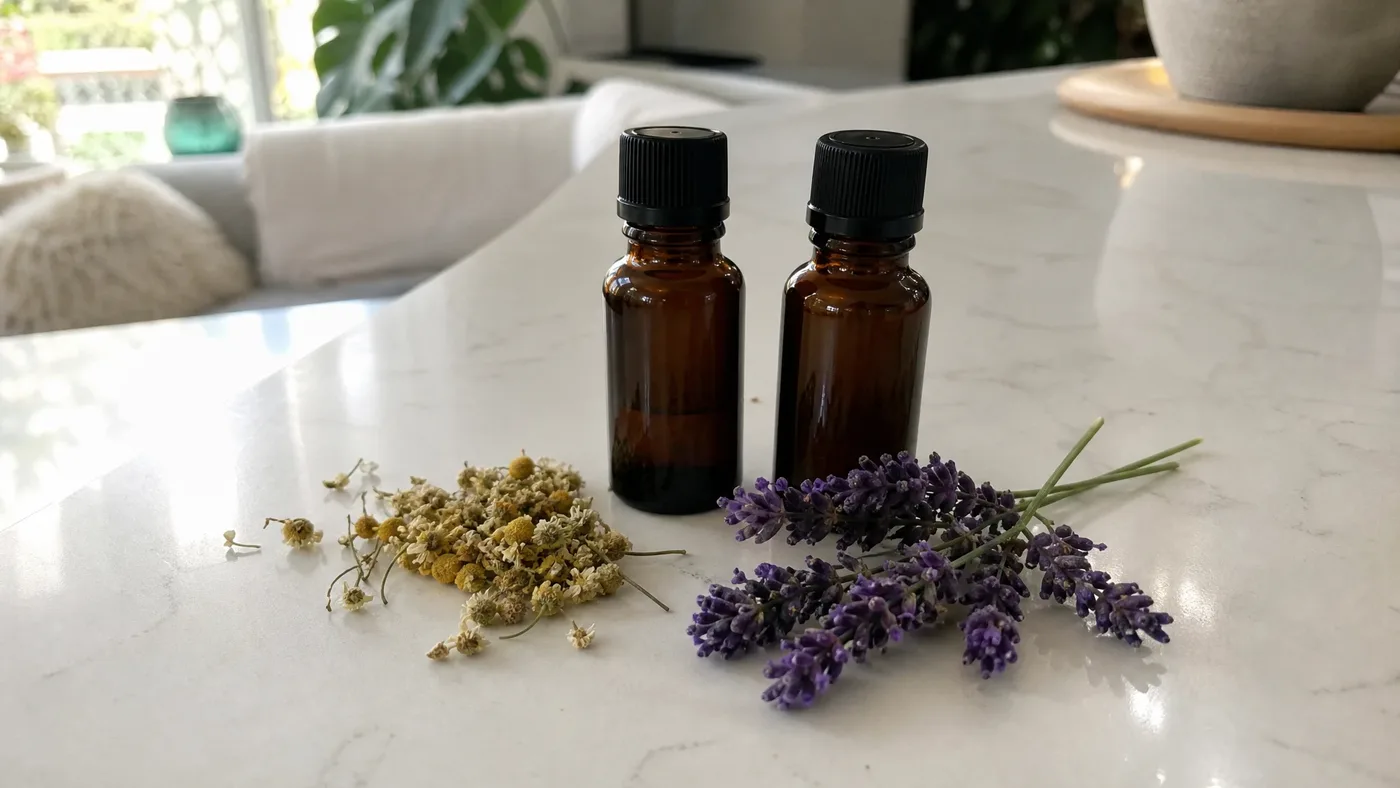
Pairing Chamomile: Which Oils Sit Well Beside It
Most blending charts treat chamomile as one oil, and that is where they go wrong. Our Roman and German chamomiles are built from different chemistry, smell different, and appreciate different company. Pick the chamomile first, then the partner, and the blend usually falls into place.
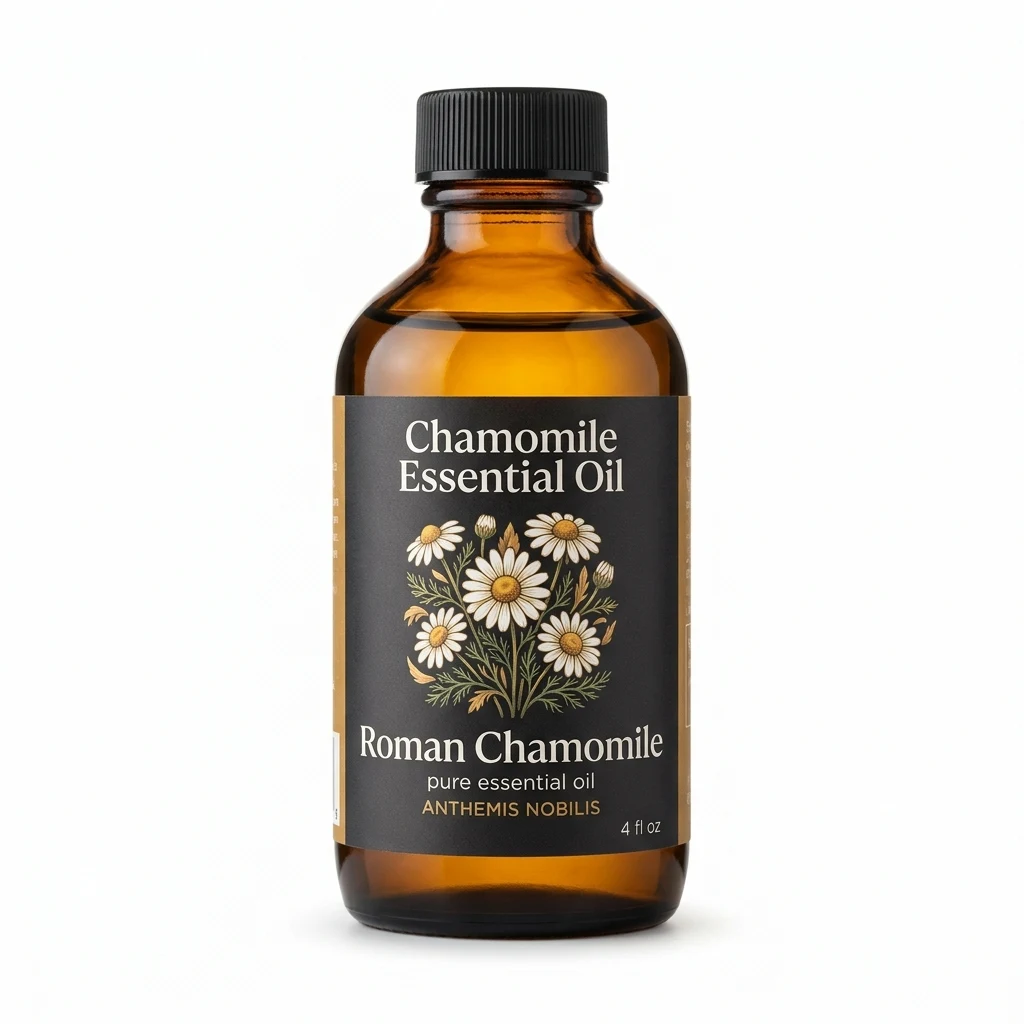
Roman Chamomile Essential Oil
Our own Roman Chamomile Essential Oil, in sizes from 0.5 oz to bulk.
From $32.99
Shop Now →Two chamomiles, two characters
A 2010 review by Srivastava, Shankar and Gupta sums up the chemistry. German-type oil is mostly alpha-bisabolol, its oxides and chamazulene, the compound that makes it blue. Roman oil has less chamazulene and is mainly esters of angelic and tiglic acid. A 2022 comparison of the two plants found that German oil carries bisabolol plus two oxides, while Roman carries only one oxide and no detectable bisabolol.
That fits how we describe them. Our Roman oil is sweet, apple-like and herbaceous, a light fruity ester note. Our German oil is sweet and herbaceous with a hay-like softness and an inky blue tint. We class Roman as a middle note, so it works beside a blend's opening and base notes instead of leading either. Reasoning from that, Roman pairs best with partners that stay light beside a fruity note, and German with partners that have enough body to stand next to it. These are our judgments from the chemistry and the scent descriptions, so treat them as starting points.
The partners we would reach for
Our shop lists lavender, bergamot, clary sage, geranium and sweet orange as partners for both chamomiles, plus ylang ylang for the German. We sell none of those, so they come from any supplier you trust.
- Lavender. A herbal-floral that shares chamomile's herbaceous edge, so it works with either oil without overpowering it.
- Geranium. A rosy middle note that sits alongside Roman's apple-like esters without covering them.
- Sweet orange. Brightens Roman's light ester note. Distilled orange and expressed orange differ for skin use, which is covered below.
- Clary sage. An herbal body note that lines up well with German's hay-like depth.
- Ylang ylang. A heavy sweet floral with the body to stand beside German. It is easy to overdo, so start with one drop.
- Bergamot. A small amount lifts either chamomile, with one condition worth knowing.
For finished formulations, we have worked three out already: lavender with chamomile, diffuser blends and a linen spray. This page is the logic behind choosing.
Citrus and sunlight
A review of citrus oils by Dosoky and Setzer explains the one skin issue in this list. Distilled citrus oils are not phototoxic, while expressed (cold-pressed) oils carry a low to moderate phototoxicity risk because of furanocoumarins. Expressed bergamot caused severe phototoxic effects in animal tests and in humans under natural sunlight, and the review notes no such hazard for furanocoumarin-free bergamot. So for anything left on skin that will see daylight, look for a bottle labelled furanocoumarin-free, or use distilled citrus, or leave it out. In a room diffuser, skin is not involved and the question goes away.
Pregnancy and sensitivities
NCCIH says little is known about chamomile in pregnancy, and the same caution applies to clary sage and anything else in a blend. If you are pregnant, ask your doctor or midwife first. The daisy-family allergy caution applies to every chamomile blend too, and it is worth adding that every extra oil is one more thing to react to. If a four-oil blend causes a rash, nobody can tell which oil did it. So we suggest keeping skin blends to two or three oils and following our patch test routine on the finished blend. Our safety post covers who should skip chamomile, and chamomile versus other oils compares them one at a time.
Drop arithmetic that keeps a blend in range
The Tisserand Institute dilution page gives 0.5% to 1.2% for the face and sensitive areas and 1% to 3% for body oils. Our own guidance is 0.5% to 2%. The percentage covers all the oils together, not each oil separately.
At about 20 drops per ml, a 30 ml bottle at 1% holds 6 drops in total. A 2:1 chamomile-to-partner split is 4 drops of chamomile and 2 of partner, and a 1:1 split is 3 and 3. If you took each oil to 1% separately, you would land at 2% or more. Heavy florals take over by smell quickly, so make chamomile the larger share and add the partner one drop at a time.
If you are blending for scent alone, such as a diffuser or a sachet, the skin dilution never comes into it. Choose the chamomile that suits the mood you want, add one partner, and let your nose tell you when it is right.
Roman Chamomile Essential Oil
Roman Chamomile Essential Oil from our own shop, in sizes from 0.5 oz to bulk.
From $32.99
Shop Now →Sources & Further Reading
- Srivastava J.K., Shankar E., Gupta S., 2010. Chamomile: a herbal medicine of the past with bright future. Mol Med Rep 3(6):895-901. pmc/PMC2995283
- Dai Y.L. et al., 2022. Molecules. Comparison of Matricaria chamomilla and Chamaemelum nobile. pmc/PMC9822300
- Dosoky N.S., Setzer W.N., 2018. Biological activities and safety of Citrus spp. essential oils. pmc/PMC6073409
- NCCIH. Chamomile. nccih.nih.gov/health/chamomile
- Tisserand Institute. Essential oil dilution guidance. tisserandinstitute.org/safety/dilution