Chamomile Oil Side Effects: Allergy Comes First
Ask what could go wrong with chamomile oil and the answer is less dramatic than the internet suggests. The best-documented side effect is allergy, especially in people sensitive to the daisy family. Most of the drug-interaction warnings you will see come from studies of tea, capsules or lotion, which is useful to know when you are deciding what applies to a few diluted drops on skin.
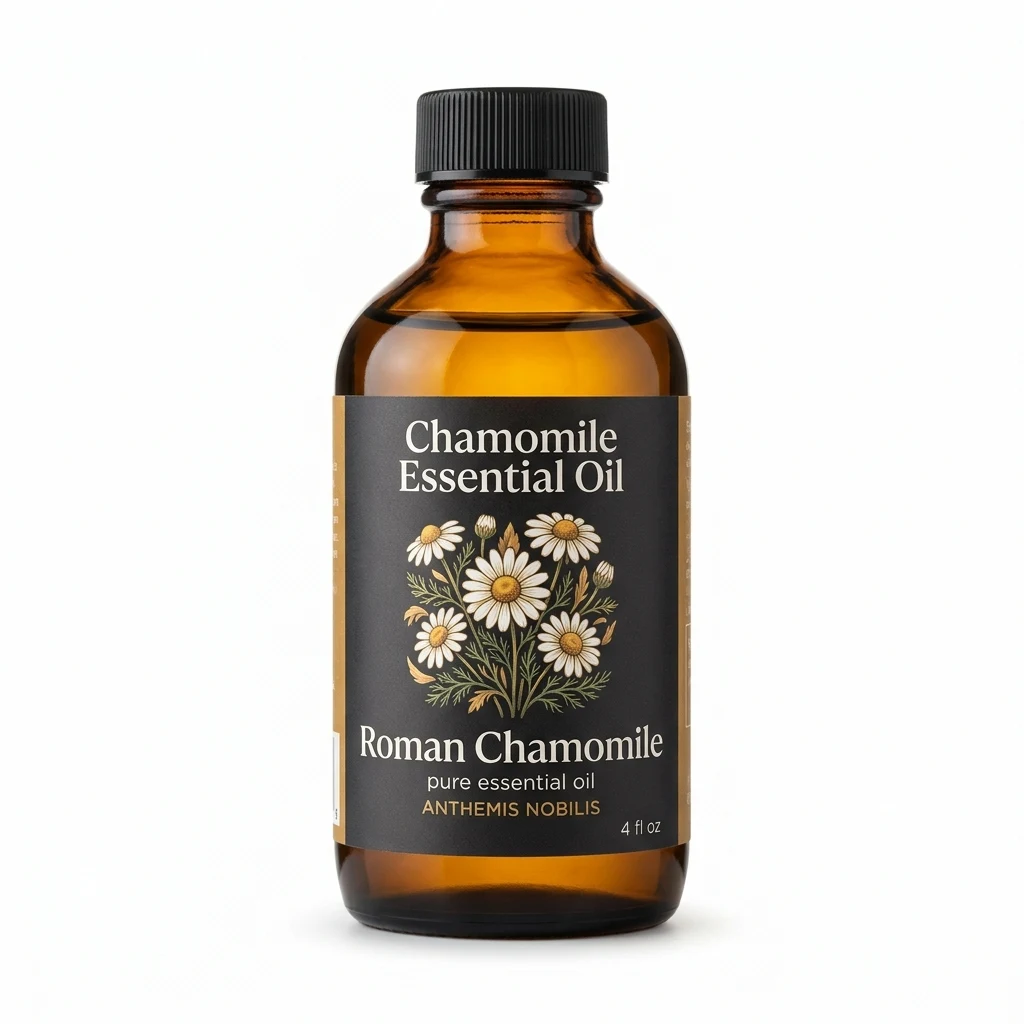
Roman Chamomile Essential Oil
Our own Roman Chamomile Essential Oil, in sizes from 0.5 oz to bulk.
From $32.99
Shop Now →The daisy family and skin allergy
Chamomile belongs to the Asteraceae (Compositae) family, along with ragweed, chrysanthemums, marigolds and daisies. A review of plant contact allergy in Europe lists at least 15 species in the family suspected of sensitizing the skin, German and Roman chamomile among them, with sesquiterpene lactones the main culprits. It also notes that epidemiology exists for only two of those plants, arnica and German chamomile, and that sensitization to German chamomile in particular is rare (Paulsen, Contact Dermatitis, 2002). NCCIH adds the practical corollary: people allergic to ragweed, chrysanthemums, marigolds or daisies are more likely to react to chamomile, and it lists eye irritation as a reported effect (NCCIH).
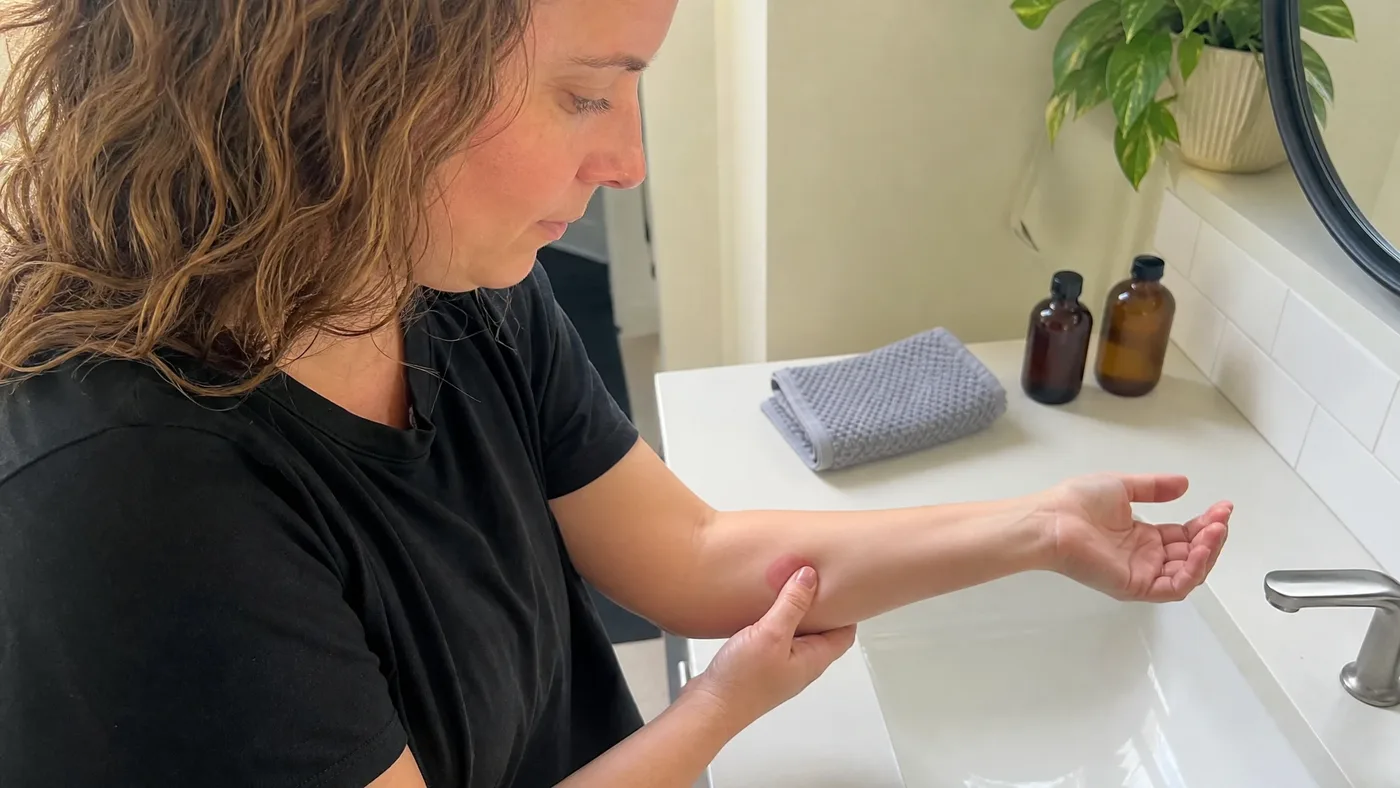
So the person who needs to be most careful is not just anyone with sensitive skin, but anyone with a history of reacting to those relatives. Delayed skin reactions can show up a day or two after contact, which is why a quick dab is not a real patch test. Our patch test guide walks through doing it properly. If your skin reacts, stop using it.
Where the interaction warnings come from
NCCIH reports that interactions between chamomile and some drugs processed by the liver, and with warfarin, have been described, and calls a sedative interaction theoretical. These warnings have an origin worth understanding.
- The warfarin worry traces largely to a single case report, as the authors of the trial below point out. A later randomized crossover trial in 12 healthy volunteers found that a week of chamomile tea (nine bags a day) or extract capsules did not change a standard clotting test compared with placebo. Those volunteers were not taking warfarin, though, and the study was about tea and extract, not oil (Schwartz et al., 2023).
- The liver-enzyme worry comes from laboratory work in which German chamomile essential oil inhibited four human cytochrome P450 enzymes in a test tube, most strongly one called CYP1A2. The authors concluded that interactions with drugs cleared mainly by those enzymes are possible (Ganzera et al., Life Sciences, 2006). Isolated enzymes are not people, and the test says nothing about how much reaches the bloodstream from skin.
Putting those together, we read it this way. We know of no human study of diluted chamomile oil on skin and medicines, so nobody can say it interacts and nobody can say it does not. The sources involve tea, capsules and lotion in much larger, repeated amounts than a diluted oil would bring. The more regular medicines you take, and the narrower the margin on any one of them, the more sensible it is to ask first.
Using it sensibly
Our oils are Roman and German chamomile, sold undiluted. Our guidance for skin is 0.5% to 2% in a carrier oil, with a patch test beforehand (how to dilute). Keep it away from eyes, children and pets, and do not take it by mouth; our swallowing guide explains why. For the wider picture see the safety overview, and for pregnancy and breastfeeding, where NCCIH says too little is known, see our pregnancy article.
If you take warfarin, blood thinners, birth control, sedatives or a transplant medicine, a pharmacist is the right person to ask. It helps to bring the species (Roman or German), the fact that it is an essential oil and not tea, how much you would dilute it, where on the body, and your full medicine list. That is a two-minute conversation that settles the question better than any article can.
For most people with no daisy-family history, chamomile is an easy oil to enjoy, and a careful patch test is the one habit that makes it easier still.
Roman Chamomile Essential Oil
Roman Chamomile Essential Oil from our own shop, in sizes from 0.5 oz to bulk.
From $32.99
Shop Now →Sources & Further Reading
- Paulsen E, 2002. Contact dermatitis from Compositae plants used in herbal medicine and cosmetics. Contact Dermatitis. pubmed.ncbi.nlm.nih.gov/12492516
- NCCIH. Chamomile. nccih.nih.gov/health/chamomile
- Schwartz JA et al., 2023. Chamomile tea or extract and prothrombin time in healthy volunteers. pubmed.ncbi.nlm.nih.gov/37730613
- Ganzera M, Schneider P, Stuppner H, 2006. Inhibitory effects of chamomile essential oil on human cytochrome P450 enzymes. Life Sci. pubmed.ncbi.nlm.nih.gov/16137701