Chamomile Oil and Acne: Where the Evidence Stands
The pitch is easy to follow: chamomile is described as antibacterial and soothing, breakouts involve bacteria and irritation, so chamomile oil must be worth a try. It is a tidy chain of reasoning, and every link in it comes from the lab bench or the tea cup rather than from a trial of the essential oil on skin. Here is what is actually known, and where it stops.
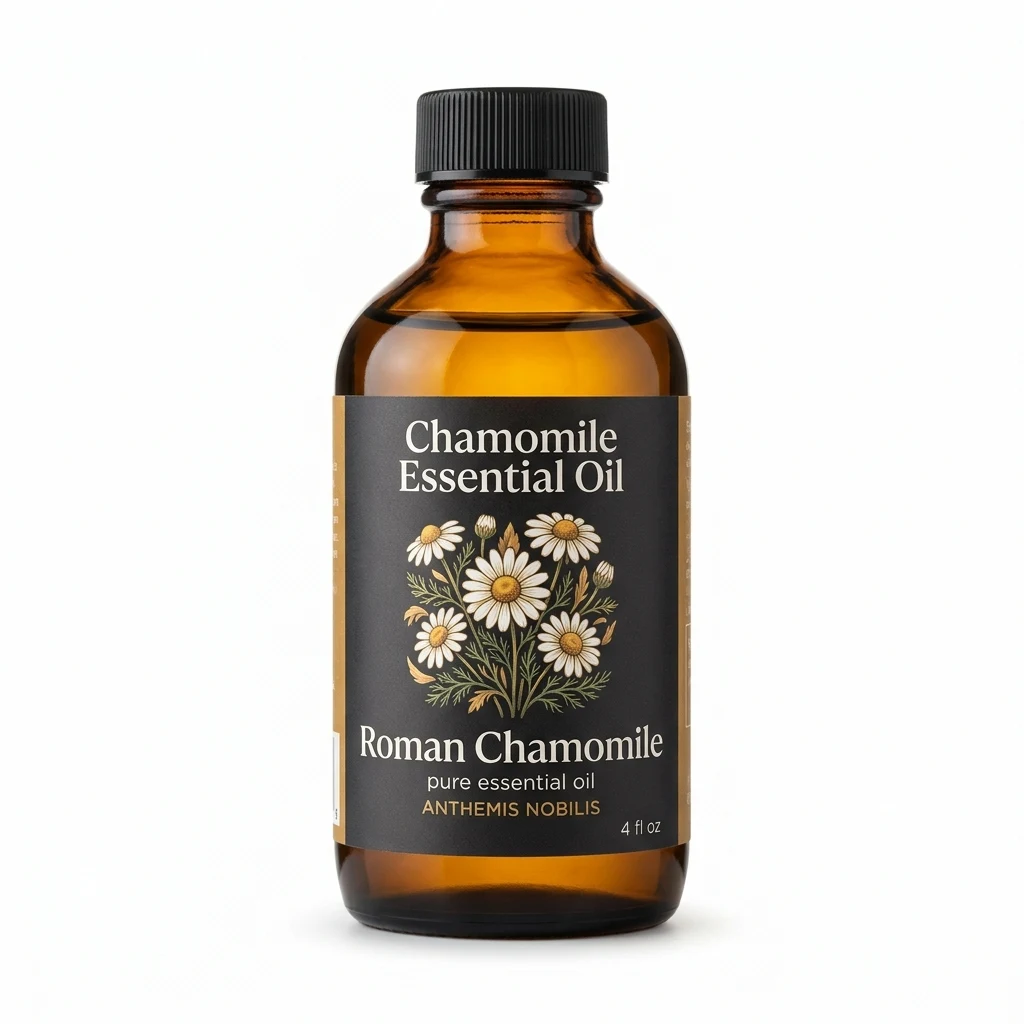
Roman Chamomile Essential Oil
Our own Roman Chamomile Essential Oil, in sizes from 0.5 oz to bulk.
From $32.99
Shop Now →What the acne guidelines recommend
If you want to know what works for acne, the benchmark is the 2024 American Academy of Dermatology guideline, built with a formal evidence-grading method. It strongly recommends benzoyl peroxide, topical retinoids, topical antibiotics and oral doxycycline, and recommends isotretinoin for severe, scarring or distressing acne. The summary we read lists no essential oil, which is not a ruling on oils, only a sign of where the strongest evidence sits. If acne is persistent, painful or leaving marks, a dermatologist is the right first call, and our chamomile oil is an external cosmetic oil with an aroma, not part of any treatment.
What the chamomile evidence consists of
We looked for a trial of chamomile essential oil on acne and did not find one. What exists is a different kind of material. A review of chamomile tea by McKay and Blumberg reports moderate antimicrobial activity in the lab and anti-inflammatory effects in animals, and it also notes that human studies are limited. That is a useful description of chamomile as a plant, and a long way from a result on a face.
It helps to compare with the oil that has been studied most. A 2024 scoping review of 29 studies by Dontje and colleagues found tea tree oil the most studied essential oil for acne, with gel formulations showing efficacy and fewer adverse reactions than conventional treatments. The same review found many studies small, short or uncontrolled, and the quality checks on the oils inconsistent. If tea tree, the front-runner, gets a qualified reading, chamomile has some distance to go. Our post on chamomile versus tea tree on skin compares the two for irritation and allergy.
What a chamomile blend is made of
Take our dilution guidance of 0.5% to 2% in a carrier. In an ounce of carrier, the top of that range is roughly 12 drops, about 0.6 ml, which means 98% of what goes on the skin is the carrier. That makes the carrier a bigger variable than the chamomile, and our carrier oil post looks at the choices. Carrier oils come from a grocery or craft supplier.
Allergy is the other practical point. NCCIH says reactions to chamomile are more likely in people allergic to ragweed, chrysanthemums, marigolds or daisies, and the McKay review notes reactions in people sensitive to daisy-family plants, including from topical use. There is also a plain practical problem: a rash on skin that is already inflamed looks a lot like a flare, so it is hard to tell what caused it. That is reasoning, not a study finding. A patch test checks one small area and cannot predict how skin that is inflamed or being dried by other products will respond.
What a fair test would look like
For chamomile oil to be shown to do anything for acne, it would take a randomized trial comparing the oil in a carrier against the carrier alone, counting lesions over several weeks, with the oil concentration stated. We have not seen one. Until that exists, a before-and-after photo on a retailer's page is the weakest tier of evidence, a point we make in our benefits evidence map.
For anyone considering it anyway, the practical cautions are plain. Skip it with a ragweed or daisy-family allergy, open or infected skin, or a diagnosed skin condition under a doctor's care, keep it away from children and pets, and do not let it delay a dermatology visit. Our safety post and our overview of chamomile on skin cover the rest.
What we can say with confidence is that chamomile is a lovely-smelling oil with a rich botanical story. Whether it earns a place in an acne routine is a question for a dermatologist and for better studies than exist today.
Roman Chamomile Essential Oil
Roman Chamomile Essential Oil from our own shop, in sizes from 0.5 oz to bulk.
From $32.99
Shop Now →Sources & Further Reading
- Reynolds R.V. et al., 2024. Guidelines of care for the management of acne vulgaris. J Am Acad Dermatol. pubmed/38300170
- McKay D.L., Blumberg J.B., 2006. A review of the bioactivity and potential health benefits of chamomile tea. Phytother Res. pubmed/16628544
- Dontje A.R. et al., 2024. Essential oils for inflammatory skin conditions: scoping review. Pharmaceuticals. pubmed/38794141
- NCCIH. Chamomile. nccih.nih.gov/health/chamomile