How to Patch Test Chamomile Oil, Step by Step
A patch test is the small ritual that stands between a new bottle and your skin, and it is easy to do badly. Done well, it takes five minutes of setup and two days of glancing at your forearm. It tells you something real about how you react to one particular blend, and it is worth knowing exactly how far that information goes.
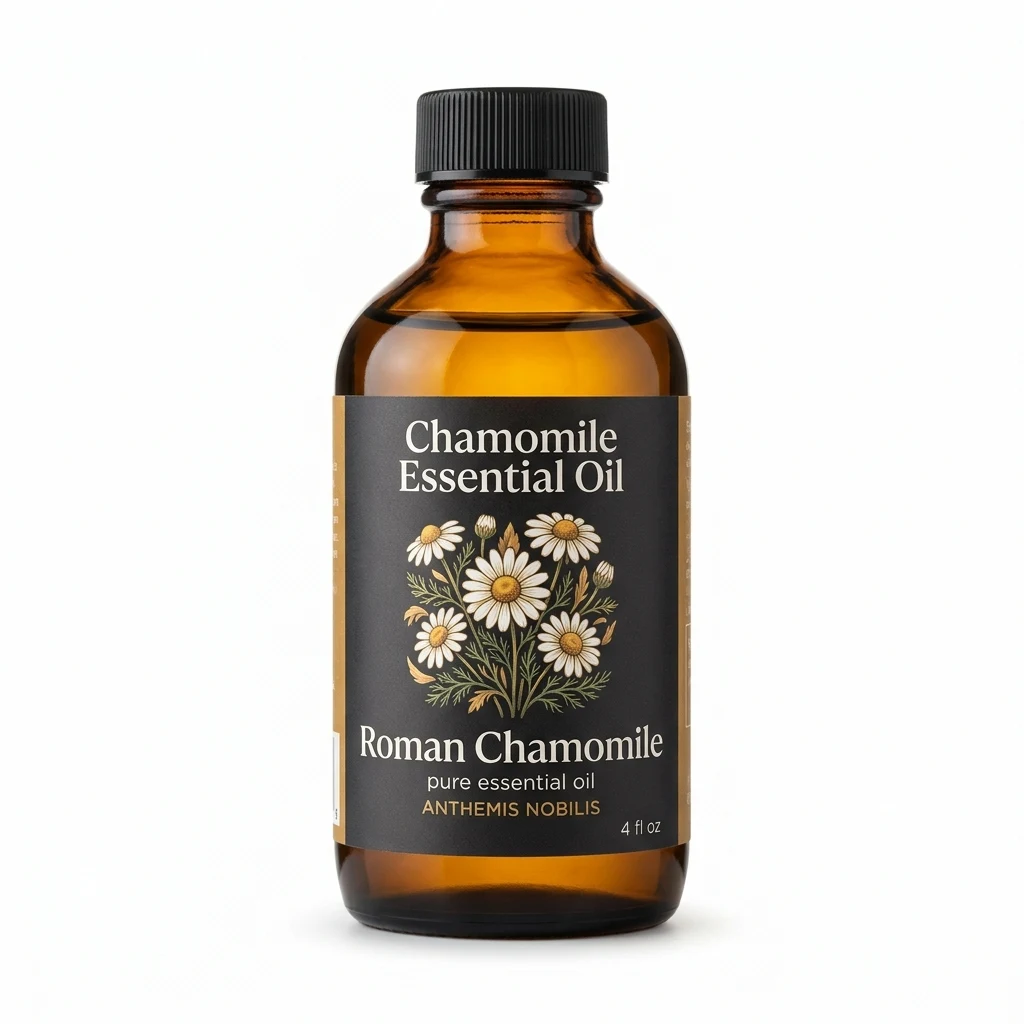
Roman Chamomile Essential Oil
Our own Roman Chamomile Essential Oil, in sizes from 0.5 oz to bulk.
From $32.99
Shop Now →What a patch test can and cannot tell you
Allergic contact dermatitis is an immune reaction, and it sometimes needs repeated exposure before it shows up. A quick dab on the arm is a good screen for an obvious, fast reaction. It is not a clearance for every future use.
Two studies show why. In a 2026 Contact Dermatitis paper by Botvid and colleagues, people who were already sensitised to a fragrance allergen applied a simulated perfume twice a day for 21 days. Reactions appeared at the highest strength in 4 of 12 people and at the lowest in 1 of 12, so both the dose and the number of days mattered. That study used a linalool derivative, not chamomile, and we cite it only for the principle.
The second is a French study of 42 people with essential oil allergy (Barbaud et al., 2023). Every one of them reacted to the oil they had personally been using, and 71% also reacted to a fragrance mix. The practical lesson: if you have ever had a reaction, a dermatologist testing your own bottle will tell you more than any home test, and a history of reacting to perfumes is worth mentioning to them.
Who should skip the home version
- Anyone allergic to a daisy-family plant. Chamomile belongs to the Asteraceae family, and NCCIH names ragweed, chrysanthemums, marigolds and daisies as the plants whose allergic people are more likely to react to chamomile.
- Anyone who has reacted to chamomile in any form. A 1991 case report describes allergic dermatitis from a Roman chamomile ointment, so Roman is not exempt from the daisy-family caution.
- Anyone with skin that is already inflamed or broken. A test there is hard to read. A dermatologist is the right call.
- Anyone testing for a child. Ask a pediatrician first, and see our post on chamomile oil around babies and kids.
The routine we recommend
No validated protocol exists for chamomile essential oil specifically, so this is a sensible routine reasoned from the studies above. If your dermatologist says otherwise, follow your dermatologist.
- Test the finished blend, never the neat oil. Our dilution guidance for both oils is 0.5% to 2% in a carrier, and we say plainly that undiluted oil should never go on skin. The Tisserand Institute lists 0.2% to 1% for reactive skin and 0.5% to 1.2% for the face, so test at the strength you actually plan to use. Our dilution post has the drop arithmetic, and carrier oils come from a grocery or craft supplier.
- Pick a spot you can watch. The inner forearm is thin-skinned, easy to see and easy to wash. Use a coin-sized patch and mark its edge with a pen dot.
- Leave it uncovered and dry. A bandage changes how much gets through and makes the result harder to read.
- Look at 24 and 48 hours, then keep looking. Delayed reactions are the signature of contact allergy. Redness, itch, bumps, swelling or a scaly patch means wash with mild soap and water and stop.
- For extra reassurance, repeat it. The 21-day design in the study above suggests that a week of twice-daily applications to the same patch tells you more than one dab. Nothing proves a week is enough, so treat a clear result as encouraging, not final.
If the patch reacts
You have your answer for that blend, and probably for that oil. A weaker dilution is not a workaround, because dose-dependence means weaker blends react less often, not never. Photograph the patch, note the product and the date, and ask a dermatologist or allergist about formal testing. Bring the bottle with you.
Easy ways to spoil a test
- Testing one dilution and then using a stronger one.
- Testing a carrier that is old or new to you and blaming the chamomile. If the carrier is new, give it its own patch.
- Testing our Roman oil and then using the German, or the reverse. They are different oils with different botanical names, and a result for one does not carry over.
- Assuming a new lot behaves like the last one. Formulators buying in bulk can ask us in writing through our contact page what documentation exists for their lot.
- Working near the eyes. NCCIH notes that chamomile may irritate them.
For the wider picture, our posts on side effects and interactions and on who should skip chamomile oil go further. A clean patch is good news about one blend on one day, and a few quiet days of skin is the best result you can ask for.
Roman Chamomile Essential Oil
Roman Chamomile Essential Oil from our own shop, in sizes from 0.5 oz to bulk.
From $32.99
Shop Now →Sources & Further Reading
- Botvid S. et al., 2026. Repeated exposure to hydroperoxides of linalool induces immunologically verified allergic contact dermatitis. Contact Dermatitis 94(6):652-661. pubmed/41713461
- Barbaud A. et al., 2023. Allergic contact dermatitis from essential oils in consumer products. Contact Dermatitis 89(3):190-197. pubmed/37403438
- McGeorge B.C., Steele M.C., 1991. Allergic contact dermatitis of the nipple from Roman chamomile ointment. Contact Dermatitis 24(2):139-40. pubmed/2040155
- NCCIH. Chamomile. nccih.nih.gov/health/chamomile
- Tisserand Institute. Essential oil dilution guidance. tisserandinstitute.org/safety/dilution