
How to Dilute Chamomile Oil: Ratios by Where It Goes
The numbers printed next to chamomile oil are ceilings, not targets, and they were not all written for the same part of the body. A face is not a forearm. Our guidance for both of our chamomile oils is 0.5% to 2% in a carrier oil, and this page shows how to choose where in that range to land.
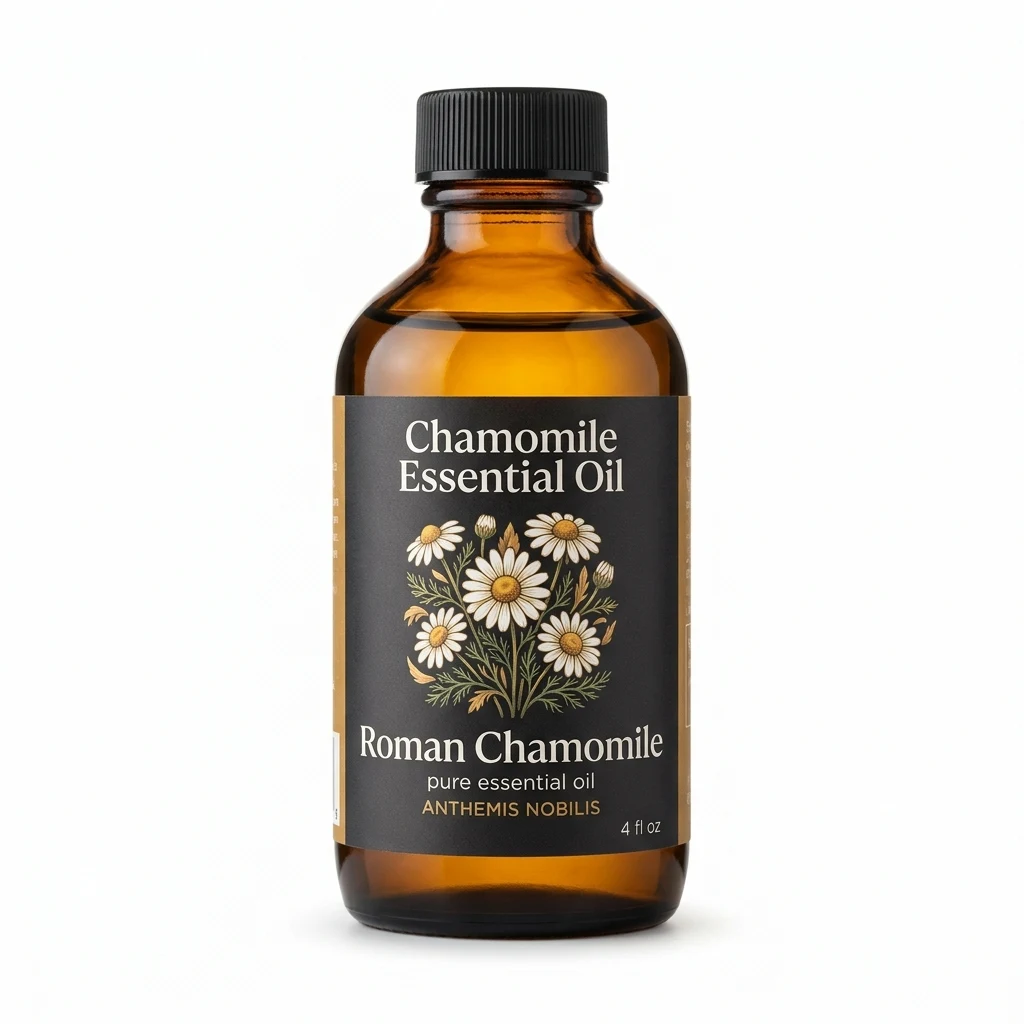
Roman Chamomile Essential Oil
Our own Roman Chamomile Essential Oil, in sizes from 0.5 oz to bulk.
From $32.99
Shop Now →Choose the area first
The Tisserand Institute's dilution guide lists 0.2% to 1% for sensitive or impaired skin, 0.5% to 1.2% for the face and underarms, 1% to 3% for body oils and lotions, and 2% to 4% for bath and wash-off products. These are general ranges for essential oils, not chamomile limits. Set beside our 0.5% to 2%, the top of our range sits above the facial range. For the face we would work in the lower half of ours, at or under 1%, and use 2% for body use only.
Tisserand's Roman chamomile page suggests up to 5 drops per 10 ml for body blends and 2 drops per 10 ml for facial ones. It does not say how big a drop is, so the percentages below are our arithmetic.
The drop math
At about 20 drops per milliliter, and one US ounce as 29.57 ml:
| Strength | Drops per 10 ml | Drops per ounce |
|---|---|---|
| 0.5% | 1 | about 3 |
| 1% | 2 | about 6 |
| 2% | 4 | about 12 |
| 2.5% | 5 | about 15 |
Our German oil page lists 3 to 12 drops per ounce for 0.5% to 2%, which matches the table. It also shows that Tisserand's facial figure is about 1%, and its body figure about 2.5%, a little above our ceiling. Between two numbers, take the lower one. For precision, weigh instead of counting drops. The only density we publish is 0.913 at 20 C for the German batch on our Certificate of Analysis, so it should not be used for the Roman oil or another lot.
Why we start low
Chamomile belongs to the daisy family, whose main contact allergens are sesquiterpene lactones. In a 2002 review of herbal remedies and cosmetics, Paulsen reported at least 15 Compositae species suspected of causing sensitization, including German and Roman chamomile, though only arnica and German chamomile have epidemiological data and German chamomile sensitization is described as rare. A French study of 42 patients with allergic reactions to essential oils found they had reacted to oils used in ordinary leave-on ways. Chamomile was not named in the abstract, but the pattern is why we say start at the lower end.
Mixing it
- Choose the strength from the area, not from the maximum.
- Measure the carrier into a clean dark glass bottle first, then add the oil.
- Cap and roll the bottle in your palms for about a minute. Essential oil mixes into fatty carriers but not into water, so see our bath post before using it in water.
- Label the bottle with the oil, the percentage, the carrier and the date.
- Patch test the finished blend. Our patch test post covers how.
We do not sell carrier oils, so buy a fresh, sealed, dated one from a supplier, because a rancid carrier causes irritation that gets blamed on the chamomile. Our carrier comparison goes through options. The German oil will stain pale fabric, so keep a diluted blue blend off pillowcases and towels.
When to skip dilution and skin use
- You react to ragweed, chrysanthemums, marigolds or daisies, which NCCIH lists as groups more likely to react to chamomile.
- You are pregnant or breastfeeding, or the blend is for a baby or child. See pregnancy and breastfeeding and babies and kids, and ask an OB-GYN, midwife or pediatrician.
- The skin is broken, inflamed or already reacting. See a dermatologist.
- You take warfarin or other blood-thinning medicine, which NCCIH lists among the interactions it reports for chamomile. Ask a pharmacist.
If you are formulating at 5 lb or more, ask us about documentation through the wholesale page before ordering.
Dilution lowers the amount on each patch of skin, but it does not change what the oil is, so start low, test, and move up only for a reason.
Roman Chamomile Essential Oil
Roman Chamomile Essential Oil from our own shop, in sizes from 0.5 oz to bulk.
From $32.99
Shop Now →Sources & Further Reading
- Tisserand Institute. Essential oil dilution guide. tisserandinstitute.org/safety/dilution
- Tisserand. Roman chamomile essential oil. tisserand.com
- Paulsen E, 2002. Contact sensitization from Compositae-containing herbal remedies and cosmetics. pubmed/12492516
- Barbaud A et al., 2023. Allergic contact dermatitis from essential oils. Contact Dermatitis. pubmed/37403438
- NCCIH. Chamomile. nccih.nih.gov