Bisabolol in Chamomile Oil: Which One Has It
Bisabolol is the chamomile compound people name most often, and it is easy to see why: it sounds technical, it appears on product pages, and it has a reputation. A few facts make it much easier to read. It belongs to German-type chamomile oil rather than Roman, it is not what makes the oil blue, and most of the research is on bisabolol on its own rather than on a bottle of essential oil.
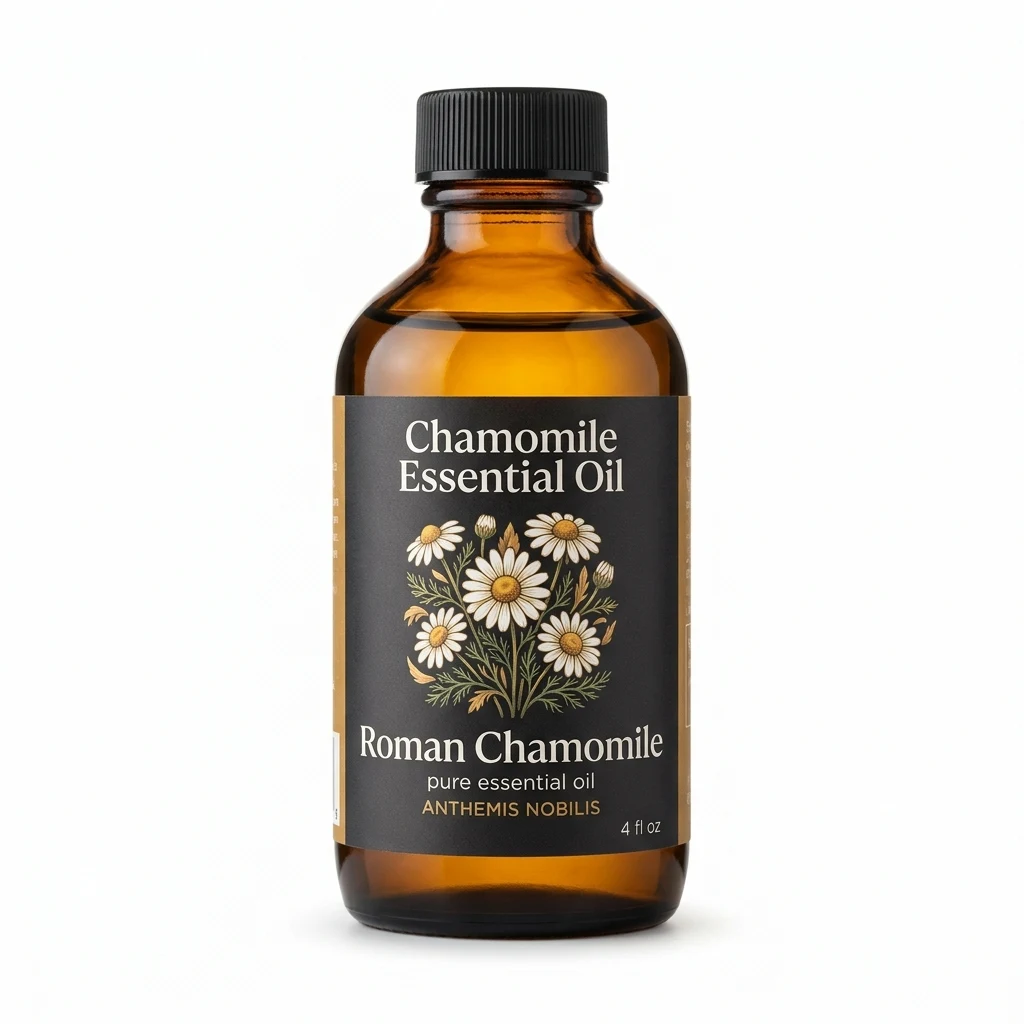
Roman Chamomile Essential Oil
Our own Roman Chamomile Essential Oil, in sizes from 0.5 oz to bulk.
From $32.99
Shop Now →Which chamomile has it
Alpha-bisabolol is a sesquiterpene alcohol. In the 2010 review by Srivastava, Shankar and Gupta, German chamomile oil is described as mainly alpha-bisabolol, its oxides and chamazulene, while Roman chamomile oil has less chamazulene and is mainly esters of angelic and tiglic acid, with farnesene and alpha-pinene. So the line "chamomile oil contains bisabolol" is only half true until you say which chamomile. A 2022 study that compared the two plants (Dai et al., Molecules) agrees: German oil carries bisabolol and two oxides, and Roman carries one oxide with bisabolol not detected.
That is a good reason to know what you are buying. We sell both, with Roman listed as Anthemis nobilis, an older name for what botanists now write as Chamaemelum nobile, and German as the blue one. Hana Tisserand makes a related point in an overview of the chamomiles: labels such as blue chamomile or Moroccan chamomile can describe quite different oils, and only blue chamomile is well researched. Our Roman versus German comparison sets the two side by side.
Bisabolol is not the blue
Bisabolol is colourless. The blue in German oil is chamazulene, which Srivastava and colleagues describe as forming from matricin, a constituent of the flower, and they call both compounds unstable. Our explainer, why chamomile oil is blue, goes into the colour. For buying, the takeaway is that blue says something about chamazulene and nothing direct about bisabolol, so we would not use depth of colour as a verdict on anything. We say typically 2 to 3 years for both oils when tightly capped, cool and dark, which is guidance on keeping rather than a stability study.
What the research actually covers
Most of the bisabolol literature is about the isolated compound. A 2022 review by Eddin and colleagues in Nutrients describes mostly cell-line and animal work, lists a range of reported activities and says further studies are needed before use in humans. No human trials were described. A 2017 review by Lin, Zhong and Santiago included German chamomile oil among 19 plant oils and butters studied for skin effects.
None of that tests a diluted blend on a person, or Roman oil. Moving from a cell experiment on one compound to a few drops of essential oil in a carrier is a big leap, because dose, route and the other constituents all differ. We keep our claims for both oils to their aroma, and the bisabolol story is one to enjoy as chemistry.
A balanced look at skin sensitivity
Bisabolol is added to many cosmetics, and Russell and Jacob (2010) note that contact dermatitis from it has been reported in Europe and suggest patch testing in suspected cases. Paulsen (2002) lists German and Roman chamomile among at least 15 daisy-family species suspected of sensitising, with sesquiterpene lactones as the main allergens, and notes that sensitisation to German chamomile is rare. Srivastava also cites up to 0.6% of those lactones in Roman oil.
Put together, bisabolol is neither a villain nor a guarantee of mildness. Our dilution guidance is 0.5% to 2% in a carrier with a patch test first, and our patch test routine walks through it. Anyone with a daisy-family allergy, or who is pregnant or breastfeeding, should check with a doctor or midwife before using chamomile oil, and our safety post has the detail.
If you need the numbers
The Certificate of Analysis we publish covers one batch of our German oil, dated 2026-08-27. It lists appearance, smell, relative density of 0.913 and refractive index of 1.498 at 20 C, and a conclusion that the batch complies with pharmacopoeia standards for chamomile essential oil. It does not give a bisabolol or chamazulene percentage. If you are formulating and need those, ask us in writing through our contact page what report exists for your lot before ordering. Our guide to reading a GC-MS report shows what to look for once you have one.
Be wary of the word "bisabolol" on a label, too. It can mean a component inside a chamomile oil, an isolated cosmetic ingredient or a line in a lotion's ingredient list, and those are three different things. We sell the first, as a point of chemistry. Understanding it is what makes the difference between our two chamomiles easy to see, and that is plenty of reason to find it interesting.
Roman Chamomile Essential Oil
Roman Chamomile Essential Oil from our own shop, in sizes from 0.5 oz to bulk.
From $32.99
Shop Now →Sources & Further Reading
- Srivastava J.K., Shankar E., Gupta S., 2010. Chamomile: a herbal medicine of the past with bright future. Mol Med Rep 3(6):895-901. pmc/PMC2995283
- Dai Y.L. et al., 2022. Molecules. pmc/PMC9822300
- Eddin L.B. et al., 2022. Health benefits, pharmacological effects, molecular mechanisms, and therapeutic potential of alpha-bisabolol. Nutrients. pubmed/35405982
- Lin T.K., Zhong L., Santiago J.L., 2017. Anti-inflammatory and skin barrier repair effects of topical application of some plant oils. pubmed/29280987
- Russell K., Jacob S.E., 2010. Bisabolol. Dermatitis. pubmed/20137740
- Paulsen E., 2002. Contact sensitization from Compositae-containing herbal remedies and cosmetics. Contact Dermatitis 47(4):189-98. pubmed/12492516
- Tisserand H. All the different chamomiles. tisserandinstitute.org