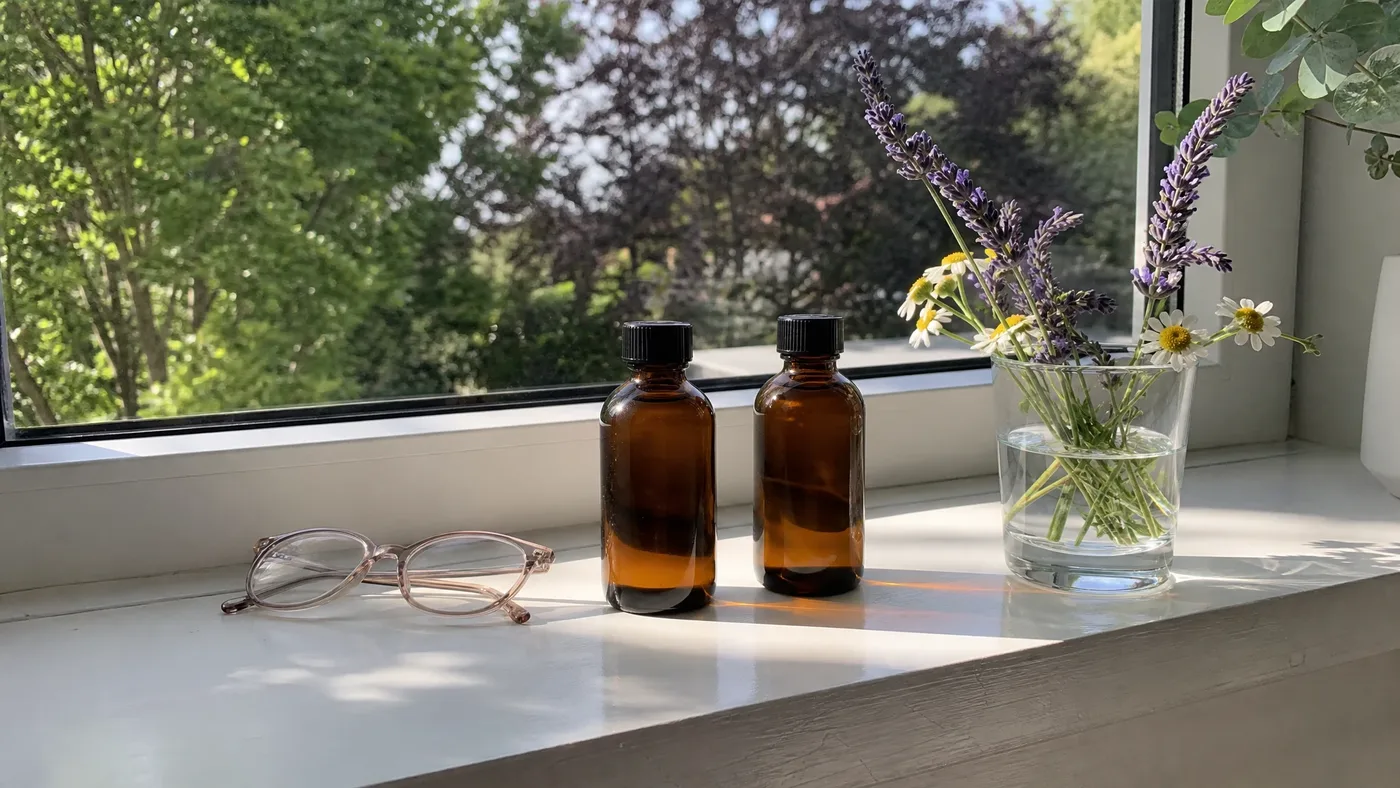
Chamomile Next to Lavender, Bergamot and Clary Sage
Chamomile sits on the shelf beside lavender, bergamot and clary sage, and shoppers often treat the four as interchangeable "soft" oils. They are not, and the differences are interesting. Some of them are about chemistry, which shapes how each oil smells and blends, and some are about skin, which shapes how you use each one.
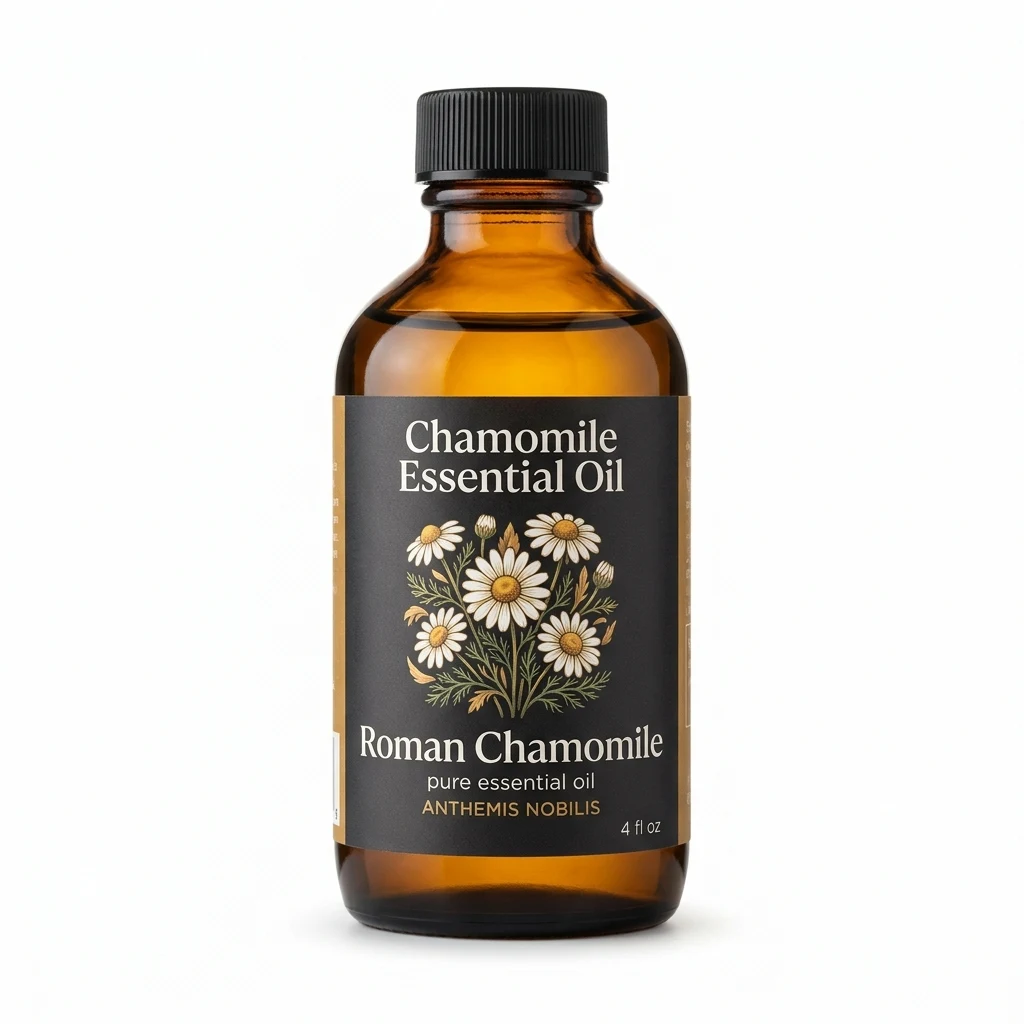
Roman Chamomile Essential Oil
Our own Roman Chamomile Essential Oil, in sizes from 0.5 oz to bulk.
From $32.99
Shop Now →Why chamomile, lavender and clary sage get along
Here is a pattern that explains many blending charts. Roman chamomile oil is built mainly from esters, the fruity-smelling molecules formed from angelic and tiglic acid (Srivastava and colleagues, 2010). ScenTree's perfumery profile of lavender oil lists linalyl acetate at 42% to 52% and linalool at 32% to 40%, so lavender is an ester-rich oil too. And ScenTree describes clary sage (Salvia sclarea) as one of the sages rich in linalyl acetate and other esters.
That is chemical reasoning rather than a sensory trial, but it fits what we list on our own Roman chamomile page, where lavender, bergamot, clary sage, geranium, sweet orange and frankincense all appear as blending partners. Related chemistry tends to sit comfortably together, and each oil adds its own twist: chamomile brings a sweet, apple-like, herbaceous note, lavender the familiar clean floral, and clary sage a more herbal depth. Our blending guide covers the pairings, and lavender and chamomile explores the best-known duo.
Where the skin considerations differ
Chamomile's main skin consideration is its family. It belongs to the Asteraceae (daisy family), alongside ragweed and arnica. In a 2004 study in Medicinski pregled, Jovanovic and colleagues patch tested 30 adults with atopic dermatitis against a Compositae mix and several plant extracts. Nine were sensitised to the mix, and chamomile was the most frequent single positive, in 5 of those 9. That tested plant extract in a small group already prone to skin allergy, so it is a pointer rather than a rate for oil, but it is a good reason for anyone with a ragweed or daisy-family allergy to talk to an allergist or dermatologist before choosing chamomile.
Bergamot raises a different question. It is a citrus oil, and a 2026 review of citrus essential oils in Chemistry and Biodiversity gives particular attention to furocoumarin-induced photosensitivity as a safety issue. If you use bergamot on skin, check the current IFRA guidance for your product type and look for a furocoumarin-free version. A patch test is a sensible step for any new oil.
A quick dilution check
Dilution guidance is organised by use, not by oil. The Tisserand Institute gives 0.2% to 1% for reactive skin, 0.5% to 1.2% for the face, 1% to 3% for body oils and 2% to 4% for bath products. Our own recommendation for both chamomile oils is 0.5% to 2% in a carrier, with a patch test first. Taking an ounce of carrier as roughly 590 drops of liquid (a rough kitchen convention), 0.5% is about 3 drops and 1% about 6, which is a sensible place to start for the face.
How to choose
- You love a sweet, fruity-herbal aroma: chamomile, Roman for the apple note, German for the blue oil with hay-like softness.
- You want a clean floral base for blending: lavender is the classic partner, and the three-oil pairing with clary sage is a natural to try.
- You want a bright citrus lift: bergamot, with the sun-exposure check above.
- You have a ragweed or daisy-family allergy: ask an allergist before using chamomile.
These are aroma and cosmetic choices. We sell chamomile oil for external use, and for sleep, stress, pregnancy, babies or pets the right people are a physician, an OB-GYN or midwife, a pediatrician or a veterinarian. We carry the two chamomile oils only, so lavender, bergamot and clary sage are for you to find at a supplier of your choice.
The best way to settle it is to smell them side by side, one drop each on a paper strip, and see which one you reach for again.
Roman Chamomile Essential Oil
Roman Chamomile Essential Oil from our own shop, in sizes from 0.5 oz to bulk.
From $32.99
Shop Now →Sources & Further Reading
- Srivastava JK, Shankar E, Gupta S, 2010. Chamomile: a herbal medicine of the past with bright future. Mol Med Rep. pmc.ncbi.nlm.nih.gov/PMC2995283
- ScenTree. Lavender oil. scentree.co/en/Lavender_oil.html
- ScenTree. Clary sage oil. scentree.co/en/Clary_sage_oil.html
- Jovanovic M et al., 2004. Contact allergy to Compositae plants in patients with atopic dermatitis. Med Pregl. pubmed.ncbi.nlm.nih.gov/15503788
- Zhang Y et al., 2026. Citrus essential oils: a review of chemical composition, bioactivity, safe use, and potential applications. Chem Biodivers. pubmed.ncbi.nlm.nih.gov/42105350
- Tisserand Institute. Dilution for essential oils. tisserandinstitute.org/dilution-essential-oils