Three Chamomile Oils, and the One You Actually Need
Walk into any craft shop and you will find three things all called chamomile oil: a small bottle of distilled essential oil, a jar of flowers steeped in sunflower or olive oil, and, in specialist catalogues, a thick CO2 extract. They are not three strengths of one product. They are three different materials, and choosing the right one is mostly a matter of knowing what you are making.
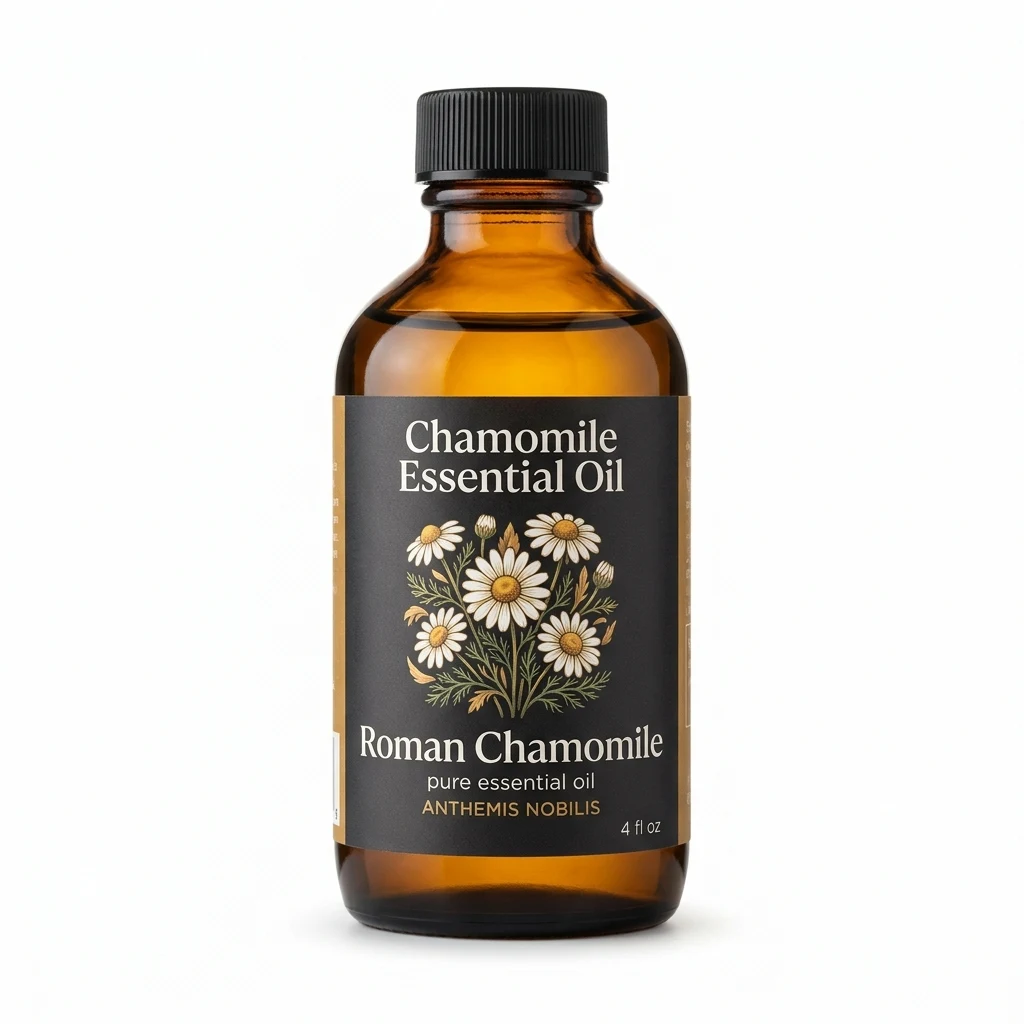
Roman Chamomile Essential Oil
Our own Roman Chamomile Essential Oil, in sizes from 0.5 oz to bulk.
From $32.99
Shop Now →Distilled essential oil: small amounts, big aroma
Essential oil is what comes off the still when steam passes through chamomile flowers and the vapour is cooled and separated from the water. It is a concentrate of the plant's volatile aroma molecules, which is why a few drops go a long way and why we ship ours undiluted. We sell two, a Roman chamomile (Anthemis nobilis) and a German chamomile, both steam-distilled.
The blue colour of German chamomile oil is a good clue to how different these materials are. The blue molecule, chamazulene, is not sitting in the fresh flower waiting to be extracted: a 2011 review in Pharmacognosy Reviews describes it as an artefact formed from a precursor called matricin during hydro or steam distillation. No still, no blue. Roman chamomile oil carries less chamazulene and is built mainly from esters of angelic and tiglic acid, which is part of why it smells softer and fruitier. Our piece on the blue colour goes deeper, and our Roman versus German buying guide helps you pick between the two.
Even within German chamomile, the oil is a range rather than a single recipe. A study of chamomile oils from different European countries reported chamazulene anywhere from 0.7% to 15.3%, and bisabolol oxide A from 3.1% to 56.0%. A bottle labelled chamomile oil tells you the family, and the plant name on the label tells you more.
Essential oil is the right choice when the finished product needs an aroma or a small, measured amount of plant material: a diffuser blend, a linen spray, a perfume, a body oil you dilute yourself. Because it arrives undiluted, we recommend 0.5% to 2% in a carrier for skin use, with a patch test first. Our dilution guide turns that into drops per ounce.
Infused oil: a carrier with a chamomile accent
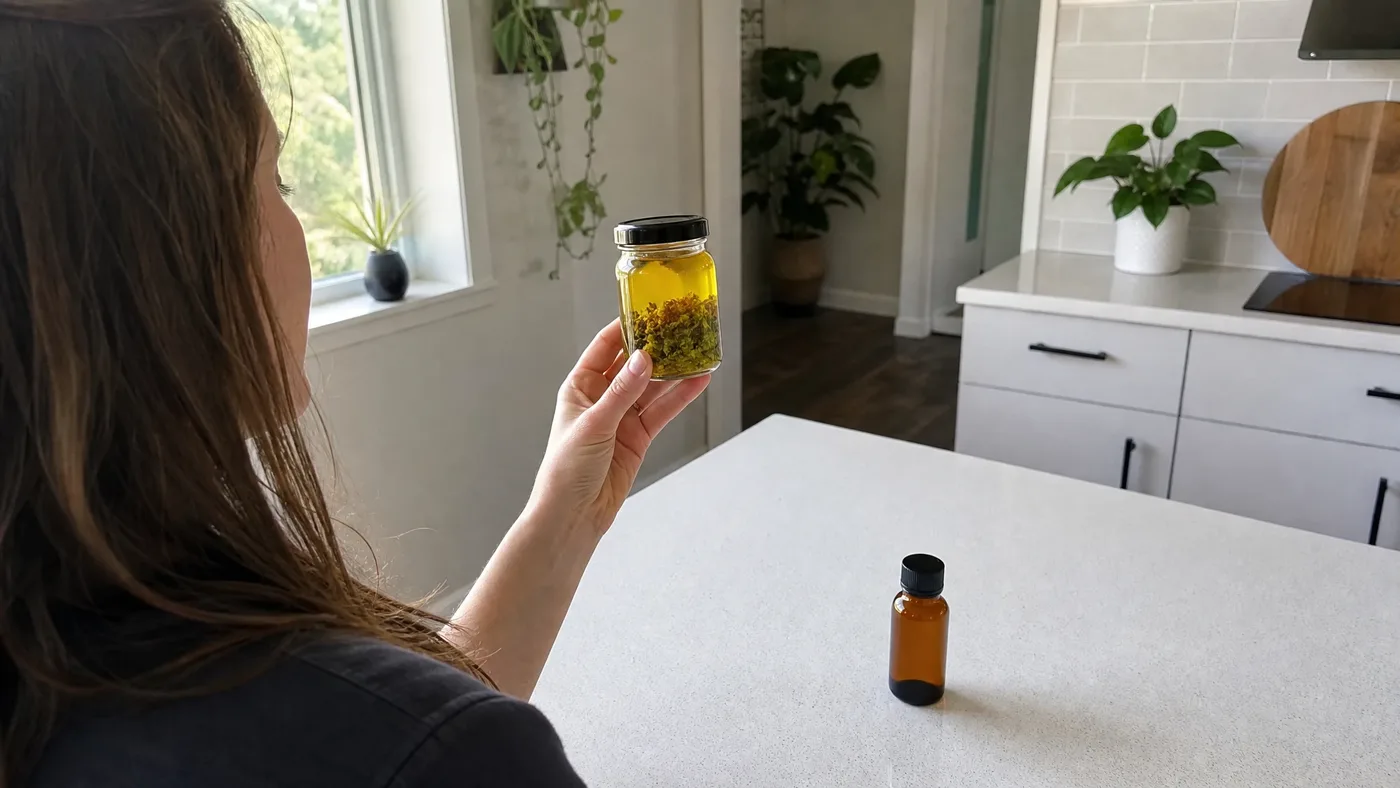
An infused (or macerated) oil is a vegetable oil that has been steeped with flowers and strained. The base is the carrier oil, and the plant contributes a modest amount of fat-soluble material and a gentle colour and scent. Nothing in the process involves a still, so there is no reason to expect a blue infusion; a blue one would be a good prompt to ask the maker what is in the jar.
It is a lovely option if you want a ready-to-use massage or body oil with no concentration decisions at all. It is not a diluted essential oil, and the two should not be swapped one for one. If you would like to make your own, use dried flowers: university extension guidance (University of Maine, Penn State) points to dried herbs as the safer choice for infused oils, because fresh plant material brings water and a botulism concern, and recommends short storage. Our home infusion post walks through it. We do not sell infused oil, so you will find it at a natural-products shop or from a maker who states the base oil and the date.
CO2 extract: the specialist's ingredient
CO2 extraction uses carbon dioxide under pressure as the solvent, sometimes with ethanol alongside. The result is usually a thicker, more complete extract than a distillate, with waxes and other non-volatile material as well as aroma compounds. One 2023 study in Antioxidants examined extracts from German chamomile white ray florets, an industrial by-product, as a source of cosmetic ingredients, and found that pressure and temperature shaped both the yield and the mix of compound groups. In other words, two CO2 extracts can be quite different products depending on how they were run.
That makes it an ingredient for formulators who want to specify those conditions and ask the supplier for a composition report. It is not something we sell, and it is not a drop-in swap for essential oil.
A quick way to choose
- Want aroma, or a blue tint in a finished product? Distilled essential oil, German for the blue.
- Want a ready-made chamomile carrier for massage? An infused oil from a supplier who names the base oil and the date.
- Formulating a cosmetic and want a fuller extract? Ask a CO2 supplier for the extraction conditions and a report.
Chamomile belongs to the daisy family, so anyone with a ragweed or daisy-family allergy should check with an allergist or dermatologist before using any of these on skin, and none of them is for swallowing. For babies, pregnancy or pets, ask a pediatrician, an OB-GYN or midwife, or a veterinarian.
Whichever form you choose, ask the seller what is actually in the bottle. A name on the label is the start of the conversation, and a clear answer is a good sign.
Roman Chamomile Essential Oil
Roman Chamomile Essential Oil from our own shop, in sizes from 0.5 oz to bulk.
From $32.99
Shop Now →Sources & Further Reading
- Singh O, Khanam Z, Misra N, Srivastava MK, 2011. Chamomile (Matricaria chamomilla L.): an overview. Pharmacogn Rev. pmc.ncbi.nlm.nih.gov/PMC3210003
- Srivastava JK, Shankar E, Gupta S, 2010. Chamomile: a herbal medicine of the past with bright future. Mol Med Rep. pmc.ncbi.nlm.nih.gov/PMC2995283
- Orav A, Raal A, Arak E, 2010. Content and composition of the essential oil of Chamomilla recutita from some European countries. Nat Prod Res. pubmed.ncbi.nlm.nih.gov/20013472
- Pastare L, et al., 2023. Supercritical fluid extraction of Matricaria chamomilla white ray florets. Antioxidants. pubmed.ncbi.nlm.nih.gov/37237958
- University of Maine Cooperative Extension, Bulletin 4385. extension.umaine.edu/publications/4385e
- Penn State Extension. How to safely make infused oils. extension.psu.edu/how-to-safely-make-infused-oils