German Chamomile vs Blue Tansy: Same Blue, Different Plant
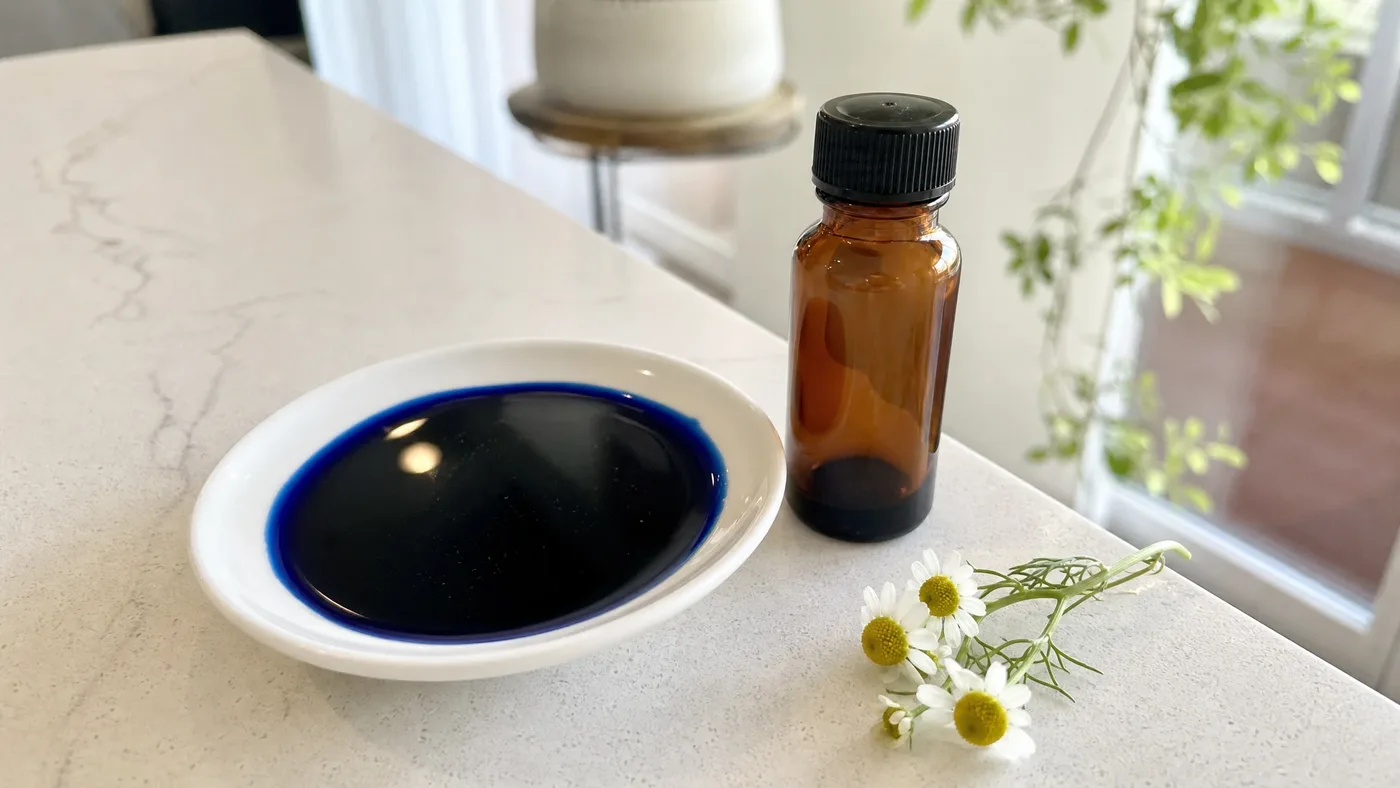
Hold a bottle of blue tansy beside a bottle of German chamomile and your eyes will tell you they are the same oil. They are not. Both get their deep blue from chamazulene, but they come from different plants with quite different chemistry, and a colour alone cannot tell you which one you have.
Roman Chamomile Essential Oil
Our own Roman Chamomile Essential Oil, in sizes from 0.5 oz to bulk.
From $32.99
Shop Now →Start with the Latin name
Blue tansy is Tanacetum annuum. German chamomile is Matricaria chamomilla, also written M. recutita. The Certificate of Analysis we publish for one batch of our German chamomile names Matricaria chamomilla, and that is the habit worth copying: look for a botanical name on the label before you look at the colour. Listings that say only "blue chamomile" do not settle which plant is inside.
The shared blue is a matter of shared chemistry rather than shared ancestry. In chamomile, chamazulene is formed from a precursor called matricin during hydro or steam distillation (Singh and colleagues, 2011), so the blue is made on the still. Our article on the blue colour explains the mechanism.
What the chemistry looks like
Published analyses show how different the rest of the profile is. A 2023 study in Antibiotics (Ettakifi and colleagues) analysed blue tansy oil from aerial parts collected in northern Morocco and identified 39 compounds, led by camphor (16.69%), alpha-pinene (12.37%) and bornyl acetate (11.97%). A 2026 study of German chamomile oil by GC-MS (Yilmaz and colleagues) reported (Z)-beta-farnesene as the largest constituent at 33.90%, followed by alpha-bisabolol oxide B at 11.60%, with chamazulene also among the major compounds.
Each is a single sample, so treat the numbers as an illustration of two different fingerprints, not as a standard for either oil. The shape is the useful part: the tansy sample was monoterpene-led, with camphor in front, while the chamomile sample was led by a sesquiterpene and bisabolol oxides. A swap on colour alone swaps all of that.
How to tell which bottle you have
- Read the label for the Latin name. Tanacetum annuum is blue tansy, Matricaria chamomilla or recutita is German chamomile.
- Ask for the report for the batch. A GC-MS table that leads with camphor, pinene and bornyl acetate looks like the tansy sample above, and one that leads with farnesene and bisabolol oxides looks like the chamomile one. Our guide to reading a GC-MS report goes line by line.
- Check that the lot number on the bottle matches the report.
If you need a report for our German chamomile, ask us in writing through the contact page before you order. We do not carry blue tansy, so for that you will want to ask whoever sells it.
The daisy-family overlap
Both plants are in the Compositae (Asteraceae) family, so both are worth a thought if you react to ragweed or other daisy-family plants. In a 2004 study (Jovanovic and colleagues, Medicinski pregled), 30 adults with atopic dermatitis were patch tested with a Compositae mix and extracts of arnica, chamomile, tansy, feverfew and yarrow. Nine were sensitised to the mix, and chamomile was the most frequent single positive, in 5 of them. That used plant extracts (the tansy was Tanacetum vulgare, not blue tansy) in a small group already prone to skin allergy, so it is a pointer, not a rate. If you have a daisy-family allergy, an allergist or dermatologist is the right person to ask before trying either oil.
If you choose the German oil
Our German chamomile arrives undiluted, so the dilution is yours to make. We recommend 0.5% to 2% in a carrier oil and a patch test first. An ounce of carrier is roughly 590 drops at the common convention of about 20 drops per ml, so about 3 drops is 0.5%, 6 drops is 1%, and 12 drops is 2%. It will stain pale fabrics, which matters for linen sprays and light-coloured cloth. If you came for a blue chamomile and are unsure what "Moroccan chamomile" means, our Moroccan chamomile article sorts it out, and chamomile next to other oils places German chamomile among its neighbours.
For pregnancy, children or pets, a physician, pediatrician or veterinarian is the right person to ask about any essential oil.
The short version: the pigment is shared and the plants are not, so let the Latin name and a batch report do the identifying rather than the colour.
Roman Chamomile Essential Oil
Roman Chamomile Essential Oil from our own shop, in sizes from 0.5 oz to bulk.
From $32.99
Shop Now →Sources & Further Reading
- Ettakifi H et al., 2023. Chemical characterization and antifungal activity of blue tansy (Tanacetum annuum) essential oil and crude extracts. Antibiotics (Basel). pmc.ncbi.nlm.nih.gov/PMC10526058
- Yilmaz S et al., 2026. Chemical composition and cytotoxicity of Matricaria recutita essential oil. Z Naturforsch C. pubmed.ncbi.nlm.nih.gov/40966193
- Jovanovic M et al., 2004. Contact allergy to Compositae plants in patients with atopic dermatitis. Med Pregl. pubmed.ncbi.nlm.nih.gov/15503788
- Singh O, Khanam Z, Misra N, Srivastava MK, 2011. Chamomile (Matricaria chamomilla L.): an overview. Pharmacogn Rev. pmc.ncbi.nlm.nih.gov/PMC3210003