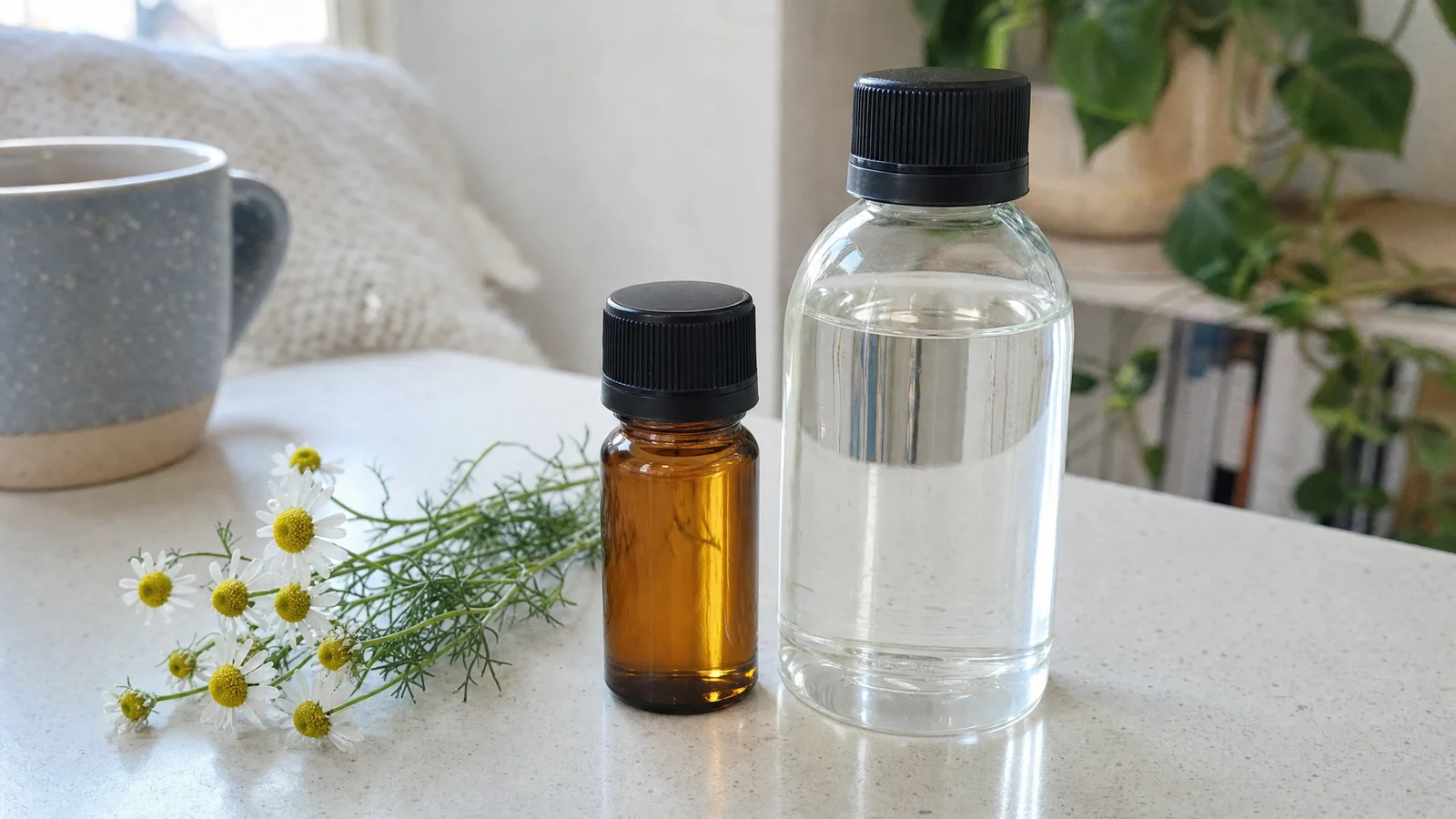
Chamomile Fragrance Oil or Essential Oil? Read the Label
A bottle that says "chamomile fragrance oil" can be perfectly lovely and still contain no chamomile at all. A bottle that says "chamomile essential oil" should hold the distilled oil of a chamomile plant and nothing else. The two share a name and a scent family, so the label is where the real difference shows up.
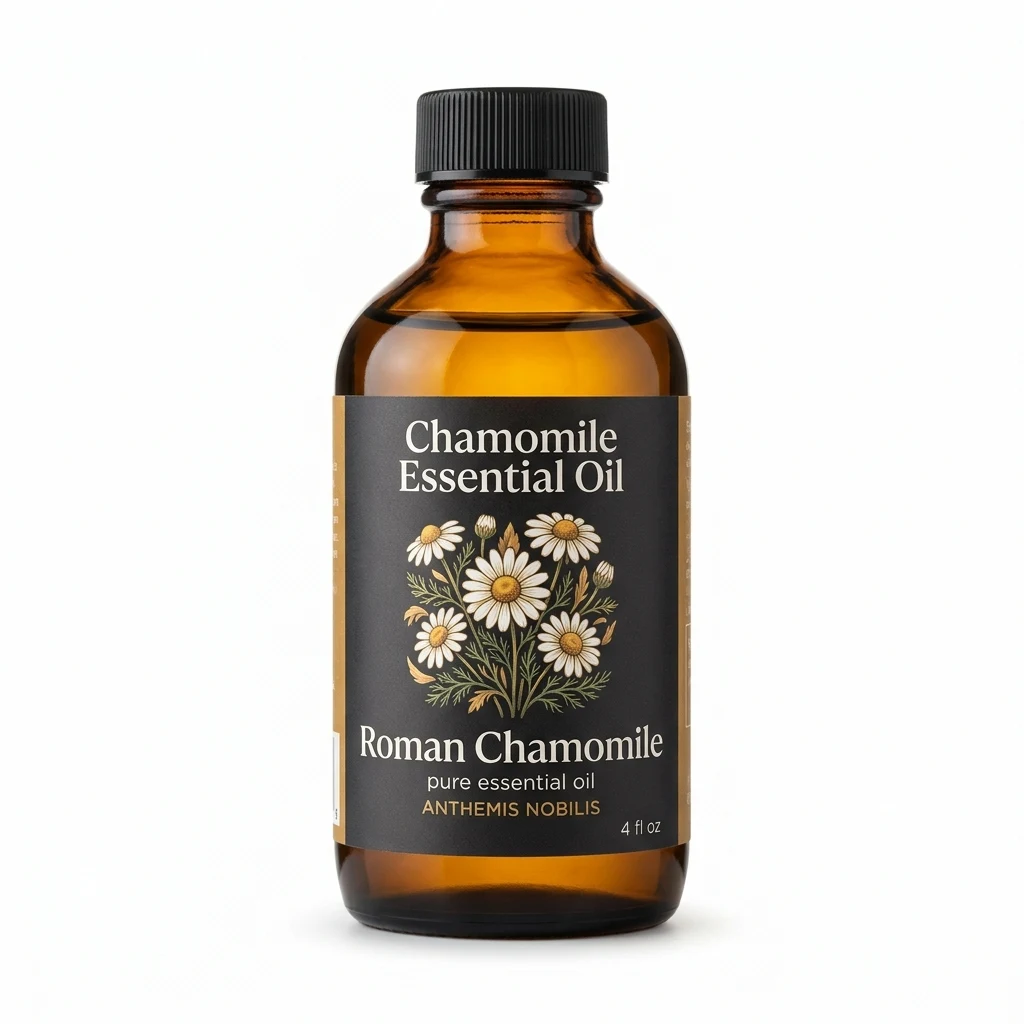
Roman Chamomile Essential Oil
Our own Roman Chamomile Essential Oil, in sizes from 0.5 oz to bulk.
From $32.99
Shop Now →What each one actually is
An essential oil comes from a plant. Steam passes through the flowers, and what condenses is the plant's own aroma material. That is what we sell: a Roman chamomile (Anthemis nobilis), which we describe as sweet, apple-like and herbaceous, and a German chamomile, sweet and herbaceous with a hay-like softness.
A fragrance oil is designed. A fragrance house blends aroma ingredients, natural and synthetic, to hit a target smell, which might be a tidy chamomile tea, a meadow, or a bakery's idea of one. Nothing about that is dishonest. It is simply a different product with a different job, and we do not sell any.
What the word "fragrance" tells you
The U.S. Food and Drug Administration explains that cosmetic ingredients are normally listed one by one, but a fragrance can appear on the label as the single word "Fragrance". Its formulas are treated as trade secrets and are complex mixtures of many natural and synthetic ingredients. FDA also notes that some of those components can cause allergic reactions in some people.
So a product listing "fragrance" has told you the category, not the contents. If you know you react to something, the plain-English move is the one FDA suggests: read ingredient lists closely or ask the manufacturer.
A named essential oil gives you more to work with. The plant is on the label, and the plant matters, because the two chamomiles are chemically different. German chamomile oil is rich in alpha-bisabolol and in azulenes such as chamazulene, which is where the blue comes from, while Roman chamomile oil contains less chamazulene and is mainly esters of angelic and tiglic acid (Srivastava and colleagues, 2010). Different chemistry, different nose.
Choosing by the job
For a diffuser or room scent, either can work, so it comes down to the aroma you want. If you want the plant's own scent, choose essential oil. If you want a very specific designed smell, a fragrance-oil supplier is the right shop. For a first look at how our two oils differ, our scent guide is a good start.
For candles and soap, fragrance oils are made for these jobs, and their suppliers publish data sheets with recommended use levels. If you want chamomile essential oil in a candle, our candle-maker guide covers the load question. Your wax supplier can help with the rest.
For skin, think about sensitivity before scent. A plant label does not make an essential oil automatically mild: chamomile is a daisy-family plant, and people sensitive to ragweed, chrysanthemums or related plants are more prone to contact allergy to it. We recommend diluting to 0.5% to 2% in a carrier oil and patch testing first, and our patch test guide shows how. If you have reacted to products before, an allergist or dermatologist is the right person to ask.
A three-bottle test
Picture three listings. The first reads "Roman Chamomile Essential Oil, Anthemis nobilis, flowers, steam-distilled". The second reads "Chamomile Essential Oil" and nothing more. The third reads "Chamomile Fragrance Oil, for candles and soap".
The first names a plant, a part and a method, and you can ask that seller about documentation. The third is openly a fragrance, and it is a good choice for the purpose it states. The second is the one worth a question: it could be either species, and you cannot compare it with anything until you know which. A botanical name such as Anthemis nobilis, Chamaemelum nobile or Matricaria chamomilla is the quickest sign that a bottle is naming a plant. Our buying checklist has the rest, and if documentation matters to you, you can ask us in writing through the contact page.
The simple rule is to decide whether you want the plant or the smell, then buy the bottle that says so.
Roman Chamomile Essential Oil
Roman Chamomile Essential Oil from our own shop, in sizes from 0.5 oz to bulk.
From $32.99
Shop Now →Sources & Further Reading
- U.S. Food and Drug Administration. Fragrances in Cosmetics. fda.gov/cosmetics/cosmetic-ingredients/fragrances-cosmetics
- Srivastava JK, Shankar E, Gupta S, 2010. Chamomile: a herbal medicine of the past with bright future. Mol Med Rep 3(6):895-901. pmc.ncbi.nlm.nih.gov/PMC2995283