How to Blend Lavender and Chamomile Oil
Lavender and chamomile are one of those pairings people mention without thinking. They are both soft, both a little sweet, and neither one shouts. The question worth answering is how to proportion them so you can actually smell both.
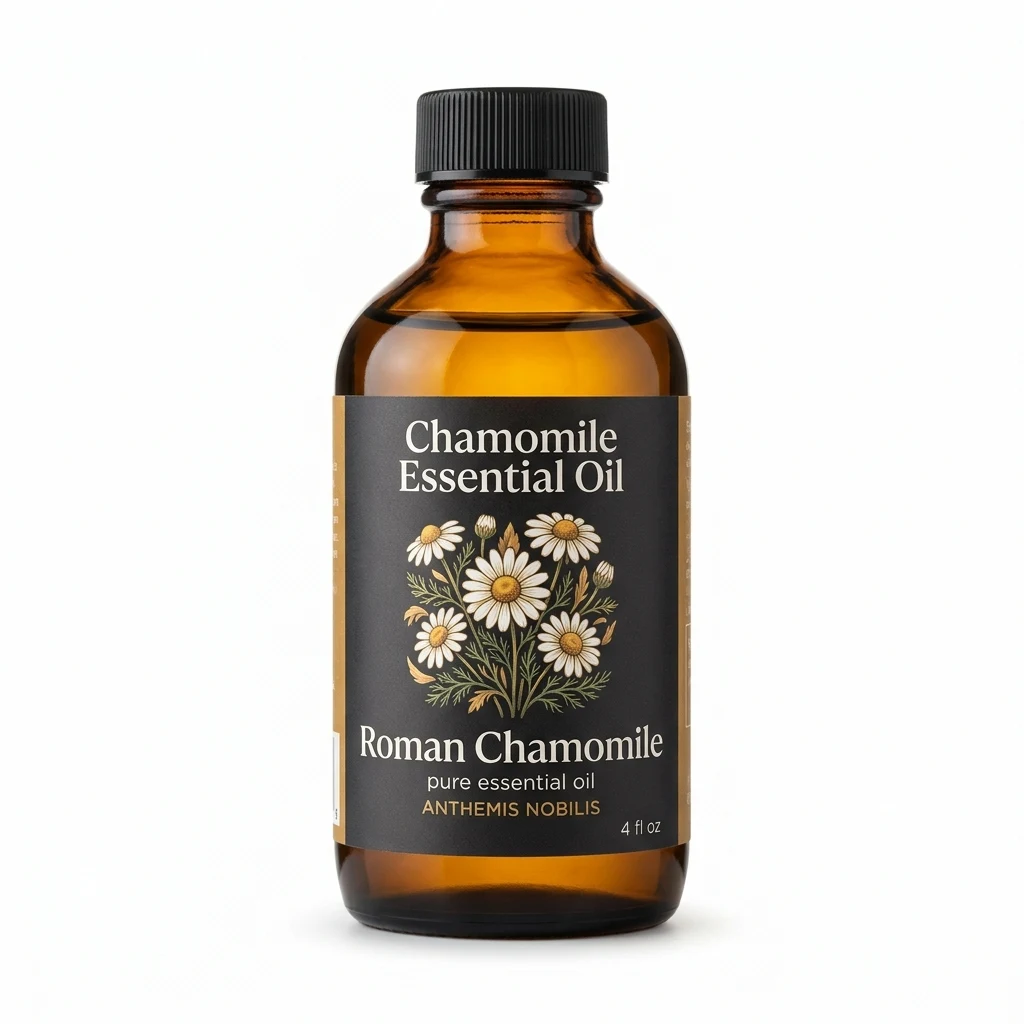
Roman Chamomile Essential Oil
Our own Roman Chamomile Essential Oil, in sizes from 0.5 oz to bulk.
From $32.99 $26.40 with code BLACKFRIDAY
Why they get along
ScenTree lists lavender's main constituents as linalyl acetate (42% to 52%) and linalool (32% to 40%), and classes it as a head-to-heart oil (ScenTree). Roman chamomile oil is dominated by angelate, tiglate and senecioate esters (Srivastava et al., 2010), so both are ester-led. We describe our Roman chamomile as a middle note, sweet, apple-like and herbaceous, and our German as sweet and herbaceous with a hay-like softness. Reasoning from those profiles, two ester-led oils with overlapping volatility should blend without one flattening the other. We would not assume that equal drops give equal presence, though. Chamomile is the quieter partner, so give it the larger share the first time and adjust by nose.
The pairing's "evening" reputation deserves a plain note. The aroma research we found names lavender: a meta-analysis of 34 studies reported that inhaling a single aroma did better than mixed aromas, and that lavender had the greatest effect (Cheong et al., 2021). Nothing we found tests lavender and chamomile together, and we sell an external cosmetic oil, so we offer this blend for its scent and nothing more. For sleep questions, a doctor is the right person.
Start with your nose, not the chart
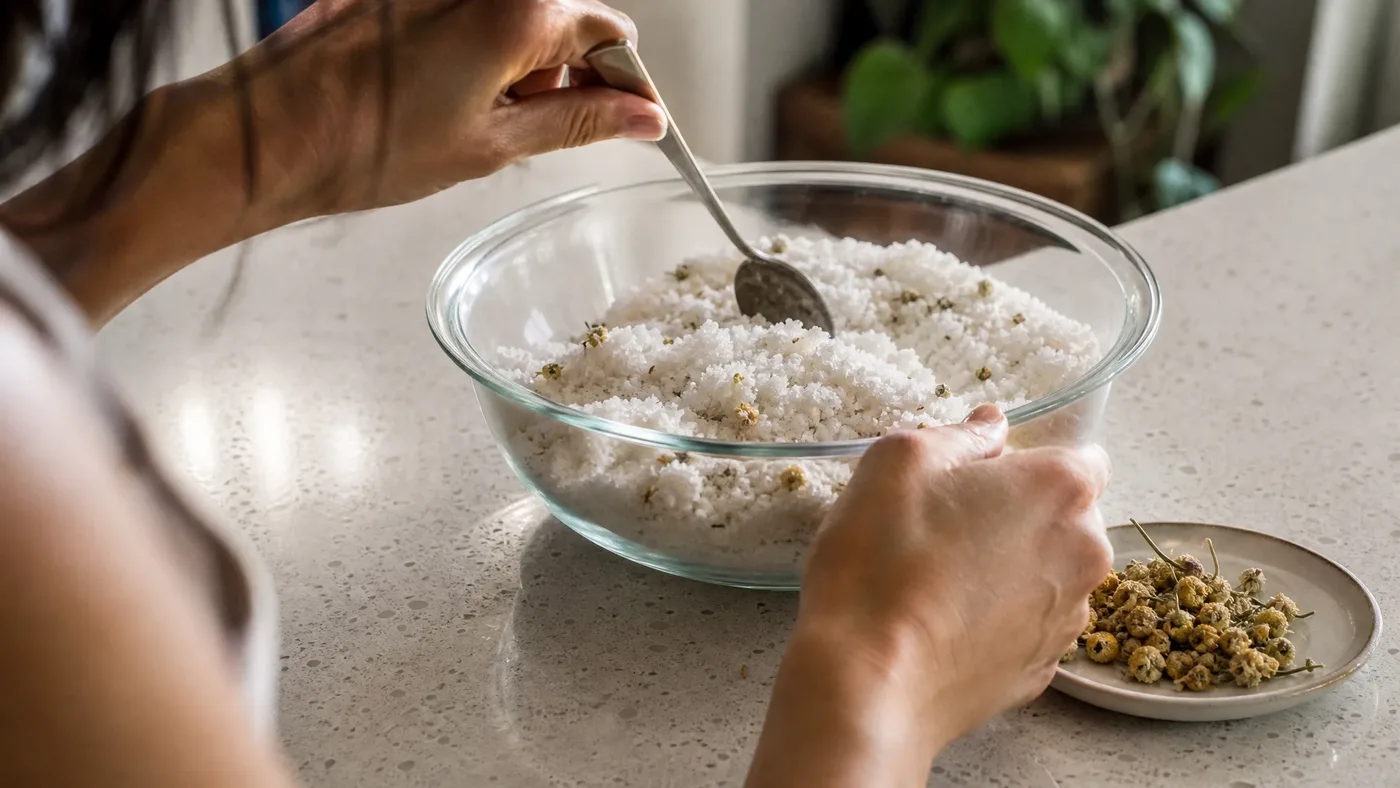
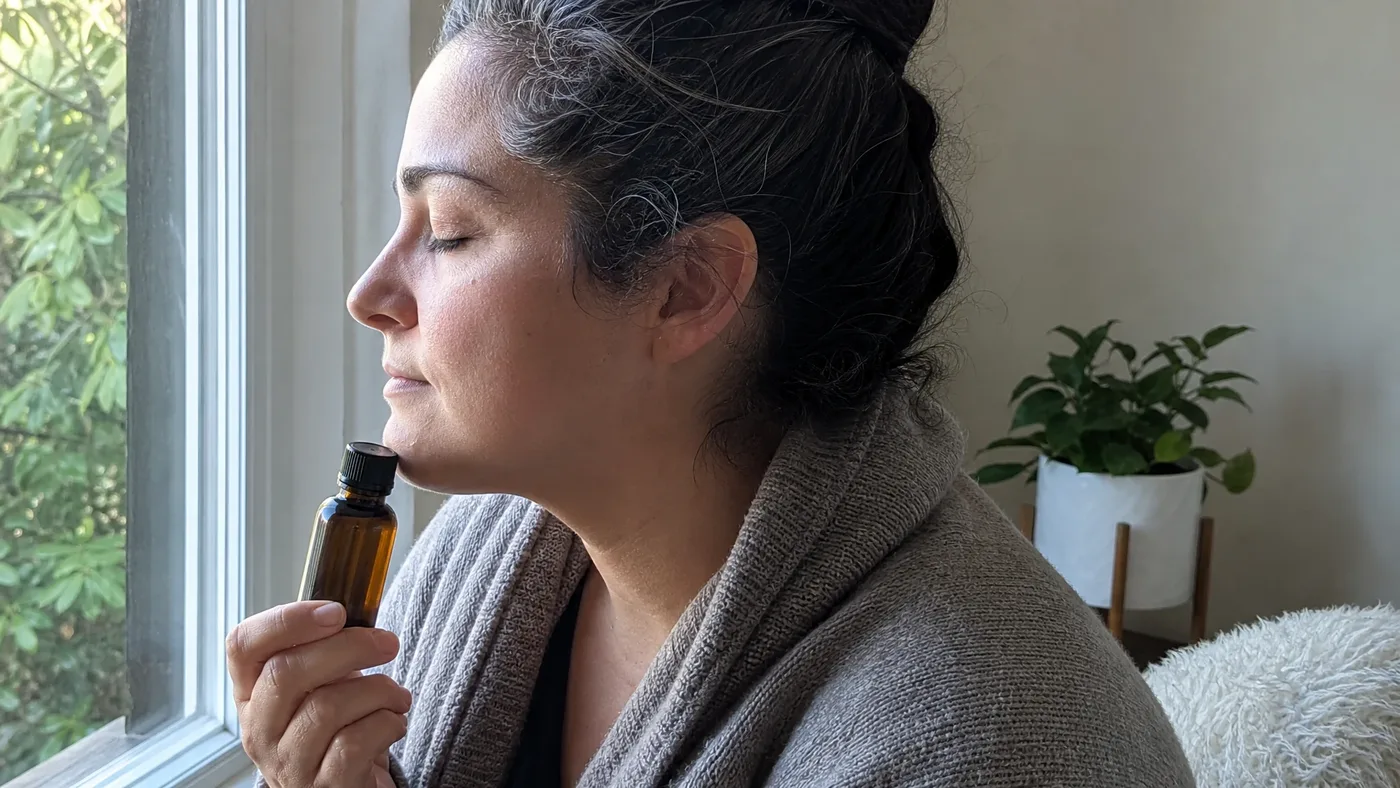
Before you measure anything, put one drop of each oil on separate paper strips and smell them one at a time. Lavender is the familiar one: clean, floral, a little herbal. Our Roman chamomile is sweet and apple-like, and our German is sweet with a hay-like softness. Hold the two strips together under your nose and move them closer and farther apart. That small experiment tells you how much of each you will want before you open a diffuser or a bottle.
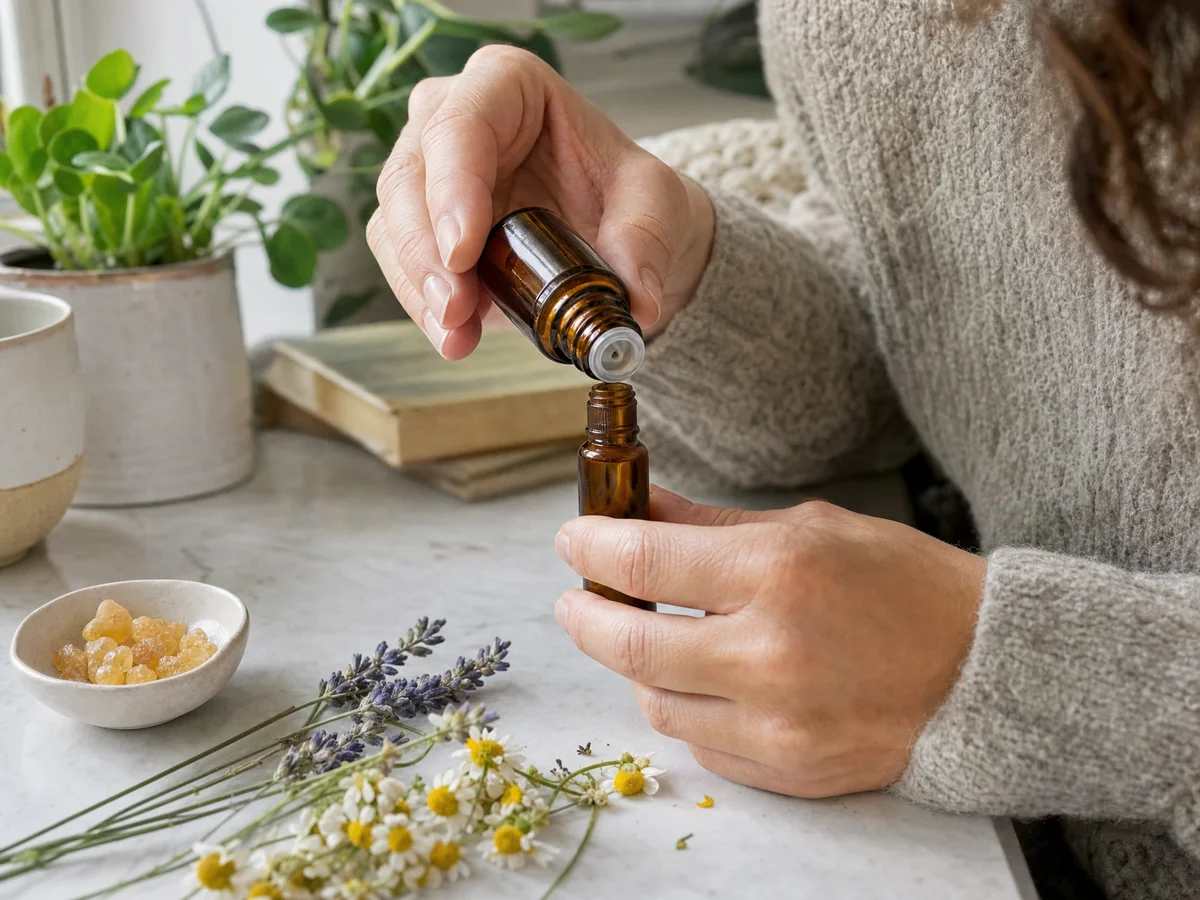
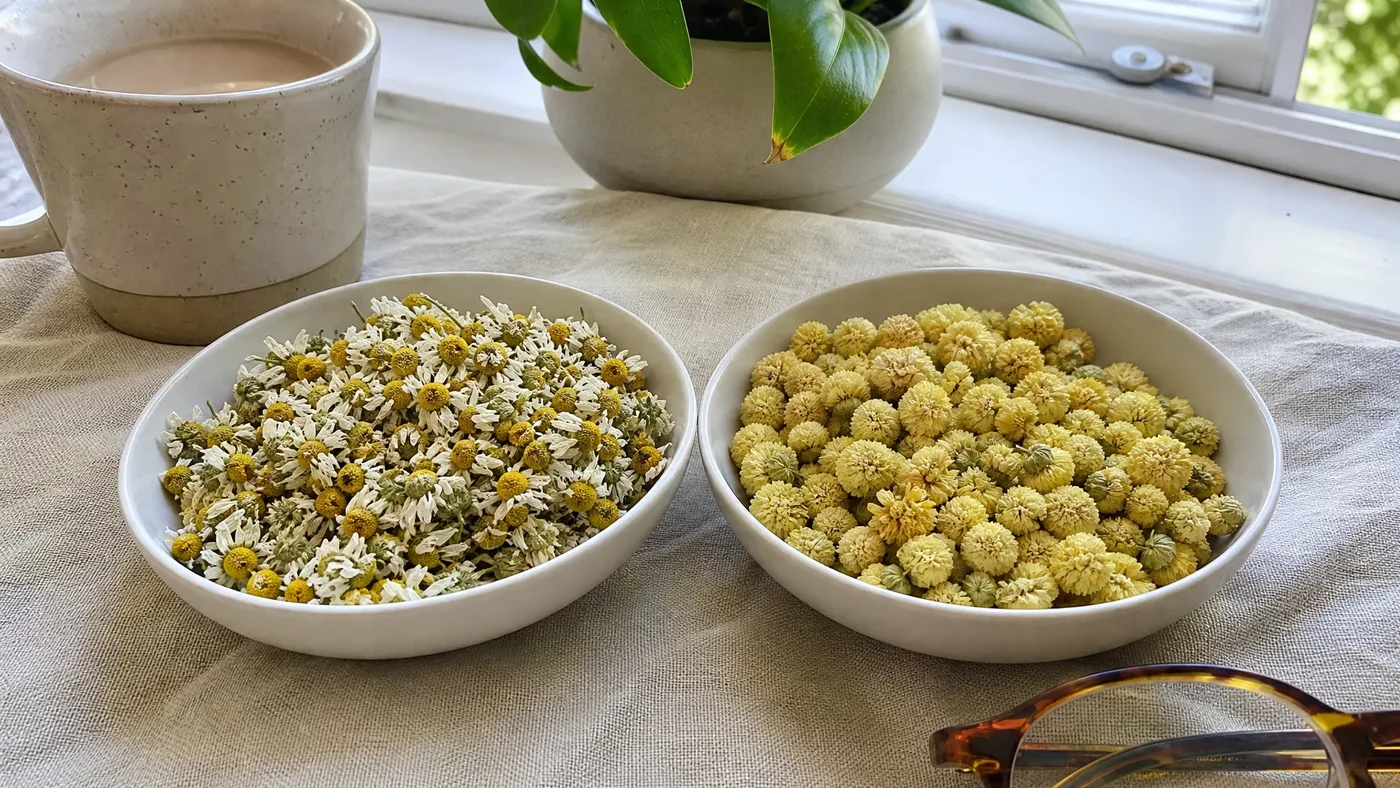
It is also worth deciding which chamomile you are using. Roman gives a fruitier, brighter blend, while German gives a softer, drier one, and it will tint a skin blend slightly. Neither is wrong. They just lead to two different blends, so pick the one you like the sound of and stick with it for the first few tries.
Proportions for a diffuser
These are formulations on paper, drop counts are totals, and lavender comes from another supplier.
- Chamomile-forward: 2 chamomile and 1 lavender, 3 drops in all.
- Balanced: 2 chamomile and 2 lavender, in a small ultrasonic unit on a timer.
- Lavender-forward: 1 chamomile and 3 lavender, with chamomile as a background note.
Tisserand suggests 6 to 8 drops for a diffuser (Tisserand), and starting at 3 is a good habit. More about devices and pets in our diffuser post.
Keeping a simple record
Blending is a lot more fun when you can repeat what you liked. Keep a small notebook by the bottles and write down each combination as you go: how many drops of each, what the room was like, what you thought after ten minutes. A drop count and a few words are enough. Within a week or two you will have a short list of ratios you trust, and you will stop wondering whether the third attempt was better than the second.
Change one thing at a time. If you move from 2 to 1 and also swap Roman for German, you will not know which change made the difference. Slow, small steps are how a blend you love turns up.
On skin, count the total
When you blend two oils into a carrier, dilute the combined oils, not each separately. The Tisserand Institute suggests 0.5% to 1.2% for the face, 1% to 3% for body oils and 0.2% to 1% for sensitive skin (Tisserand Institute). Our guidance for both chamomile oils is 0.5% to 2%, so for the face we would stay at the lower end. The arithmetic, using a rough 20 drops to the ml: 10 ml of carrier at 1% total is 0.1 ml, about 2 drops, and at 2% it is about 4 drops. A body oil of 1 drop chamomile and 1 drop lavender in 10 ml of carrier sits near 1%. Drop size varies, so working in percentages with a small measuring syringe is more reliable. Chamomile belongs to the daisy family, so skip it if you react to ragweed or daisies, and patch test every blend. Our dilution guide and patch test guide have the method, and other chamomile partners are worth exploring.
The nicest thing about a two-oil blend is how little it needs. Two bottles, a notebook and a quiet minute with your nose will teach you more than any chart.
A good blend is one where you can still find each oil in it. Start with chamomile in the lead and let lavender fill in around it.
Roman Chamomile Essential Oil
Roman Chamomile Essential Oil from our own shop, in sizes from 0.5 oz to bulk.
From $32.99 $26.40 with code BLACKFRIDAY
Sources & Further Reading
- ScenTree, Lavender oil
- Srivastava, Shankar and Gupta, Molecular Medicine Reports, 2010: chamomile chemistry and uses
- Tisserand, Roman chamomile essential oil product page
- Tisserand Institute, Dilution of essential oils
- Cheong et al., Medicine, 2021: aroma inhalation and sleep, meta-analysis abstract