Chamomile vs Tea Tree Oil: Two Different Skin Questions
People often set chamomile and tea tree against each other as the soft oil and the strong one. It is a tidy picture, and it hides the more useful one: the two oils raise different questions for skin. With tea tree the question is how old the bottle is. With chamomile it is which plant family you react to.
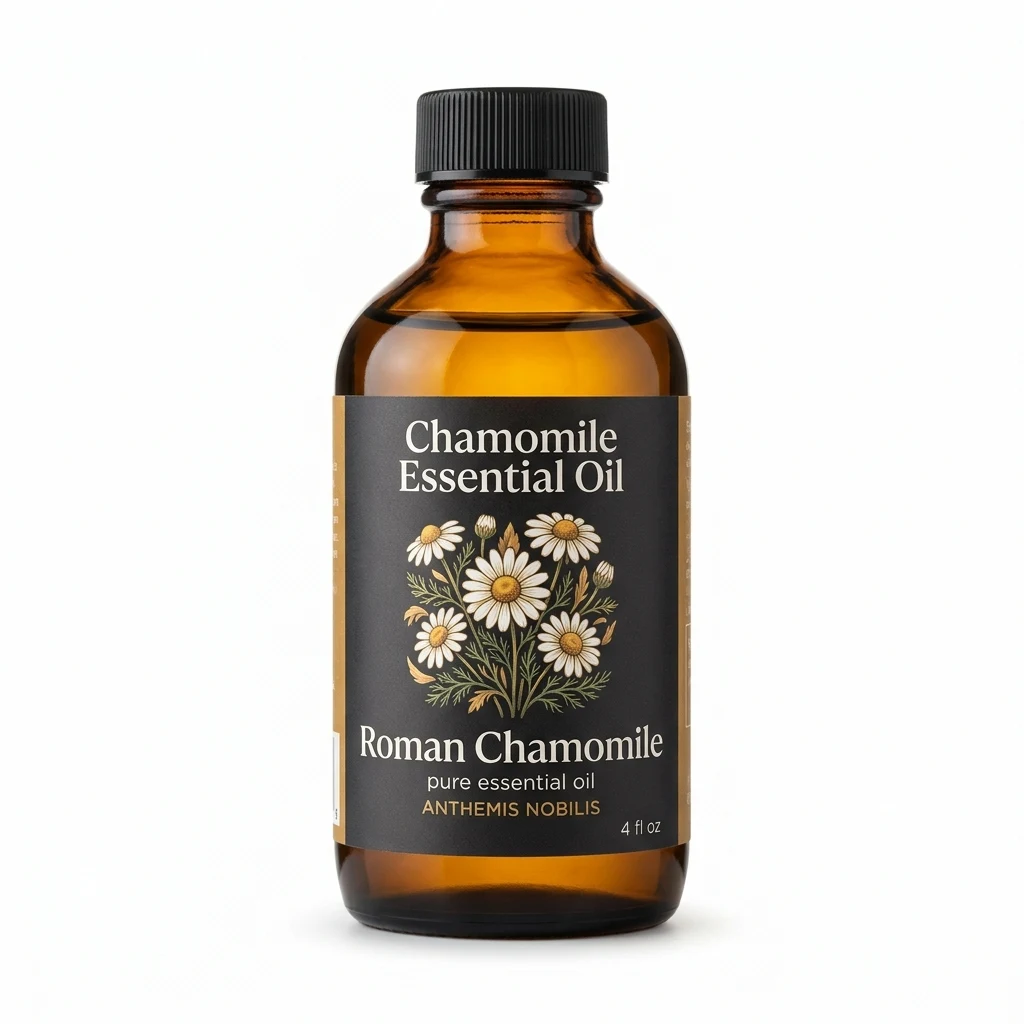
Roman Chamomile Essential Oil
Our own Roman Chamomile Essential Oil, in sizes from 0.5 oz to bulk.
From $32.99
Shop Now →Tea tree: freshness matters
Skin reactions fall into two broad types. Irritation shows up on contact and depends on how much oil touches the skin. Sensitisation is an immune response that builds with exposure, and it is the one the patch-test research on both oils is mostly about.
For tea tree, the key finding is about age. In a 1999 study (Hausen, Reichling and Harkenthal, American Journal of Contact Dermatitis), fresh tea tree oil turned out to be a very weak sensitiser in guinea pigs, while oil that had oxidised on a window sill was about three times stronger. People already allergic to tea tree reacted to the compounds that form as the oil degrades, such as alpha-terpinene, terpinolene and ascaridole.
The clinic side points the same way. An Australian review of patch-test records (Rutherford and colleagues, 2007) identified 41 people out of 2,320 who reacted to oxidised tea tree oil, 1.8%. Two thirds recalled using tea tree oil, and eight had put it on neat. These were people sent to a dermatology clinic, so the figure is not a rate for the general public. The authors' own conclusion is that fresh oil from a newly opened product produces no or weak reactions. The practical lesson is a good one for any essential oil: keep bottles capped, cool and dark, and be wary of very old ones.
Chamomile: it is about the family
Chamomile belongs to the Asteraceae (Compositae) family, the daisy family, and the documented skin question here is cross-reaction within it. In a 2004 study (Jovanovic and colleagues, Medicinski pregled), 30 adults with atopic dermatitis were patch tested with a Compositae mix and extracts of arnica, chamomile, tansy, feverfew and yarrow. Nine were sensitised to the mix, and chamomile was the most frequent single positive, in 5 of those 9. That used plant extract in a small, allergy-prone group, so applying it to chamomile oil is an inference, but a reasonable one to heed.
The practical reading is simple. If you react to ragweed, arnica or other daisy-family plants, an allergist or dermatologist should weigh in before you try chamomile oil. If you do not, treat it like any new oil: dilute, patch test, and go slowly.
Dilution for either oil
Our chamomile oils are sold undiluted, so the carrier and the counting are yours. We recommend 0.5% to 2% in a carrier oil. An ounce of carrier is about 29.6 ml, or roughly 590 drops at the common kitchen convention of about 20 drops per ml, which gives these rough counts:
| Target | Drops per ounce of carrier |
|---|---|
| 0.5% | about 3 |
| 1% | about 6 |
| 2% | about 12 |
The Tisserand Institute organises dilution by use rather than by oil: 0.2% to 1% for reactive skin and 0.5% to 1.2% for the face. Reasoning from those figures, the lower end of our range is the better place to start for the face, and a patch test comes first either way. Our patch test guide shows how, and the dilution guide goes further.
Which one, then?
We sell the two chamomile oils and not tea tree, so we will keep this practical. If you have no daisy-family history and want a chamomile oil for cosmetic use, dilute within our range and patch test. If you already have tea tree at home, check how old it is. Broken or weeping skin, persistent skin trouble, or a child's skin are matters for a dermatologist or pediatrician rather than for any essential oil. Our comparison with other oils and our cosmetic care guide carry on from here.
The useful habit to take away is to ask what a given oil is actually known to do to skin, and to match your caution to that answer rather than to a reputation.
Roman Chamomile Essential Oil
Roman Chamomile Essential Oil from our own shop, in sizes from 0.5 oz to bulk.
From $32.99
Shop Now →Sources & Further Reading
- Hausen BM, Reichling J, Harkenthal M, 1999. Degradation products of monoterpenes are the sensitizing agents in tea tree oil. Am J Contact Dermat. pubmed.ncbi.nlm.nih.gov/10357714
- Rutherford T, Nixon R, Tam M, Tate B, 2007. Allergy to tea tree oil: retrospective review of 41 cases with positive patch tests over 4.5 years. Australas J Dermatol. pubmed.ncbi.nlm.nih.gov/17535193
- Jovanovic M et al., 2004. Contact allergy to Compositae plants in patients with atopic dermatitis. Med Pregl. pubmed.ncbi.nlm.nih.gov/15503788
- Tisserand Institute. Dilution for essential oils. tisserandinstitute.org/dilution-essential-oils