Chamomile in Skin and Hair Care: Choose It for the Scent
Open a few bottles of skin-care products and you will notice that the oil in them is rarely the star. A drop of chamomile in a carrier oil is there mostly for how it smells. That is a perfectly good reason to use it, and it changes how we think about putting chamomile oil on skin and hair: choose it for the aroma, and spend your effort on the carrier.
Roman Chamomile Essential Oil
Our own Roman Chamomile Essential Oil, in sizes from 0.5 oz to bulk.
From $32.99
Shop Now →What chamomile brings to a product
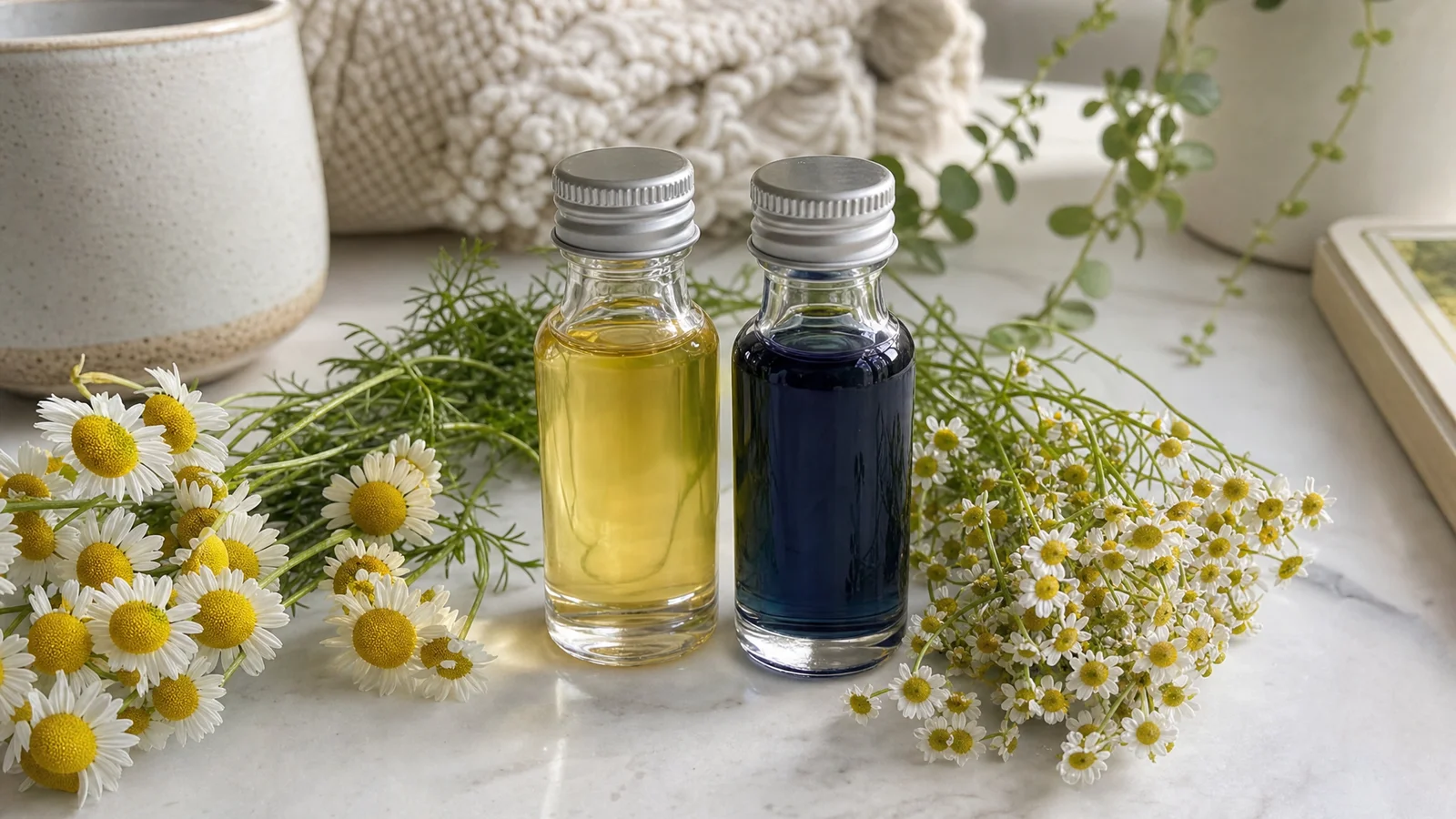
We sell two chamomile oils, a Roman one that is sweet and apple-like, and a blue German one with a hay-like softness. The Roman oil is mainly angelic and tiglic acid esters, while German oil is mainly alpha-bisabolol, its oxides and chamazulene, the compound that makes it blue (Srivastava et al., 2010). So the cosmetic-sounding chatter about bisabolol belongs to the German type only, and it is chatter about one component, not the whole bottle.
For perspective, a 2022 review of alpha-bisabolol says most of the work it covers was done in cell lines and animals and that human studies are still needed (Eddin et al., Nutrients, 2022). We make no skin or hair outcome claims for either oil, and we think the honest case for chamomile in a routine is the aroma. Our comparison of Roman and German chamomile will help you choose the scent.
The carrier is most of what touches your skin
At our recommended 0.5% to 2% dilution, 98% or more of what you smooth on is carrier oil. That makes the carrier the decision that matters, and there is real human data on it. In a small forearm study of 19 volunteers, olive oil reduced the integrity of the outer skin layer and caused mild redness, while sunflower seed oil preserved it, and the authors advised against olive oil for dry skin (Danby et al., Pediatric Dermatology, 2013). A review of plant oils in skin care points toward oils with more linoleic than oleic acid for barrier work (Vaughn et al., 2018).
Our takeaway is practical: a barrier-friendly, high-linoleic carrier such as sunflower, with a little chamomile for scent, is a better-reasoned design than a heavy hand with chamomile in whatever oil is in the cupboard. Carriers are sold by supply shops and grocers, not by us; our carrier oil guide covers the options, and our dilution guide has the drop math.
On hair: scent only
For hair, chamomile oil works the same way, as an aroma. A few diluted drops in a pre-wash scalp oil or a scented rinse is a pleasant use, and our hair article keeps that framing. We do not describe it as a hair or scalp treatment. If thinning, flaking or itching is the worry, a dermatologist is the right call.
The one thing worth checking first
Chamomile is in the daisy family, and plants in that family are on dermatologists' lists of suspected sensitizers, mainly because of compounds called sesquiterpene lactones. The same review notes that sensitization to German chamomile is rare (Paulsen, 2002), and the NCCIH adds that people allergic to ragweed, chrysanthemums, marigolds or daisies are more likely to react (NCCIH). If that sounds like you, ask an allergist first. Everyone else should patch test the finished blend; our patch test guide shows how, and our safety article covers who should skip it.
Skip chamomile oil on broken or inflamed skin, around the eyes, and for babies and young children unless a pediatrician says otherwise. Anyone pregnant or breastfeeding should ask an OB-GYN or midwife first.
Keep it simple and you will enjoy it more: a good carrier, a few drops of the chamomile you like the smell of, and a patch test before the first use.
Roman Chamomile Essential Oil
Roman Chamomile Essential Oil from our own shop, in sizes from 0.5 oz to bulk.
From $32.99
Shop Now →Sources & Further Reading
- Srivastava JK, Shankar E, Gupta S, 2010. Chamomile: A herbal medicine of the past with bright future. Mol Med Rep 3(6):895-901. PMC2995283
- Eddin LB et al., 2022. Alpha-bisabolol review. Nutrients. PubMed 35405982
- Danby SG et al., 2013. Effect of olive and sunflower seed oil on the adult skin barrier. Pediatr Dermatol. PubMed 22995032
- Vaughn AR et al., 2018. Natural oils for skin barrier repair. PubMed 28707186
- Paulsen E, 2002. Contact sensitization from Compositae-containing herbal remedies and cosmetics. Contact Dermatitis 47(4):189-198. PubMed 12492516
- NCCIH. Chamomile. nccih.nih.gov/health/chamomile