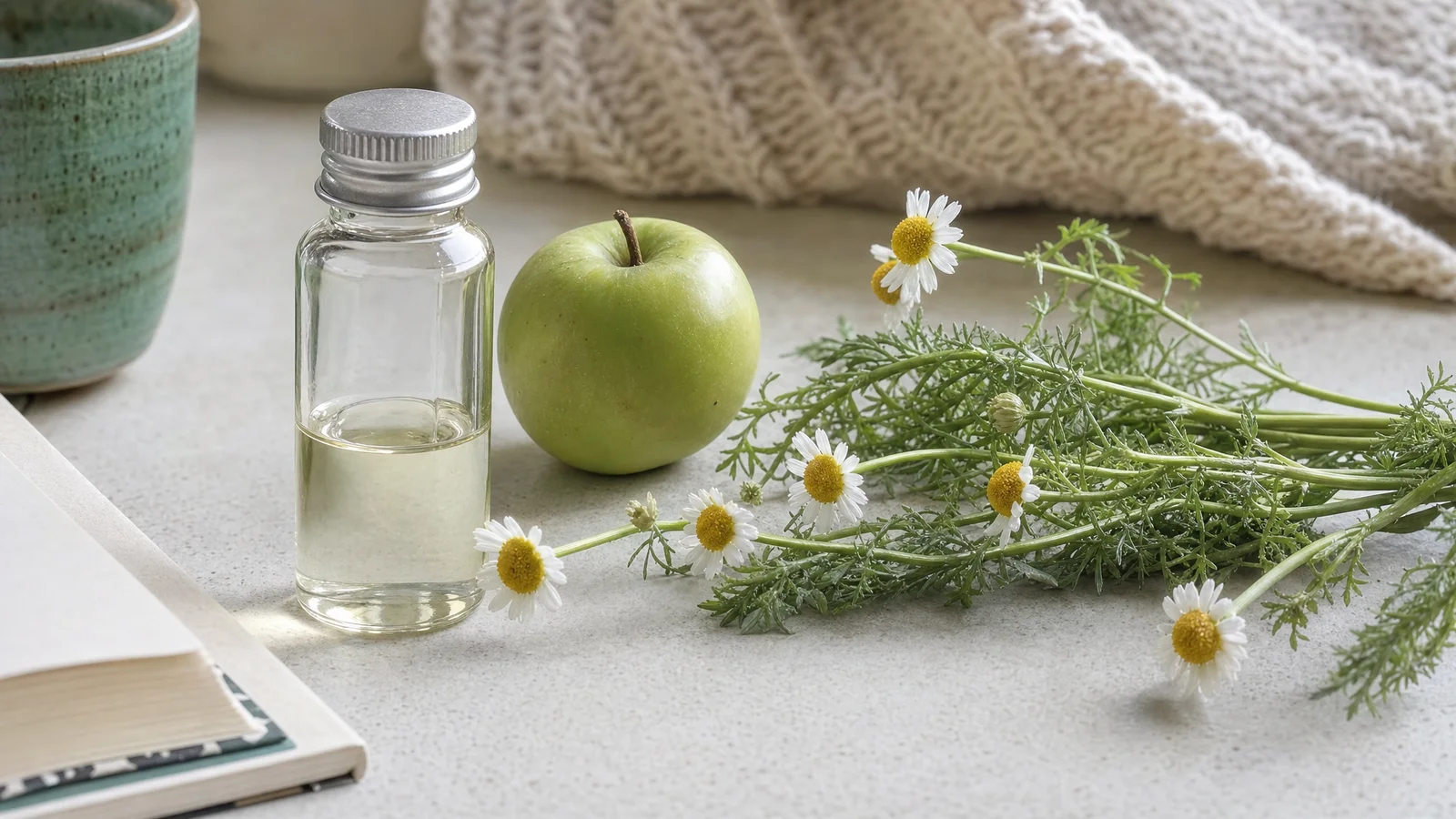
Why Roman Chamomile Oil Smells So Fruity
Open a bottle of Roman chamomile oil expecting a tea bag and you get a surprise. The scent is sweet, fruity and a little herbaceous, closer to a bowl of ripe apples than to anything steeped in a cup. It is the softer, rounder of the two chamomiles we sell, and it is built very differently from its blue German cousin.
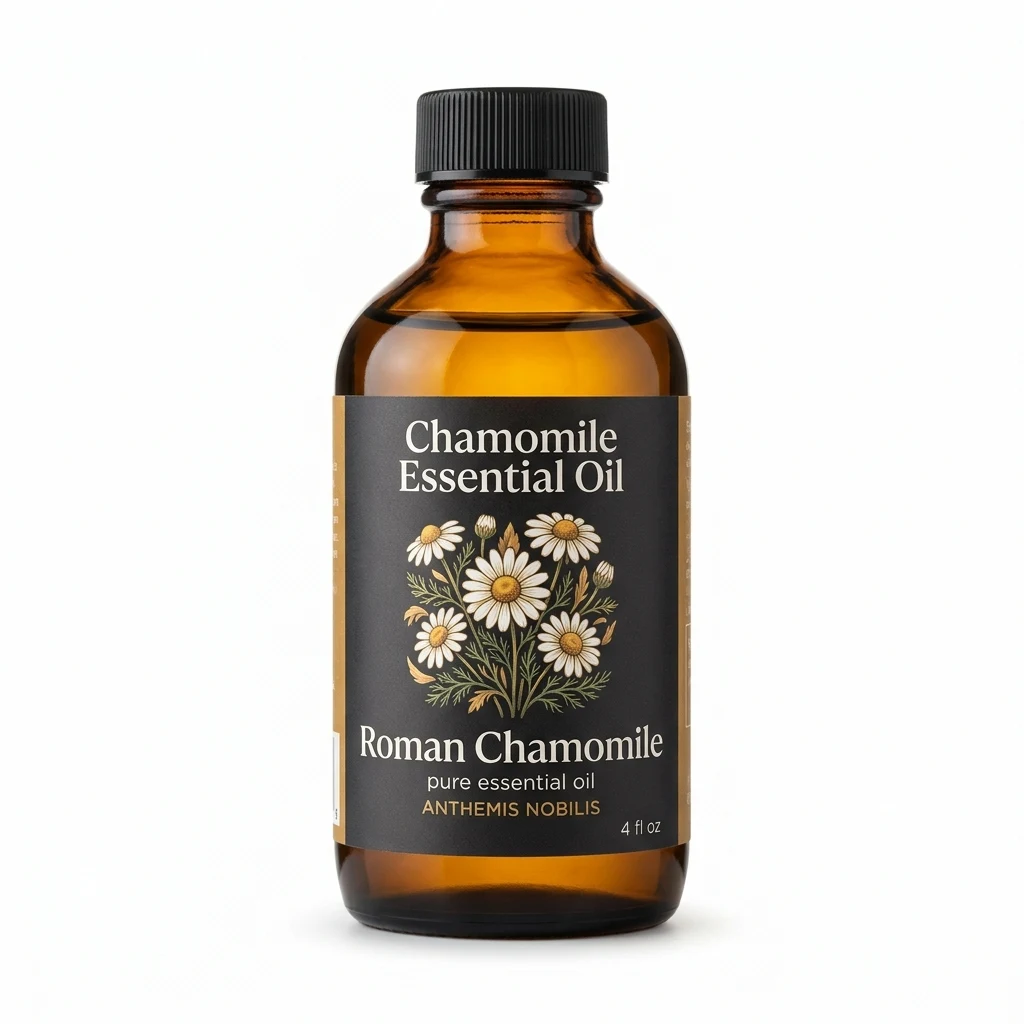
Roman Chamomile Essential Oil
Our own Roman Chamomile Essential Oil, in sizes from 0.5 oz to bulk.
From $32.99
Shop Now →What "apple-like" really means
We describe our Roman chamomile (Anthemis nobilis on our label, a name botanists now often write as Chamaemelum nobile) as sweet, apple-like and herbaceous, softer and fruitier than German chamomile, and in perfumery terms it sits in the middle of a blend. There is a good reason it reads that way. Published analyses describe Roman chamomile oil as made mostly of esters of angelic and tiglic acid (Srivastava et al., 2010), and esters are the fragrance family behind the smell of many fruits. In a Lithuanian analysis of distilled Roman chamomile, a single ester, 3-methylpentyl angelate, made up roughly a fifth to more than a quarter of the oil depending on the plant's growth stage (Baranauskiene et al., 2022).
None of the sources we read pins the word "apple" on one particular molecule, so take that last step as reasoning rather than a lab result. It is a sensible bit of reasoning, though: a fruity nose from a chemical family known for fruity smells.
No two Roman oils are identical
The same Lithuanian study watched the oil change as the plant matured, which is why its figures come as ranges. A separate analysis of Roman chamomile flowers from Morocco was led by entirely different compounds, beta-oplopenone and spathulenol among them (El-Assri et al., 2025). Origin, plant part and harvest timing all seem to matter, so if one Roman chamomile you smell differs from another, that is simply the plant being a plant.
For our Roman oil we list flowers as the plant part and steam distillation as the method. If documentation matters for your project, ask us about it through our contact page before ordering, and our guide to reading a GC-MS report shows what to look for in any analysis you are handed.
Where the aroma fits
Our pages list natural perfumery, diluted face and body oils and balms, candles, soap, linen sprays and evening diffuser blends among the uses for chamomile oils. For Roman specifically, we suggest pairing it with lavender, bergamot, clary sage, geranium, sweet orange or frankincense. As a middle note it does best when something brighter sits above it and something deeper sits beneath, so it holds the centre of the blend instead of leading it. Our pairing guide goes through each partner, and three room and candle pairings put numbers on a few of them. We sell the chamomile only, so carrier oils, wax and the partner oils come from a supplier that specialises in them.
A word on skin
The oil arrives undiluted, so it needs a carrier before it goes anywhere near skin. We recommend 0.5% to 2% in a carrier oil with a patch test first, and we never suggest applying it neat. Tisserand's Roman chamomile page suggests about 2 drops per 10 ml for the face and up to 5 drops per 10 ml for massage or body use (Tisserand). At the usual convention of 20 drops to the ml, that works out to roughly 1% and 2.5%, so for the face we would stay in the lower half of our range. Chamomile belongs to the daisy family, and people with ragweed, daisy or chrysanthemum allergies are more likely to react (NCCIH), so those readers should check with an allergist first. More on this in our safety guide.
Think of Roman chamomile as the fruit in the bowl rather than the whole meal. It rounds out whatever it stands next to, and that is exactly why it rewards a patient nose.
Roman Chamomile Essential Oil
Roman Chamomile Essential Oil from our own shop, in sizes from 0.5 oz to bulk.
From $32.99
Shop Now →Sources & Further Reading
- Srivastava, Shankar and Gupta, Molecular Medicine Reports, 2010: chamomile chemistry and uses
- Baranauskiene et al., Food Research International, 2022: Roman chamomile essential oil composition
- El-Assri et al., Frontiers in Chemistry, 2025: Chamaemelum nobile flower oil from Morocco
- Tisserand, Roman chamomile essential oil product page
- NCCIH, Chamomile