Roman vs German Chamomile Oil: Why Only One Is Blue
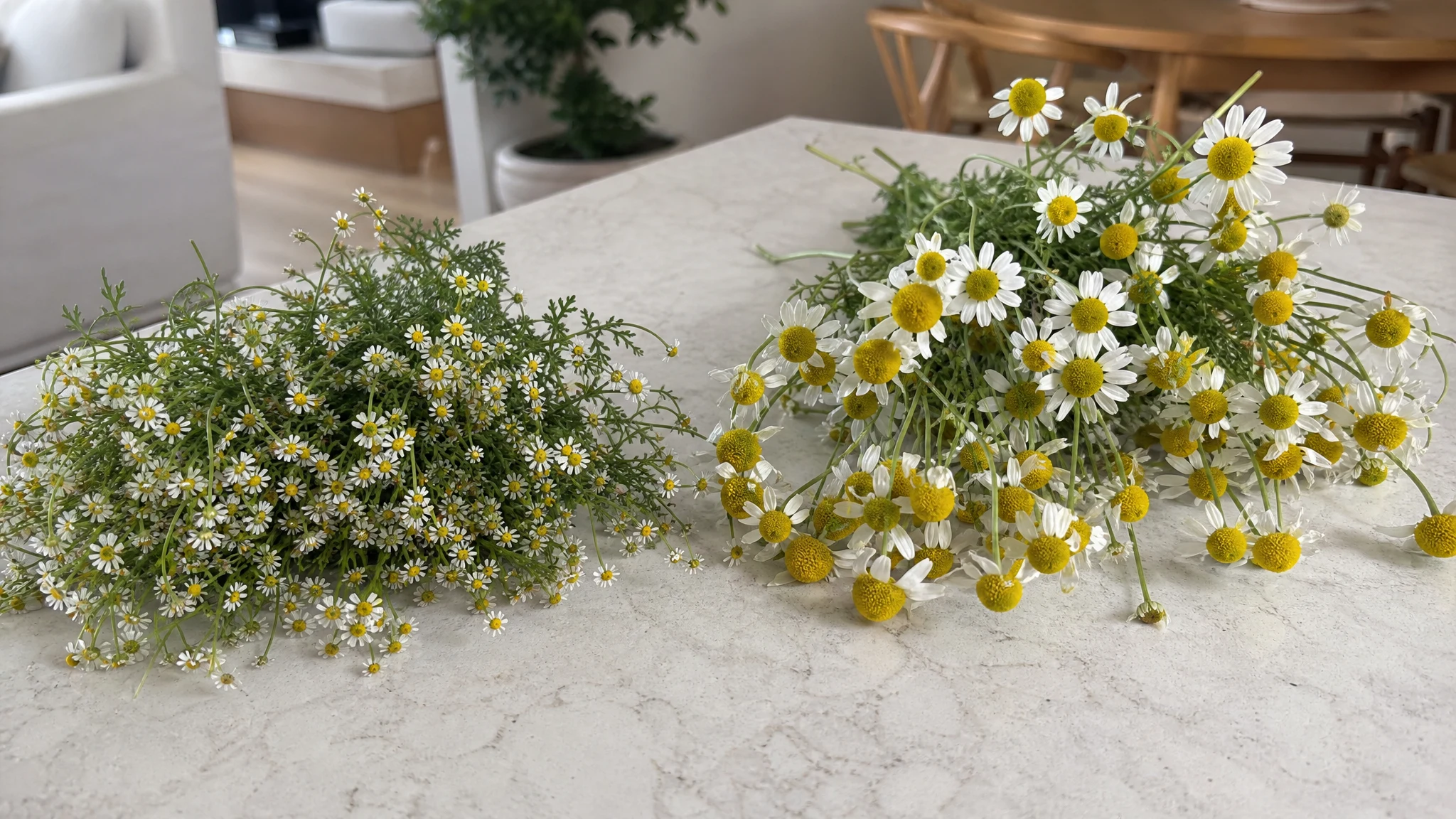
Here is a small piece of chamomile trivia that explains a lot: the deep blue color of German chamomile oil is not in the flower. The petals are white and the center is yellow. The blue appears during distillation, when a precursor in the flowers turns into chamazulene. Once you know that, the whole difference between Roman and German chamomile oil starts to make sense.
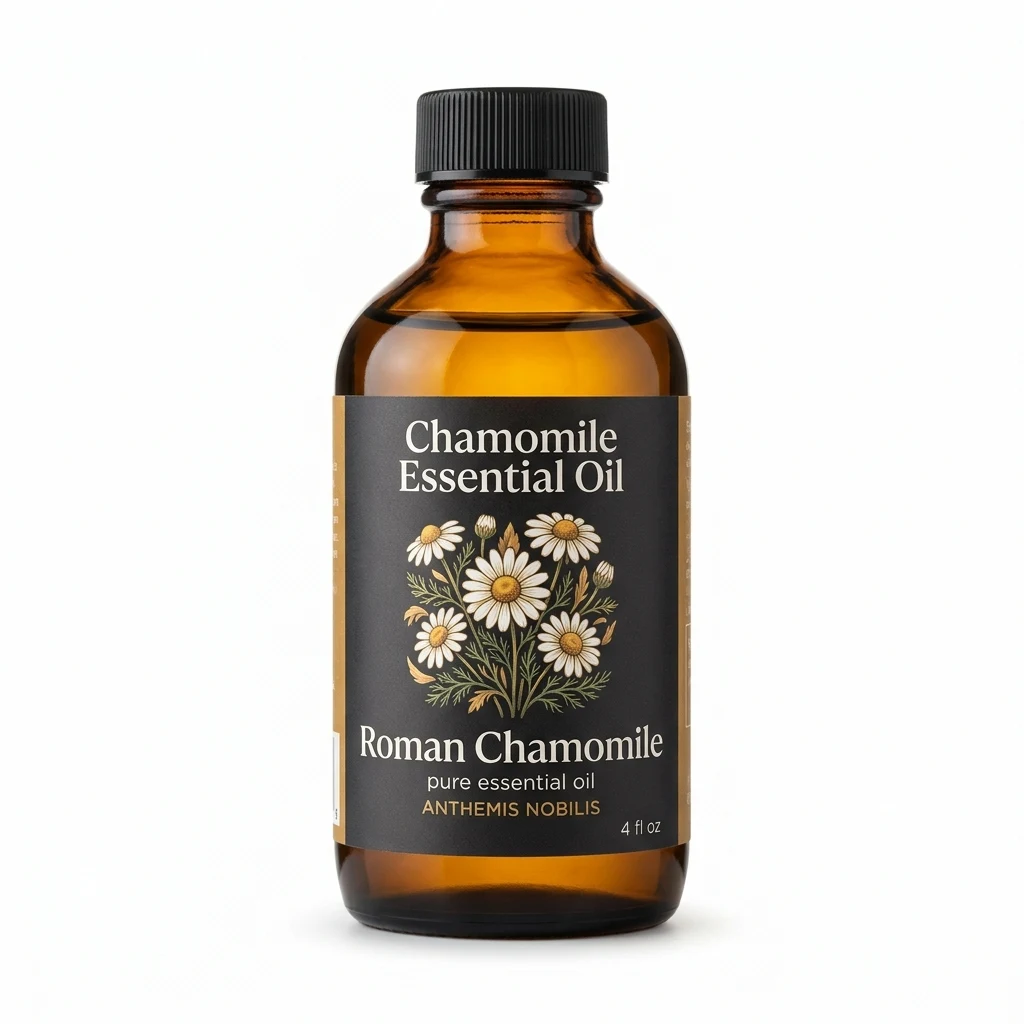
Roman Chamomile Essential Oil
Our own Roman Chamomile Essential Oil, in sizes from 0.5 oz to bulk.
From $32.99
Shop Now →The blue that is made in the still
A review of chamomile chemistry describes chamazulene as an artifact formed from a compound called matricine during hydro and steam distillation, and notes that how much ends up in the oil depends on the origin and age of the flowers and drops when flowers are stored (Singh et al., Pharmacognosy Reviews, 2011). The same review reports that German chamomile flower oil carries chamazulene alongside alpha-bisabolol and its oxides, and that the plant comes in several chemical types. In other words, a blue oil is a sign that this particular chemistry happened, and the amount of blue varies from lot to lot.
Fresh German oil is described as ranging from brilliant blue to deep green, turning dark yellow after storage (Srivastava et al., 2010). Laboratory work on chamazulene shows why: under strong UVA light it broke down into several oxygen-containing products, while a dark sample held at 50 C for 50 days did not degrade (Gabbanini et al., Molecules, 2024). That is a lab result and not a shelf-life promise, but it supports the habit we recommend anyway: keep chamomile oil tightly capped, cool and out of the light.
Why Roman oil does not turn blue
Roman chamomile is a different plant, and its oil is built differently. It is mainly esters of angelic and tiglic acid, with less chamazulene, which is why it does not carry the German oil's tint. A comparison of the two plants found bisabolol oxide A in the Roman plant but no alpha-bisabolol, where the German plant had alpha-bisabolol plus oxides A and B (Dai et al., Molecules, 2022). Roman oil's character comes from those esters, and they are a big part of the sweet, apple-like aroma people associate with it.
That is why we do not think of Roman and German as a budget and a premium version of one product. They are different oils from different plants, and neither stands in for the other in a formula without changing it.
Even one species is not one profile
The more you read, the more you see that the same plant name covers a range. Hydrodistilled Roman chamomile from Lithuania was dominated by angelate esters, with 3-methylpentyl angelate making up roughly a fifth to over a quarter of the oil depending on growth stage (Baranauskiene et al., Food Research International, 2022). Flowers of the same species from Morocco gave a very different top three, led by beta-oplopenone (El-Assri et al., Frontiers in Chemistry, 2025). We cannot reconcile the two from the abstracts alone, and we do not need to: the useful lesson is that origin, plant part, season and genetics all shift what is in a bottle.
It is also why we describe our oils by what we can point to. Our Roman oil is listed as Anthemis nobilis, the older name for what many sources now call Chamaemelum nobile, with a sweet, apple-like, herbaceous aroma. Our German oil is blue and hay-like in softness. The Certificate of Analysis we publish covers one batch and gives density and refractive index, not a full chemical profile, so if you need GC-MS, chamazulene or bisabolol results for a lot, ask us in writing through the contact page, and see how to read a GC-MS report. We would rather you ask than guess.
What that means when you choose
- If you want color, only the German oil gives it, and it can stain light fabric and pale skin products. Our piece on why blue chamomile oil is blue goes deeper.
- If you want a clear, sweeter, fruitier aroma, the Roman oil is the one we point to. Lavender, bergamot, clary sage, geranium, sweet orange and frankincense are the blending partners we list for it.
- If you are comparing suppliers, ask which plant, which part, which origin and which batch, before price or size.
Our buying walk-through turns this into a use-by-use choice, and our origins comparison looks at what a country label does and does not tell you.
One care note applies to both. Chamomile is a daisy-family plant, with contact dermatitis reported especially in people allergic to pollen or Compositae plants (Dai et al., above), so anyone with a ragweed or daisy allergy should check with an allergist first. Dilute to 0.5% to 2%, patch test, and see our safety guide for the rest.
Next time someone tells you chamomile oil is blue, you can ask them which chamomile, and whether it has been sitting in the light.
Roman Chamomile Essential Oil
Roman Chamomile Essential Oil from our own shop, in sizes from 0.5 oz to bulk.
From $32.99
Shop Now →Sources & Further Reading
- Singh O, Khanam Z, Misra N, Srivastava MK, 2011. Chamomile (Matricaria chamomilla L.): an overview. Pharmacogn Rev. PMC3210003
- Srivastava JK, Shankar E, Gupta S, 2010. Chamomile: A herbal medicine of the past with bright future. Mol Med Rep 3(6):895-901. PMC2995283
- Gabbanini S et al., 2024. Chamazulene photodegradation. Molecules. PubMed 38893479
- Dai YL et al., 2022. Matricaria chamomilla and Chamaemelum nobile compared. Molecules. PMC9822300
- Baranauskiene R et al., 2022. Chamaemelum nobile essential oil across growth stages. Food Res Int. PubMed 36076410
- El-Assri EM et al., 2025. Chamaemelum nobile essential oil from Morocco. Front Chem. PubMed 39968372