Chamomile Massage Oil: Matching Dilution to Body Area
When people plan a chamomile massage oil they usually ask how many drops to use. The better first question is where the oil is going. A face, a forearm and a back each call for a different strength, and that holds whether you buy our Roman or our German oil.
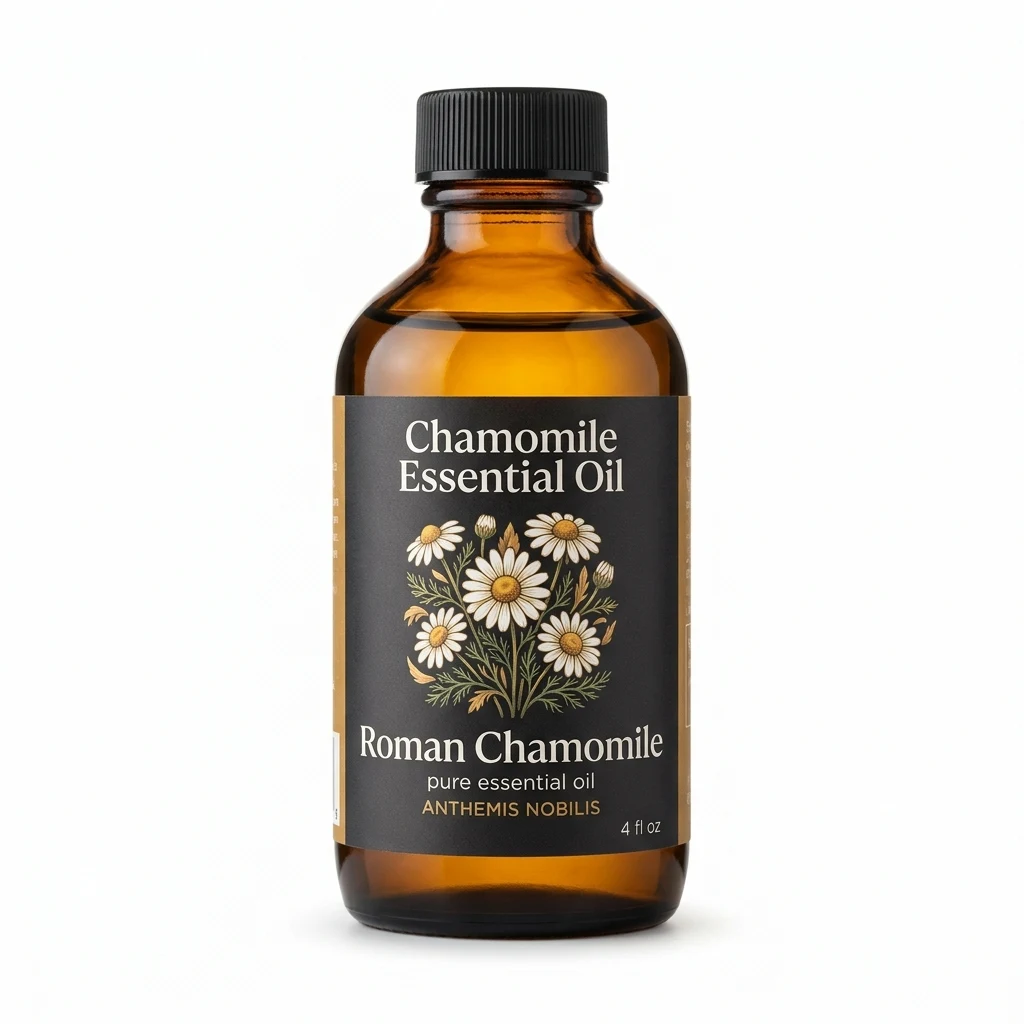
Roman Chamomile Essential Oil
Our own Roman Chamomile Essential Oil, in sizes from 0.5 oz to bulk.
From $32.99
Shop Now →Choose the area, then the percentage
The Tisserand Institute dilution guide gives 0.5% to 1.2% for facial cosmetics and sensitive areas such as underarms, and 1% to 3% for body oils and lotions. These are general ranges for essential oils, not a chamomile-specific limit. Our own guidance for both oils is 0.5% to 2% in a carrier with a patch test first. Putting the two side by side, we would treat 2% as a body-only figure, keep the face and other thin skin at or under 1.2%, and begin a first body massage at 1%. We would not go to the 3% end of Tisserand's body range, which is above anything we recommend.
The drop math
Percent means milliliters of essential oil per 100 ml of finished oil. A 30 ml bottle is close to one ounce. Drops vary with the bottle, so we use 20 per ml, which matches the 3 to 12 drops per ounce on our German oil page.
| Strength | Oil in 30 ml | Drops (about 20 per ml) |
|---|---|---|
| 0.5% | 0.15 ml | 3 |
| 1% | 0.3 ml | 6 |
| 1.2% (face ceiling) | 0.36 ml | 7 |
| 2% (our ceiling) | 0.6 ml | 12 |
Scale carefully. Six drops suits a 30 ml bottle at 1%, but the same six drops in 100 ml make about 0.3%. Write the bottle size and the percentage on the label.
For comparison, Tisserand's Roman chamomile page suggests up to 5 drops per 10 ml for body use and 2 drops per 10 ml for the face. At 20 drops per ml that works out to about 2.5% and 1%, so the facial figure fits our advice, while the body figure sits a little above our 2%. We suggest taking the lower number.
What a massage trial tested
Aromatherapy massage studies are often quoted as if they tested chamomile alone. In a 2022 randomized trial by Mehrabian and colleagues, nursing-home residents in Iran received a 3% blend of lavender, chamomile and rosemary oils in jojoba, in 20-minute sessions three times a week. Anxiety scores fell in the massage group while the routine-care group's rose. With no comparison group receiving massage with plain carrier, no blinding and a small sample, the trial cannot separate the oils from the massage itself, and it tells you nothing about one oil at 1%. We cite it to show how these studies are built, not as a promise about our oils.
Carriers
We do not sell carrier oils, so buy a fresh, dated one from a supplier. For choices see our carrier oil comparison, and mix only what you will use within a few weeks. If you have a tree-nut allergy, check any nut-based carrier with an allergist.
Who should skip it
- Anyone allergic to ragweed, daisies or other daisy-family plants. Paulsen's review lists German and Roman chamomile among suspected sensitizers. Read our patch test guide first.
- Anyone with broken, inflamed or freshly shaved skin.
- Anyone pregnant or with a medical condition. Ask your OB-GYN, midwife or physician.
- Children. Ask a pediatrician.
- Anyone massaging for muscle pain or cramps. See a physician, and read our posts on pain and cramps for what has been studied.
Technique and pressure belong to a licensed massage therapist, so we have said nothing about strokes. Our dilution guide and safety overview cover the rest.
Decide the area, write the percentage on the bottle and patch test before you commit to a full massage.
Roman Chamomile Essential Oil
Roman Chamomile Essential Oil from our own shop, in sizes from 0.5 oz to bulk.
From $32.99
Shop Now →Sources & Further Reading
- Tisserand Institute. Dilution. tisserandinstitute.org/safety/dilution
- Tisserand. Roman chamomile essential oil. tisserand.com
- Mehrabian S et al., 2022. Aromatherapy massage for depression and anxiety in elderly adults. PMC8887855
- Paulsen E, 2002. Contact sensitization from Compositae-containing herbal remedies and cosmetics. pubmed/12492516