Making Chamomile Infused Oil at Home: A Safe Method
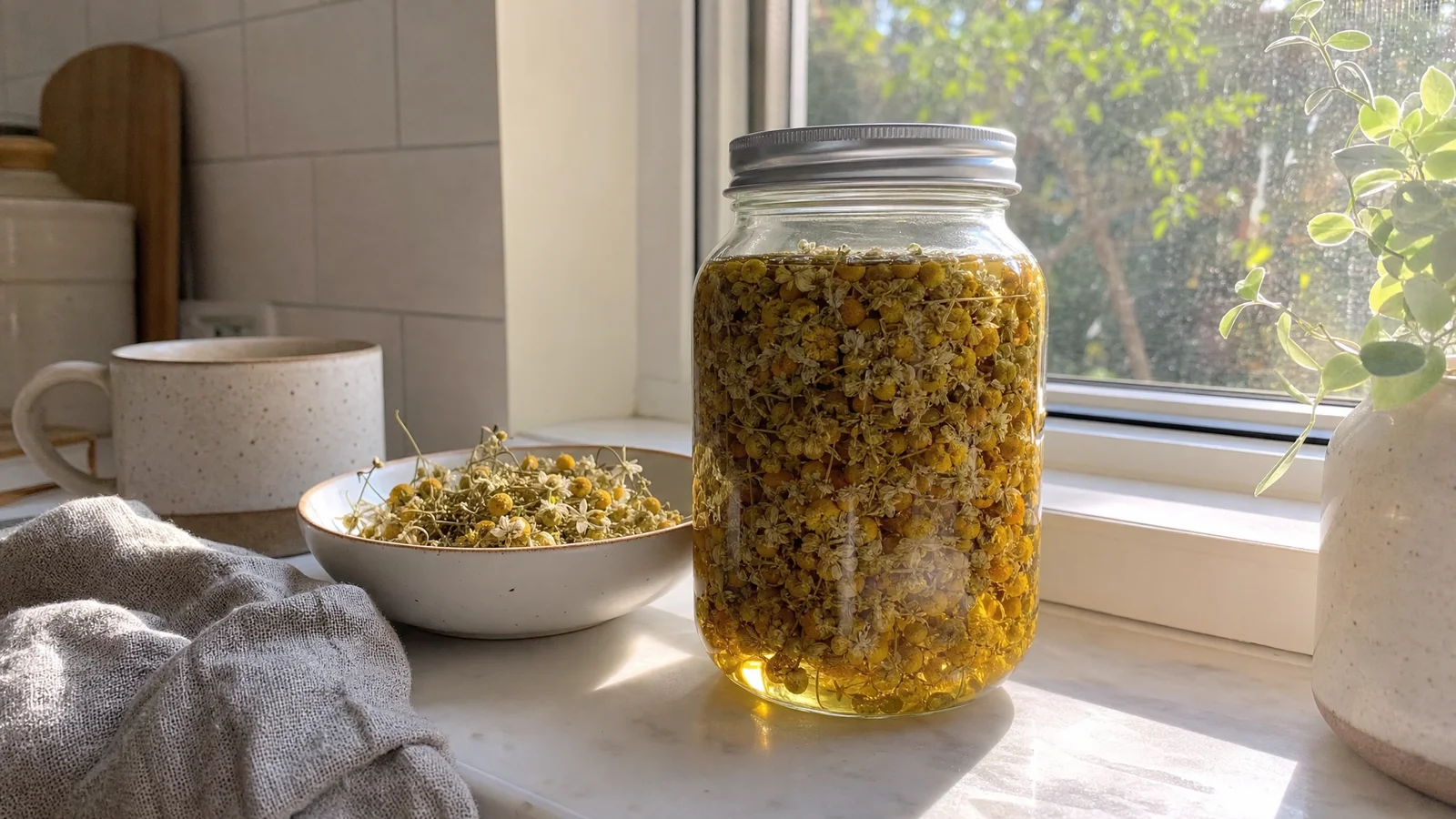
A jar of chamomile flowers steeping in oil on a sunny shelf is a lovely image, and it is also the version most likely to go wrong. The single thing that decides whether a home infusion is a good idea is how dry the flowers are. Get that right and the rest is easy.
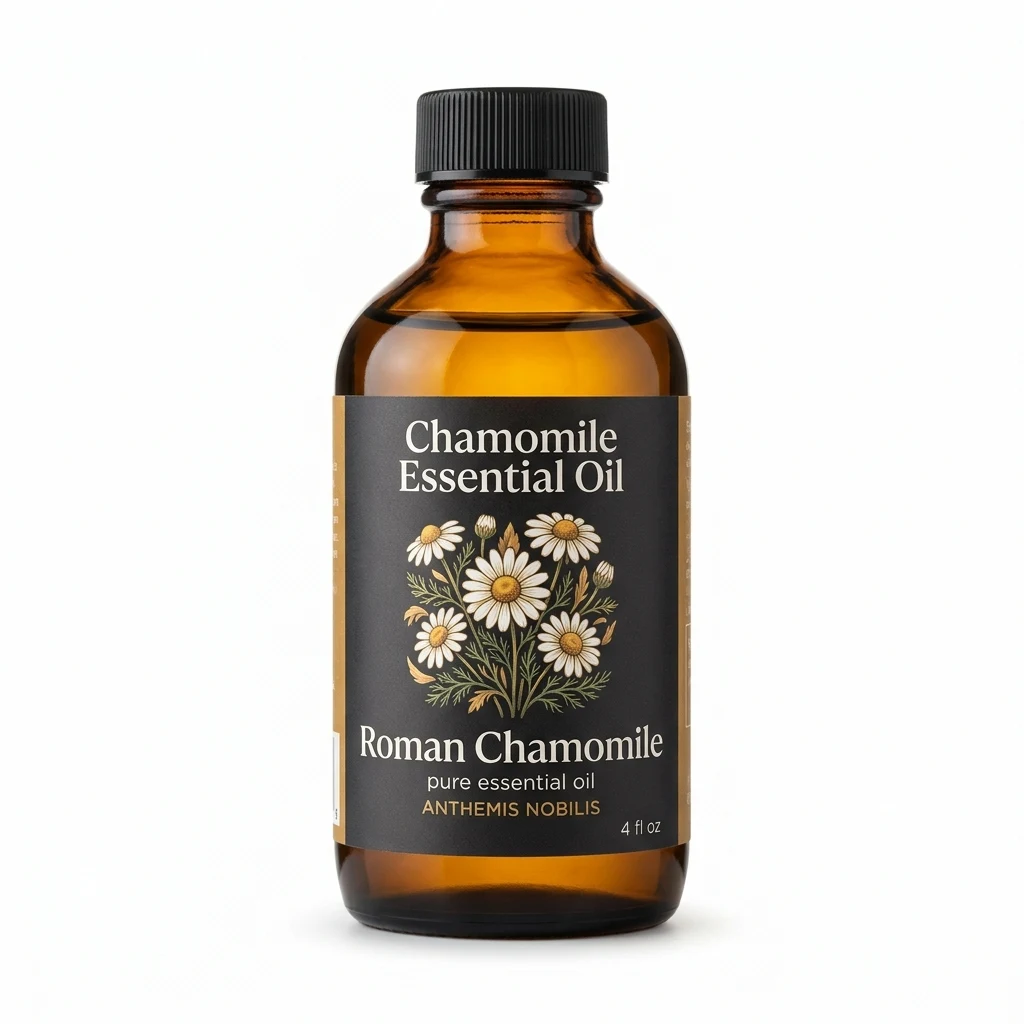
Roman Chamomile Essential Oil
Our own Roman Chamomile Essential Oil, in sizes from 0.5 oz to bulk.
From $32.99
Shop Now →Infused oil and essential oil are different things
Infused (macerated) oil is carrier oil that has sat with plant material and picked up whatever dissolves into oil. Essential oil is the volatile fraction of the flower, collected by steam distillation of the flower heads, with the distillation water returned to the still in a step called cohobation (Sharifi-Rad et al., Microbiological Research, 2018). No kitchen jar reproduces that, and no amount of essential oil in a carrier reproduces an infusion. We sell two steam-distilled chamomile essential oils, Roman and German, and no infused chamomile oil, so this is a project for you to make rather than something to buy from us. Our comparison of essential oil, infused oil and CO2 extract goes further.
Why dried flowers only
Extension food-safety guidance is written for cooking, not skin care, but the logic carries over. The University of Maine bulletin calls dried herbs the safest way to make infused oils, because they lack the moisture that lets bacteria grow in the oil (University of Maine Cooperative Extension, Bulletin 4385). Penn State Extension explains the other side: oil flavored with fresh herbs or garlic can be a source of botulism, because spores that live on plant material can grow in the oxygen-free setting oil creates at room temperature (Penn State Extension). Its route for fresh herbs is a soak in a 3% citric acid solution for at least 24 hours, which is a food-preparation method, and it warns that weaker solutions or shorter soaks can leave an unsafe product.
A skin oil is not food, but jars get reused, bottles get mouthed and fresh flowers carry water, so we take the cautious reading of those sources: dried flowers, dry tools, no fresh blossoms and no water. Even dried flowers are not sterile. The National Library of Medicine's LactMed entry notes that C. botulinum spores have been found in some loose-leaf chamomile teas (LactMed). Drying removes the moisture that lets spores grow, and the spores themselves stay.
Step by step
1. The flowers
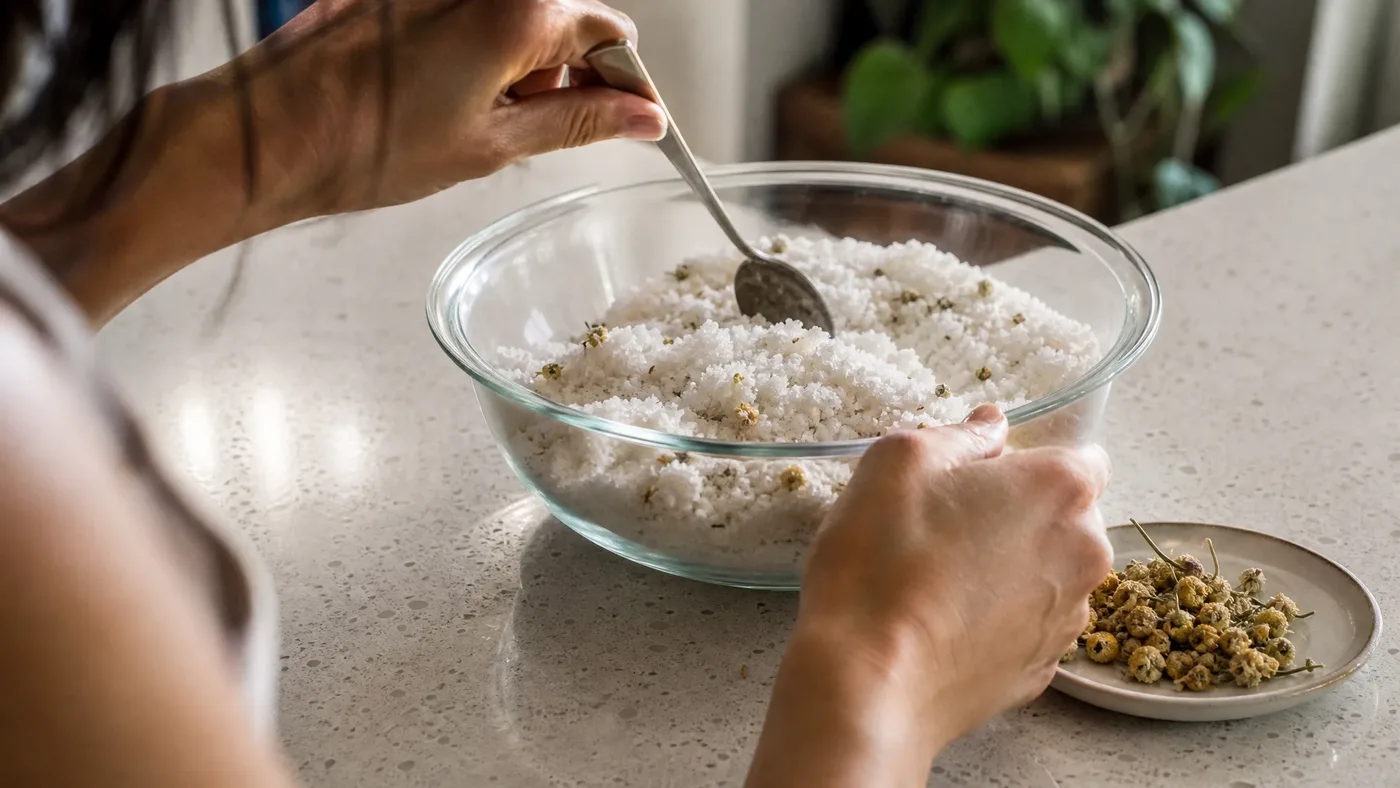
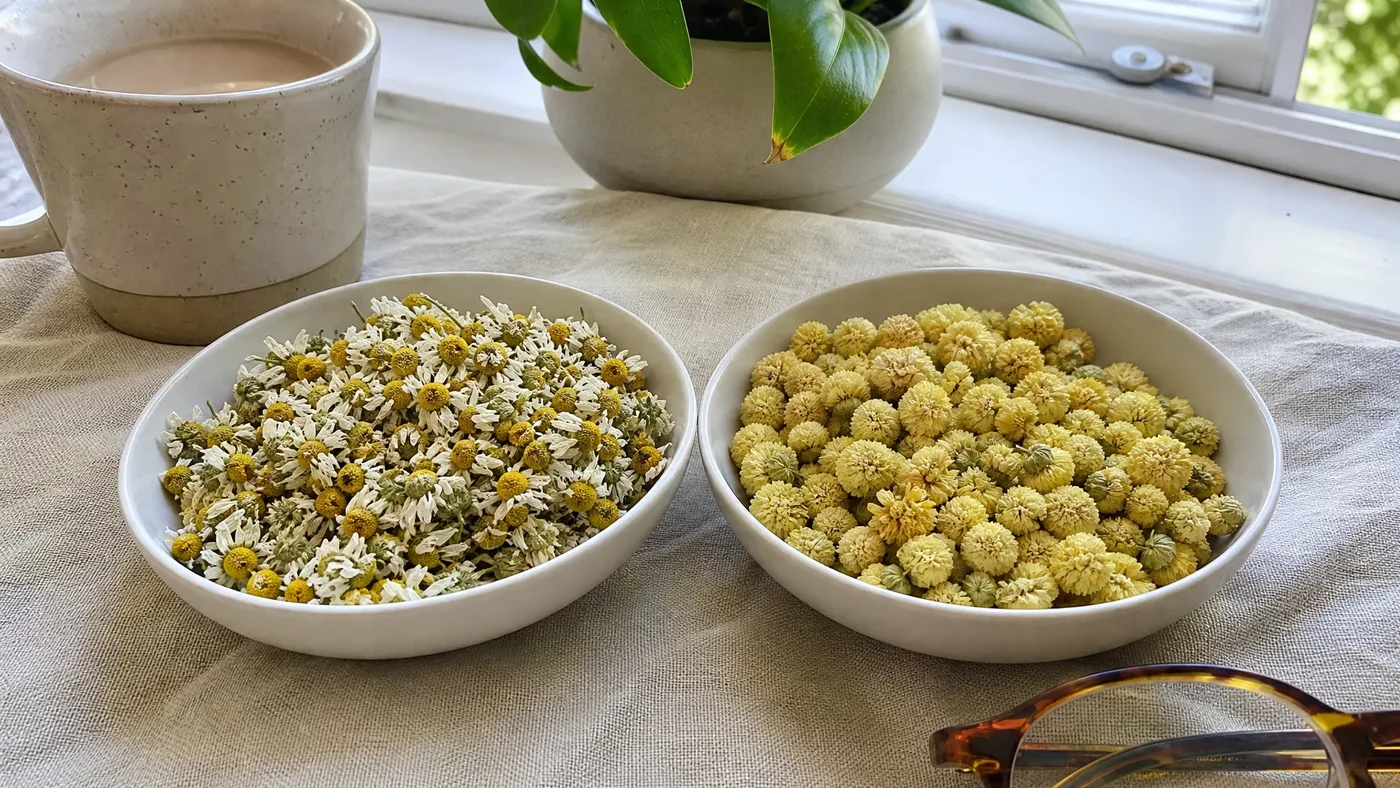
Use dried flowers sold for herbal use, or flowers you dried until they snap rather than bend. If you grew them, our post on growing chamomile covers the two plants. German chamomile (Matricaria chamomilla) is an annual and Roman chamomile (Chamaemelum nobile) a low perennial (NC State Plant Toolbox), so write the species you used on the label.
2. The oil and the ratio
Choose a carrier you would be happy to use on skin anyway, bought from a supply shop or grocery since we do not sell carriers; our carrier oil guide helps with the choice. The extension pages give no flower-to-oil ratio, so this one is our arithmetic: 20 g of dried flowers to 200 g of oil, which is 10% by weight, fills a pint jar loosely and keeps the flowers covered. Weigh both, because a cup of fluffy flowers varies a lot.
3. Warm or slow
- Warm method. The Maine bulletin's food method heats the oil to 180 F, pours it over the dried material in a sanitized container, caps it and lets it cool. For a skin oil, stopping there works, or you can hold the jar in a warm water bath for a few hours on low heat.
- Slow method. Leave the closed jar in a cool spot out of direct sun and shake it now and then. No source gives a time, so judge by eye and nose rather than the calendar.
Keep the flowers submerged, since plant material poking above the surface is where mold starts.
4. Strain, label, and set a limit
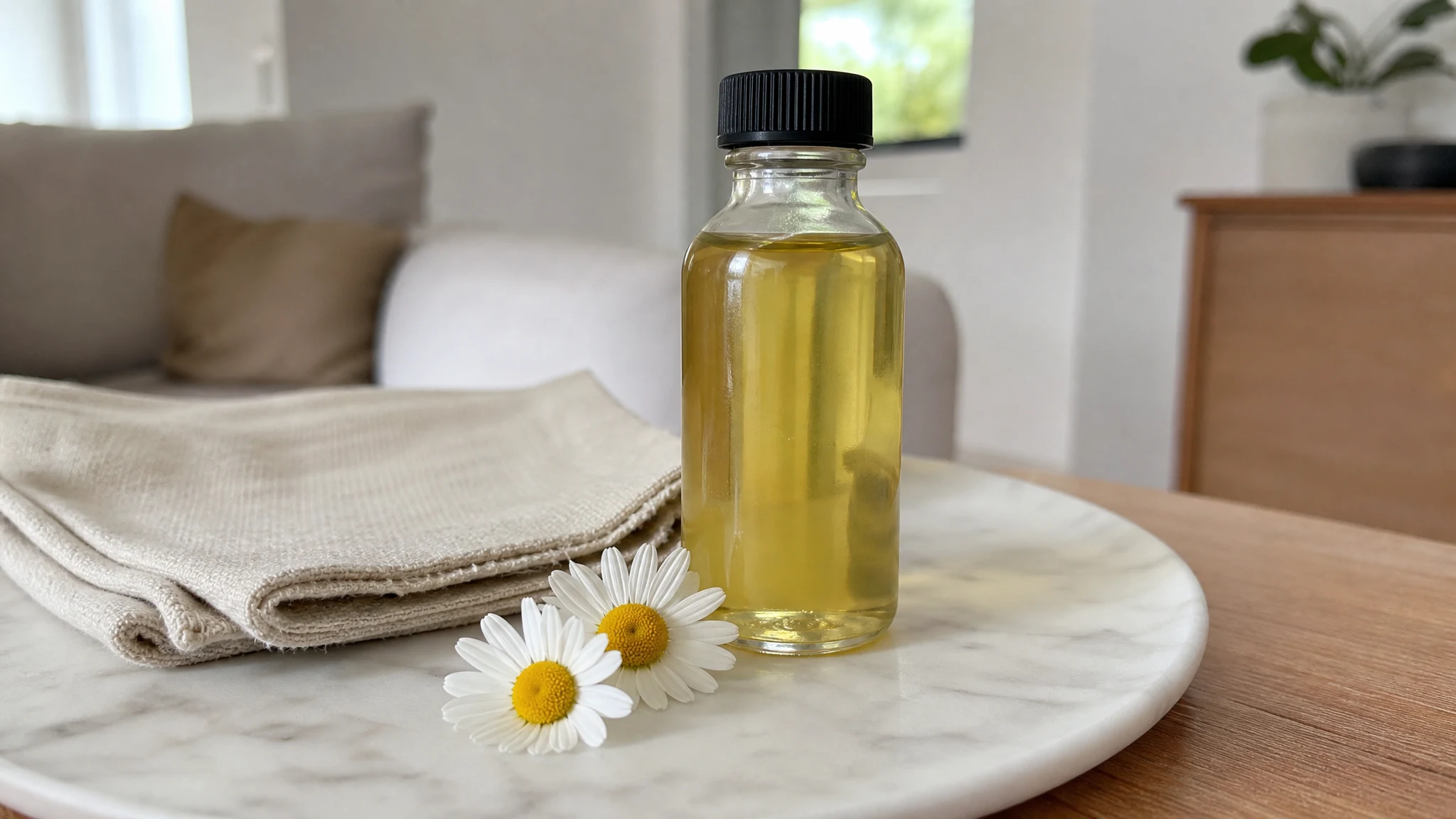
Strain through muslin or a paper filter and squeeze gently. Let it settle, and if any water collects at the bottom, discard the batch: it means the flowers were not dry enough. Bottle it in clean dark glass and date it. The Maine bulletin says not to keep homemade infused oils more than three months, so use the same limit.
What to expect
An infused oil is a lightly scented carrier oil, with the faint herbal smell of the flowers rather than the aroma of distilled oil. We make no skin or hair claims for it. The caution is the same one that applies to the essential oil: chamomile is a daisy-family plant, and people allergic to ragweed, chrysanthemums, marigolds or daisies are more likely to react to it (NCCIH). LactMed also records contact dermatitis in two women from a 10.5% Roman chamomile ointment. Those reports concern other preparations, so the inference to a home infusion is ours, but it points one way: patch test first (our patch test guide) and skip it with a daisy-family allergy. Our safety article collects the cautions.
When you open the jar to strain it, take a moment with it. You should find a light, golden oil with a faint, hay-like, herbal smell, much quieter than the distilled oils. That quietness is part of its charm, and it is a good reason to enjoy it as a simple, lightly scented carrier rather than expect it to behave like essential oil.
Common slips
- Fresh flowers. The one mistake with a food-safety consequence.
- Eating it. The extension guidance is for food-grade ingredients and containers. This page is about a skin oil, so read those bulletins in full before eating any of it.
- Too long on the shelf. Plant fragments speed rancidity, so make small batches.
- Calling it essential oil. If you give or sell it, label it as chamomile-infused plus the carrier. The FDA puts the duty to ensure cosmetics are safe on the people who make and market them (FDA).
When infusion is the wrong tool
If you want a stable, scent-forward ingredient for a blend or perfume, distilled oil is the better fit, because an infusion adds color and a faint herbal note. To add chamomile aroma to a balm or oil blend, we recommend 0.5% to 2% in a carrier with a patch test first, and our dilution guide and DIY chamomile balm do that arithmetic.
Whichever route you take, start with one small jar, label it with the date and species, and judge it before you scale up.
Roman Chamomile Essential Oil
Roman Chamomile Essential Oil from our own shop, in sizes from 0.5 oz to bulk.
From $32.99
Shop Now →Sources & Further Reading
- Sharifi-Rad M et al., 2018. Matricaria genus as a source of antimicrobial agents. Microbiol Res. PubMed 30172312
- University of Maine Cooperative Extension. Bulletin 4385. extension.umaine.edu/publications/4385e
- Penn State Extension. How to safely make infused oils. extension.psu.edu
- LactMed. Chamomile. ncbi.nlm.nih.gov/books/NBK501808
- NC State Extension Plant Toolbox. Matricaria chamomilla. plants.ces.ncsu.edu
- NCCIH. Chamomile. nccih.nih.gov/health/chamomile
- FDA. FDA authority over cosmetics. fda.gov