
Chamomile Essential Oil: Two Plants Under One Name
Ask ten people what chamomile oil is and you will get tea, an infused oil, a hydrosol, a fragrance and an essential oil, all under the same two words. Even inside the essential oil category the name covers two different plants. We sell both, and the first thing we tell anyone is to find out which one a piece of advice is actually about.
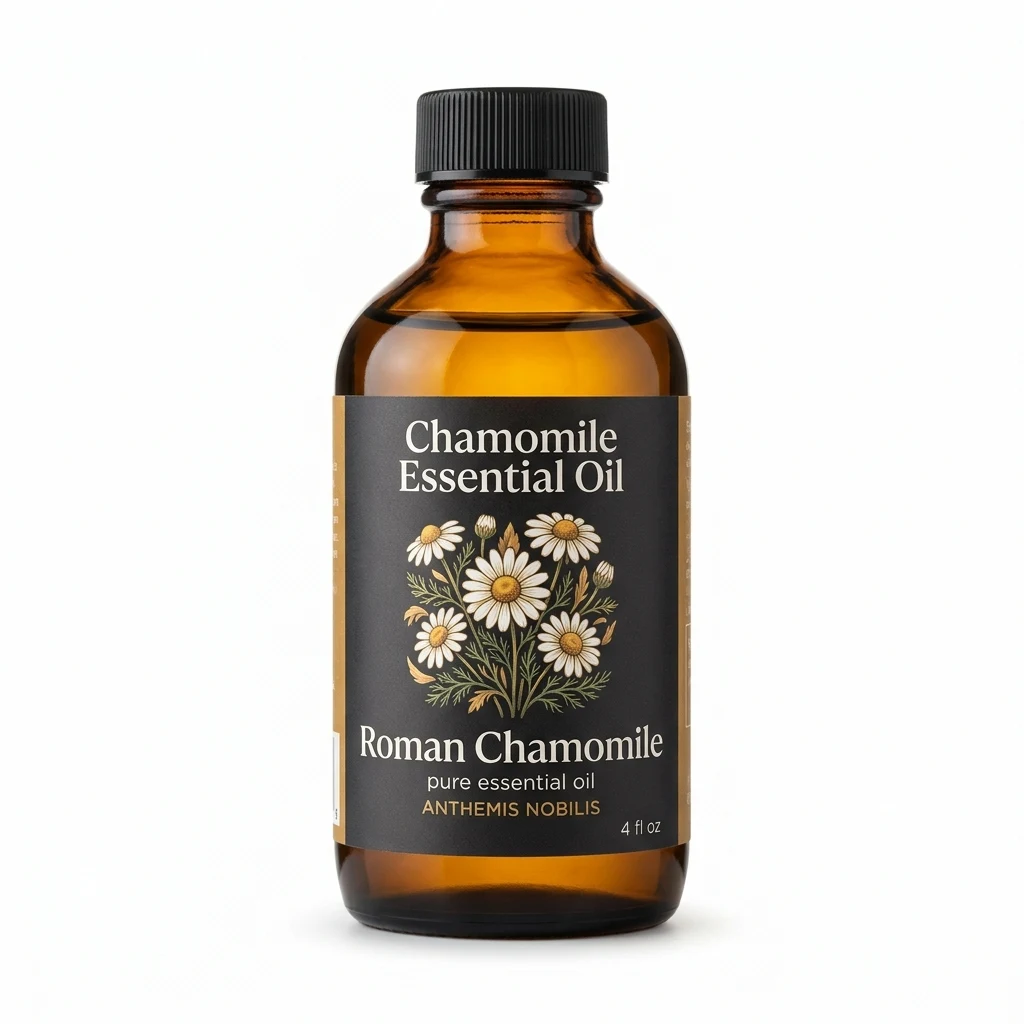
Roman Chamomile Essential Oil
Our own Roman Chamomile Essential Oil, in sizes from 0.5 oz to bulk.
From $32.99
Shop Now →Two plants, one name
Roman chamomile is a low, spreading perennial. German chamomile is a taller annual. Both are in the daisy family and both are steam-distilled from the flowers, but a recent review of the two concludes that they differ in chemistry, taste and potential effects and should not be used interchangeably (Such et al., Nutrients, 2026). That review looks at food and supplement use, so take it as a statement about the plants rather than about any bottle, ours included.
In practice this means a recipe written for one chamomile can behave differently with the other, and most of what circulates online never says which one it means. When we write about chamomile oil, we name the oil.
How they smell and look
Our Roman Chamomile Essential Oil is listed under the botanical name Anthemis nobilis. It smells sweet, apple-like and herbaceous, softer and fruitier than the German oil, and in perfumery terms it is a middle note. You will also see the same plant labeled Chamaemelum nobile, which is the name current botany prefers; the British Standards record for Roman chamomile oil lists both together (BSI). Two names for one plant is ordinary in this trade.
Our German Chamomile Essential Oil is the blue one. Its aroma is sweet and herbaceous with a hay-like softness, and the inky blue tint comes from a naturally occurring compound called chamazulene. The Certificate of Analysis we publish for one batch lists the botanical name Matricaria chamomilla, a relative density of 0.913 and a refractive index of 1.498, both at 20 C. If you need GC-MS results or a chamazulene figure for a particular lot, ask us in writing through the contact page before you order, and our guide to reading a chamomile GC-MS report will help when it arrives.
What is going on in the bottle
The short chemistry lesson is useful because it explains the color. German chamomile oil is built largely around alpha-bisabolol, its oxides and chamazulene. Roman chamomile oil is mostly esters of angelic and tiglic acid, with less chamazulene (Srivastava et al., 2010). Chamazulene is blue, so the oil that has more of it looks blue. Reasoning from that, the color tells you which species you are likely holding and is not a quality score, a point we take further in our chemistry comparison.
Roman oil has its own complexity. A 2026 gas chromatography study of two commercial Roman oils identified 190 constituents, including whole families of angelate, tiglate and senecioate esters (Radulovic and Mladenovic, Molecules, 2026). It is a reminder that a sweet, fruity oil is not a simple one.
What people do with them
Both oils are aroma ingredients first. Common uses are a few drops in a diffuser, diluted face and body oils and balms, bath preparations, natural perfumery, candles, soap and linen sprays. For blending, we point to lavender, bergamot, clary sage, geranium, sweet orange and frankincense, and our piece on oils that blend with chamomile explains why those pairings work. Chamomile oil is for aroma and external cosmetic use; for health questions, a pharmacist or physician is the right person, especially if you take prescription medication, and we cover what has been studied in our benefits article.
A few things are not chamomile essential oil and we do not sell them: tea, infused oil, hydrosol, CO2 extract. Our comparison of essential oil, infused oil and CO2 extract shows how they differ.
A short word on care
Our oils are sold undiluted, so dilute to 0.5% to 2% in a carrier oil, patch test first, keep the oil away from eyes, children and pets, and never take it internally. People with ragweed or other daisy-family allergies should check with an allergist first. The details are in our safety guide.
If you are still choosing, start with the scent you want to live with. The blue one is a good conversation piece, and the Roman is the sweeter, fruitier of the pair.
Roman Chamomile Essential Oil
Roman Chamomile Essential Oil from our own shop, in sizes from 0.5 oz to bulk.
From $32.99
Shop Now →Sources & Further Reading
- Such S, Zagula G, Puchalski C, Czernicka M, 2026. German and Roman Chamomile: Species-Specific Phytochemical Profiles, Bioactive Potential, and Relevance for Functional Foods and Nutraceutical Development. Nutrients 18(13):2181. doi.org/10.3390/nu18132181
- Srivastava JK, Shankar E, Gupta S, 2010. Chamomile: A herbal medicine of the past with bright future. Mol Med Rep 3(6):895-901. PMC2995283
- Radulovic NS, Mladenovic MZ, 2026. Roman chamomile essential oil: structural elucidation of new esters. Molecules 31(2):256. doi.org/10.3390/molecules31020256
- BSI. Essential oil of roman chamomile [Chamaemelum nobile (L.) All. syn. Anthemis nobilis L.]. doi.org/10.3403/30485768