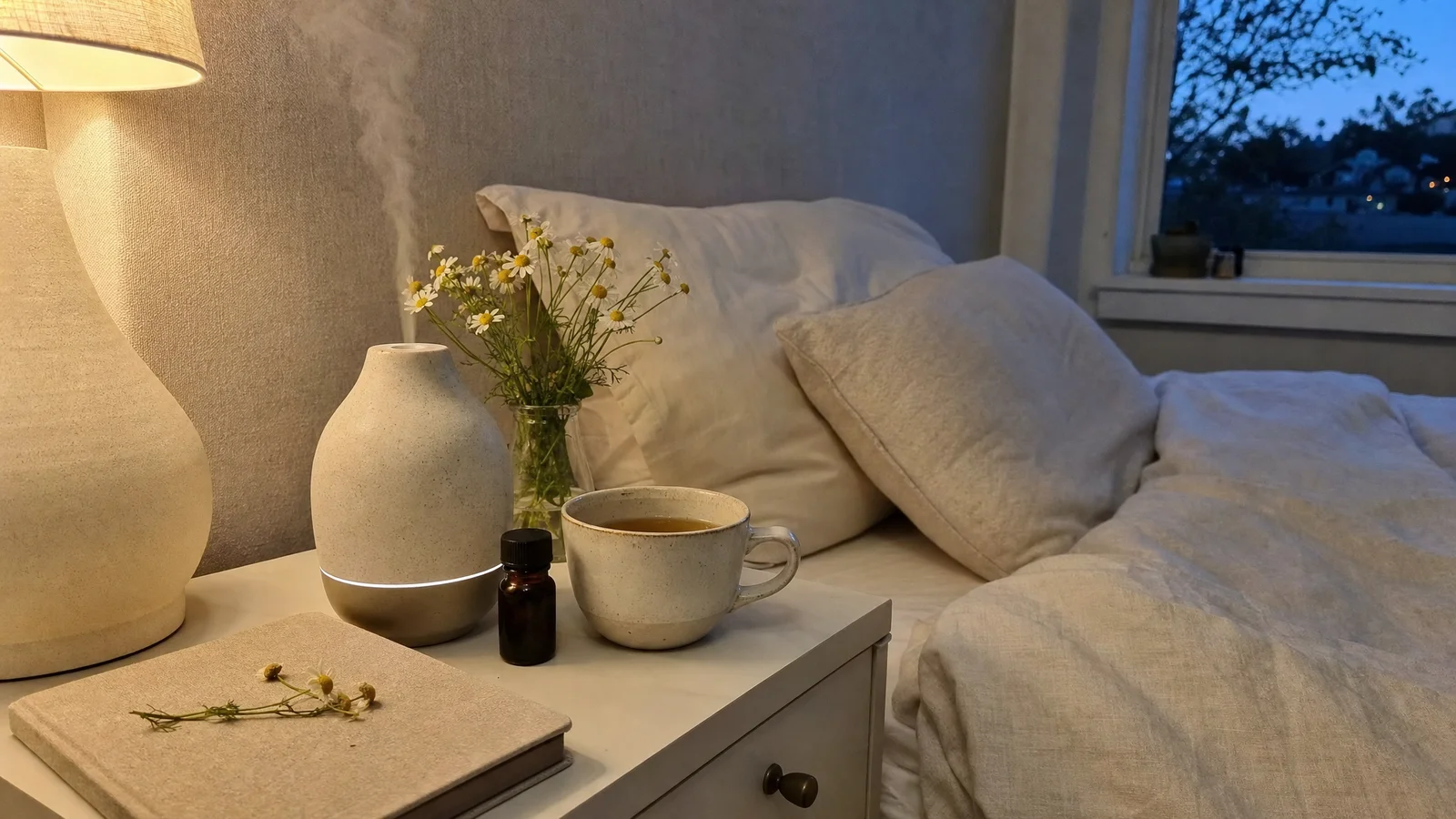
Building a Chamomile Evening Routine Around the Scent
Picture the end of a day: lights low, a warm bath running, something soft smelling of apples and hay. That is the appeal of chamomile oil in an evening routine, and it is a scent appeal. We do not present either of our oils as a sleep aid, and the steps below are about enjoying the aroma and using it sensibly.
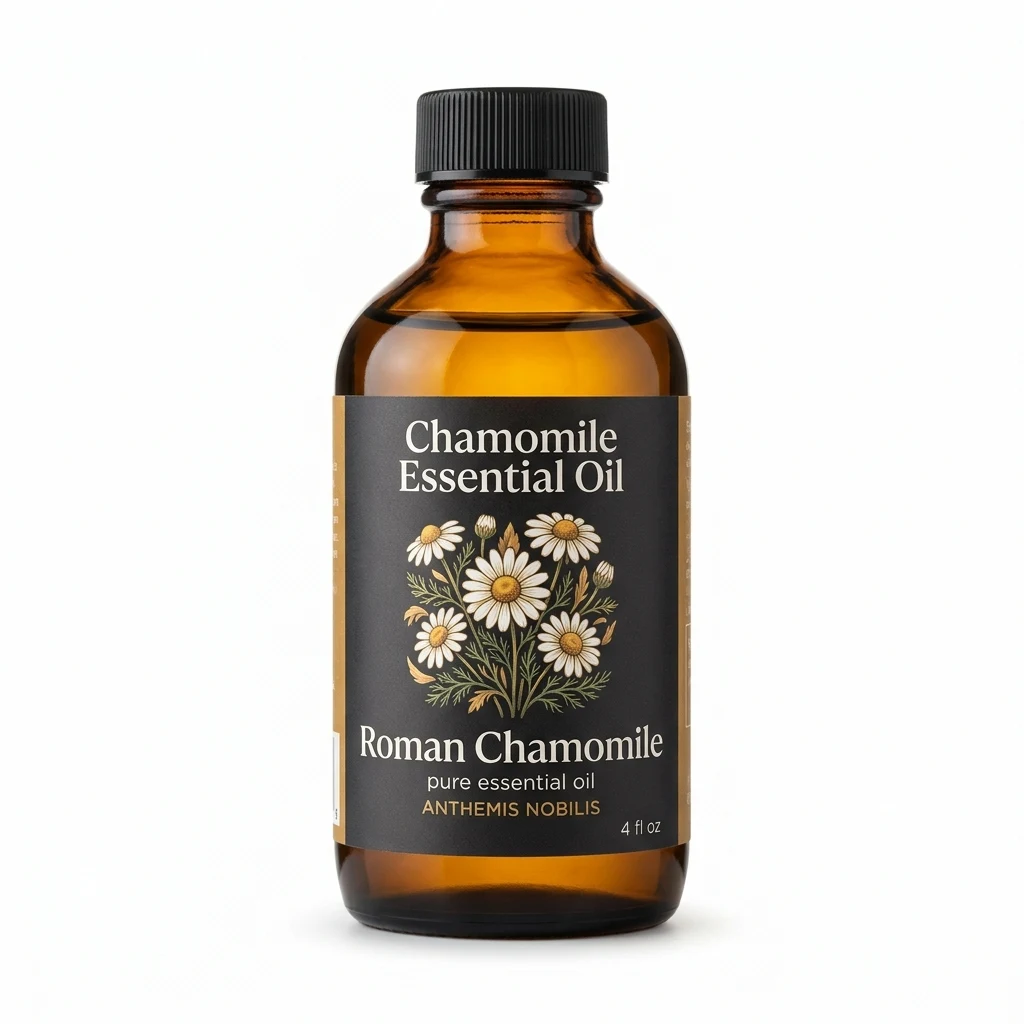
Roman Chamomile Essential Oil
Our own Roman Chamomile Essential Oil, in sizes from 0.5 oz to bulk.
From $32.99
Shop Now →What the research looked at
A 2021 meta-analysis of 34 studies by Cheong and colleagues reported that aroma inhalation was associated with improved sleep problems overall, with single aromas outperforming mixtures and lavender showing the largest effect. Chamomile was not singled out in the abstract. The nearest chamomile study is a 2022 trial by Ebrahimi and colleagues: 183 older adults inhaled three drops of 1.5% chamomile oil, 1.5% lavender oil or water each night for 30 nights. Both oil groups scored lower on a depression, anxiety and stress scale than the water group, at the end and a month later. That scale measured mood, not sleep. If sleep is a regular struggle, that is a conversation for your physician, and no scent should delay it.
The diffuser
Tisserand's Roman chamomile page suggests 6 to 8 drops for a diffuser. Run it for a limited time in a room you are in, and keep pets and young children out of the room. One household study of tea tree oil, Zisook et al., 2025, found a heat diffuser released roughly ten times more terpenes than an ultrasonic one, which is a good reason to follow your device's manual and ventilate. See our diffuser post and the note on humidifiers.
A body oil
If you like a scented body oil, the arithmetic is straightforward. At about 20 drops per ml, 10 ml of carrier at 1% takes 2 drops. Our dilution guidance for both chamomile oils is 0.5% to 2% with a patch test first. The Tisserand Institute gives 0.5% to 1.2% for the face and 1% to 3% for body oils, and we would keep the face at or below 1%. If you are starting out, use the scent alone for a week and add skin use later, if at all. Chamomile is a daisy-family plant, so anyone who reacts to ragweed, daisies or chamomile tea should skip it and see an allergist. Our patch test guide explains the method.
Bedding
A pillow spray puts oil near your face for hours, and an undissolved oil can stain fabric. We would scent the room rather than the pillow. Our linen spray formulation explains the dissolving problem.
What to leave out
- Swallowing it or adding it to tea. Never. See why.
- Neat oil on skin or fabric. We say never apply the undiluted oil to skin.
- Diffusing around pets, babies or small children. The ASPCA lists the Roman chamomile plant as toxic to dogs, cats and horses. That is the plant, but ask your veterinarian. For babies, ask a pediatrician, and see our age-band post.
- Using it in pregnancy without asking. See what sources say and check with your OB-GYN or midwife.
Roman or German for the evening
We sell both. Roman is sweet and apple-like, softer and fruitier than German, which is a blue oil with a hay-like softness. Our Roman vs German guide walks through the choice.
The best evening routine has the fewest steps you will actually do, with chamomile added last and kept light.
Roman Chamomile Essential Oil
Roman Chamomile Essential Oil from our own shop, in sizes from 0.5 oz to bulk.
From $32.99
Shop Now →Sources & Further Reading
- Cheong MJ et al., 2021. Aroma inhalation therapy on sleep problems, meta-analysis. Medicine. pubmed/33655928
- Ebrahimi H et al., 2022. Lavender and chamomile essential oil inhalation aromatherapy. Explore. pubmed/33454232
- Zisook RE et al., 2025. Tea tree oil airborne dispersion in a simulated household. pubmed/41004428
- Tisserand Institute. Dilution. tisserandinstitute.org/safety/dilution
- Tisserand. Roman chamomile essential oil. tisserand.com
- ASPCA. Roman chamomile. aspca.org