Chamomile Oil in Hair Care: Scent, Dilution, Staining
If you are thinking of adding chamomile oil to your hair routine, the useful question is what job you want it to do. In a hair oil or leave-in, it is a fragrance: the sweet, apple-like note of Roman chamomile or the hay-like softness of the German oil. The rest of the work belongs to the carrier and to how you apply it.
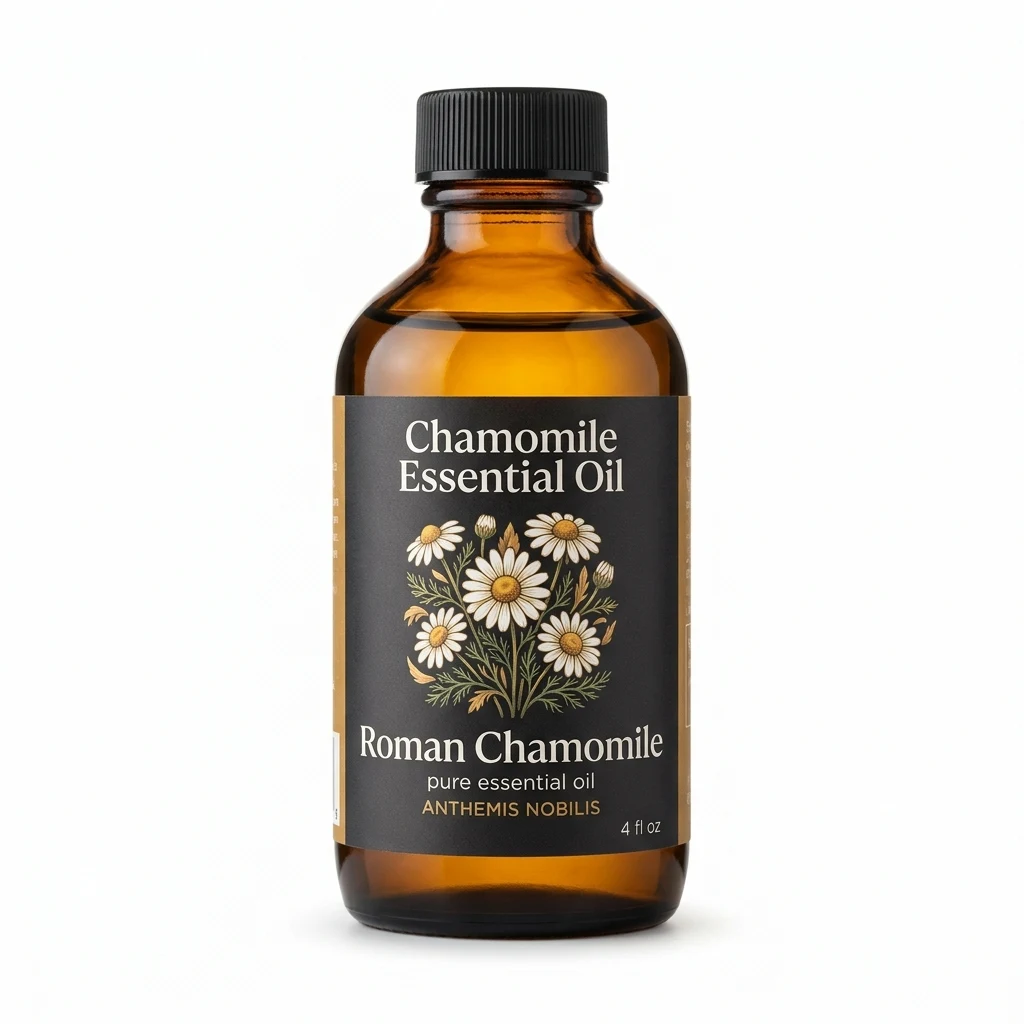
Roman Chamomile Essential Oil
Our own Roman Chamomile Essential Oil, in sizes from 0.5 oz to bulk.
From $32.99
Shop Now →What the carrier brings
We make no hair claims for either of our oils, and we have not seen a study of chamomile essential oil on hair. What the literature does offer is about the base oil. In a 2003 study from a hair-care company, Rele and Mohile reported that coconut oil reduced protein loss from hair when used before and after washing, while sunflower and mineral oil did not. It is a company study and a small piece of evidence, but it makes a practical point: in an oil-based routine, the carrier is the main ingredient and the essential oil is the scent. We do not sell carrier oils, so choose one from a supplier you like.
A pre-wash oil
This is the easiest way to use a small bottle. The math is simple: one ounce of carrier is about 29.6 ml, so 0.5% is roughly 0.15 ml, or about 3 drops at 20 drops per ml, and 1% is about 6 drops. Our dilution guidance is 0.5% to 2% in a carrier with a patch test first. For anything that sits on the scalp, we would stay at 0.5% to 1%, because a scalp oil often stays on for a while, and chamomile is a daisy-family plant. Paulsen's 2002 review lists German and Roman chamomile among the suspected Compositae sensitizers, though sensitization to German chamomile is described as rare.
Keep the oil clear of the eyes, patch test on the inner forearm first (our patch test guide has the method), and wash it out thoroughly.
A leave-in for lengths and ends
A leave-in is a finishing touch, so use very little: a few drops of carrier worked through mid-lengths and ends, with chamomile oil at about 0.5%. The German oil is blue from chamazulene, and its pigment can mark light fabric and potentially pale or bleached hair. Test on a hidden strand and a white towel first. The Roman oil is the less colored of our two, and our Roman aroma guide describes its character in more detail.
Why we leave oil out of rinse water
A rinse is water, and essential oil floats on water, so drops added to a rinse jug would arrive on your scalp as a bead of concentrated oil. We explain the same thing for baths in our bath post. Making a rinse with a dispersant is a formulation job better left to a supplier or cosmetic chemist, and a water-based mixture that you store also needs preservation. Our recommendation is to keep our oil in oil-based products.
Who should sit this out
- Anyone who has reacted to chamomile tea, arnica, ragweed or other daisy-family plants.
- Anyone with a red, flaking, weeping or painful scalp, or sudden changes in their hair. See a dermatologist before adding anything new.
- Children, and anyone pregnant or breastfeeding, unless a clinician agrees.
Stop at the first itching, redness or tingling and wash with a mild shampoo. For more on carriers see our carrier oil comparison, and for ratios our dilution guide.
A few drops of chamomile in a hair oil you already like is a small, scented pleasure, and that is all we would ask of it.
Roman Chamomile Essential Oil
Roman Chamomile Essential Oil from our own shop, in sizes from 0.5 oz to bulk.
From $32.99
Shop Now →Sources & Further Reading
- Rele AS, Mohile RB, 2003. Effect of mineral oil, sunflower oil, and coconut oil on prevention of hair damage. J Cosmet Sci. pubmed/12715094
- Paulsen E, 2002. Contact sensitization from Compositae-containing herbal remedies and cosmetics. Contact Dermatitis. pubmed/12492516