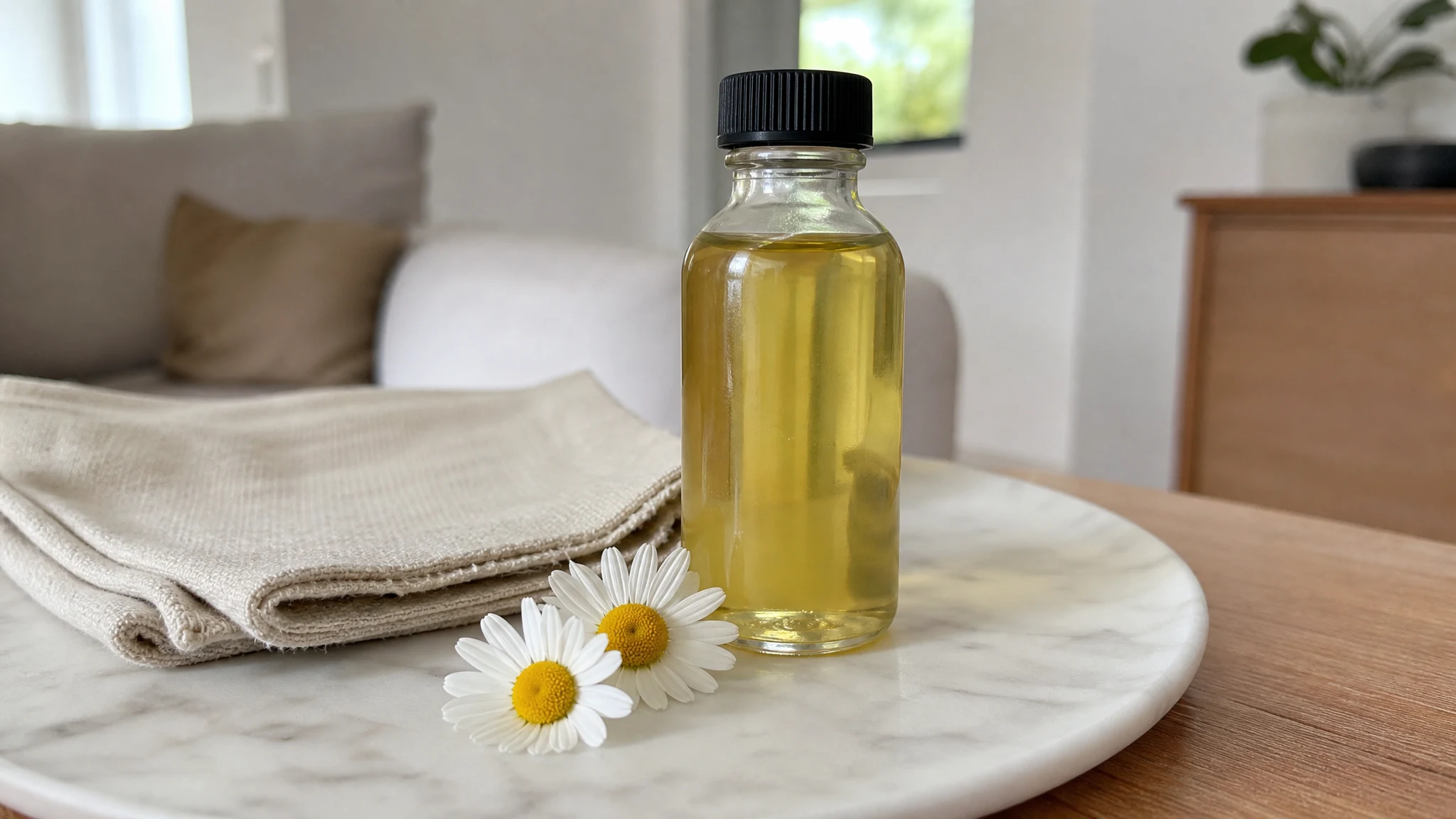
A Chamomile Face Oil Formula: 3 Drops in 30 ml
Here is the formula up front: 30 ml of carrier oil and 3 drops of chamomile essential oil, which comes to about 0.5%. It is a light, scent-led face oil, and every number in it has a reason. The rest of this page walks through them so you can adjust with confidence.
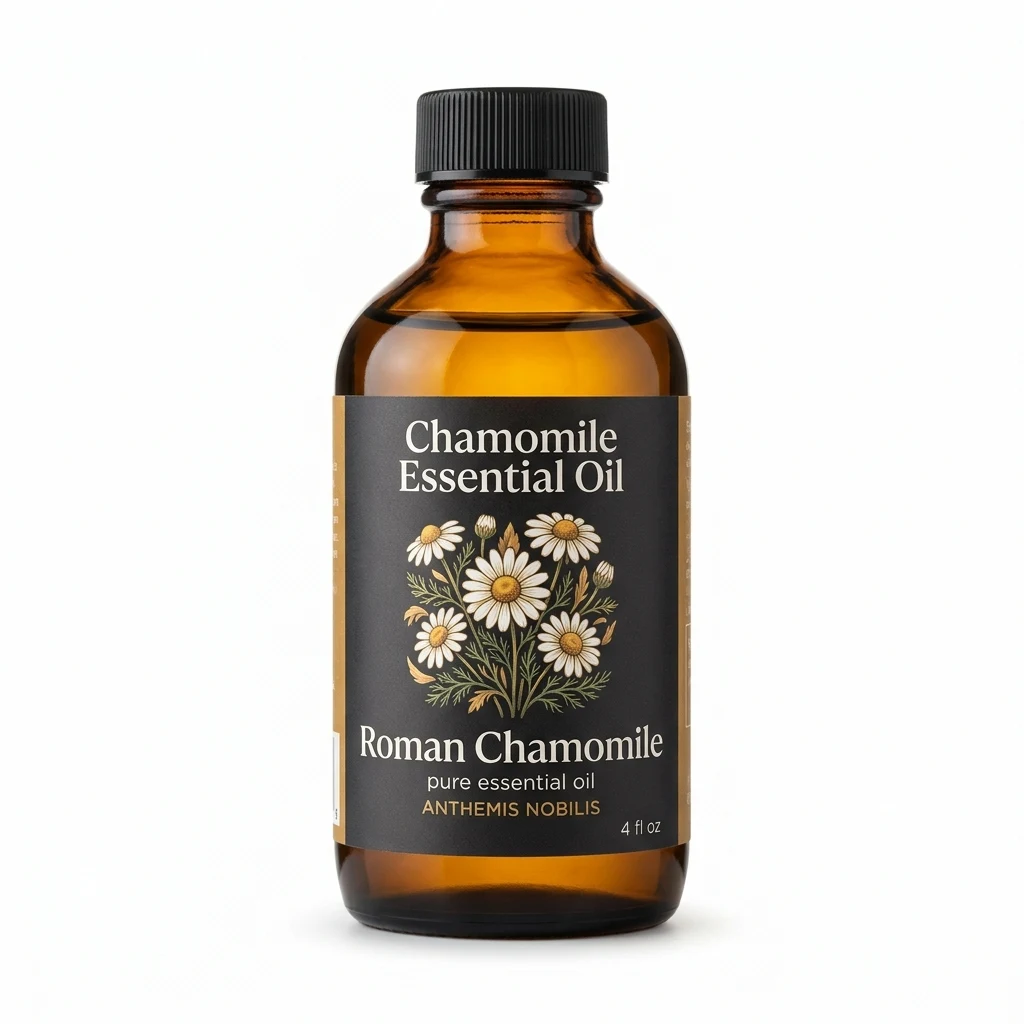
Roman Chamomile Essential Oil
Our own Roman Chamomile Essential Oil, in sizes from 0.5 oz to bulk.
From $32.99
Shop Now →The formula and the drop math
- Carrier oil: 30 ml, which is about one fluid ounce (29.57 ml), in a clean amber glass dropper bottle.
- Chamomile essential oil: 3 drops of Roman or German. At the common convention of 20 drops per ml, 3 drops is 0.15 ml, and 0.15 divided by 30 is 0.5% by volume. Anyone formulating by weight should weigh the oil instead.
- Why 0.5%: we recommend 0.5% to 2% in a carrier oil and chose the bottom for a face. The Tisserand Institute lists 0.5% to 1.2% for facial products (Tisserand Institute), and its Roman chamomile page works out to about 1% for the face, which is 2 drops in 10 ml (Tisserand). Half a percent leaves comfortable room under both.
- Water: none. An oil-only blend has no water phase; adding water, hydrosol or aloe would make a different product.
Doubling to 6 drops gives roughly 1%. On a face we would stay at 3 drops unless you want a stronger scent, because the extra drops add aroma and nothing else we can document.
The carrier is the real decision
At 0.5%, 99.5% of what you smooth on is carrier, so this is where to spend your attention. In a forearm study of 19 volunteers, olive oil reduced the integrity of the outer skin layer and caused mild redness over four to five weeks of twice-daily use, while sunflower seed oil preserved it, and the authors advised against olive oil for dry skin (Danby et al., 2013). A review of plant oils for the skin barrier favors those with more linoleic than oleic acid (Vaughn et al., 2018). Reasoning from the two, a cold-pressed, high-linoleic oil such as sunflower makes a better default for a leave-on face oil than olive oil. Carriers come from a supply shop or grocery; we sell only the chamomile. Our carrier oil guide compares more of them.
Roman or German
Pick on aroma. Our Roman oil is sweet, apple-like and herbaceous, and our German oil has a hay-like softness with a blue tint from chamazulene. At 3 drops in 30 ml the blue is faint, though German chamomile can stain pillowcases if you overdo it. We compare them in our buying guide.
Making it
- Wash and dry the dropper bottle completely, since leftover water shortens the life of the blend.
- Pour in the 30 ml of carrier.
- Add the 3 drops of chamomile, cap, and roll the bottle between your palms for about 30 seconds.
- Label it with the date, the oils and the percentage.
- Wait a day and patch test the finished blend, as in our patch test guide, before it goes near your face.
Before it goes on your face
Chamomile is a daisy-family plant. A dermatology review lists German and Roman chamomile among suspected sensitizers while describing sensitization to German chamomile as rare (Paulsen, 2002), and the face is where a reaction would be most visible and closest to the eyes. Keep the blend away from the eyes, skip it if you have reacted to chamomile tea, arnica or ragweed, if your skin is broken or inflamed, or if you are pregnant or breastfeeding unless your OB-GYN or midwife agrees, and ask a pediatrician about children. Stop at the first redness, itching or stinging, and see a dermatologist if it persists.
Storage and scaling
Our oil typically keeps two to three years capped in a cool, dark place, but a blend is only as stable as its carrier, so check the carrier's best-before date, keep the bottle in the dark and discard it if it smells rancid or looks cloudy. Thirty milliliters is a quantity most people can use up.
To scale, work by volume: 60 ml takes 6 drops, and since half a drop cannot be measured, 30 ml is the practical minimum for this formula. To switch carriers, keep the drop count and patch test again, because a different carrier is a different product on your skin. Add other essential oils only after looking up each one's own limits and the combined total.
What this is
This is a lightly scented face oil, and we do not present it as a treatment for any skin condition. If a skin concern is the real reason you are here, a dermatologist is the next step. If the aroma is the point, this is a modest, low-dose way to enjoy it. The wider picture is in our skin and hair article, and the full list of cautions is in chamomile oil safety.
Three drops, a good carrier and a day of patience is all it takes.
Roman Chamomile Essential Oil
Roman Chamomile Essential Oil from our own shop, in sizes from 0.5 oz to bulk.
From $32.99
Shop Now →Sources & Further Reading
- Tisserand Institute. Dilution of essential oils. tisserandinstitute.org/safety/dilution
- Tisserand. Chamomile, Roman essential oil. tisserand.com
- Danby SG et al., 2013. Effect of olive and sunflower seed oil on the adult skin barrier. Pediatr Dermatol. PubMed 22995032
- Vaughn AR et al., 2018. Natural oils for skin barrier repair. PubMed 28707186
- Paulsen E, 2002. Contact sensitization from Compositae-containing herbal remedies and cosmetics. Contact Dermatitis 47(4):189-198. PubMed 12492516